

You are using an out of date browser. It may not display this or other websites correctly.
You should upgrade or use an alternative browser.
You should upgrade or use an alternative browser.
Restoring a Sansui AU-X1
- Thread starter wmac
- Start date

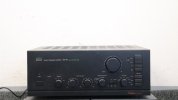
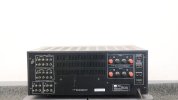
Register to hide this ad

When I received it, the seller told me that there was no sound, so I started to measure the rails, and they are ok, also the relay click, and the offset in the terminals is about 6mV in one side and 10 mV on the other, well, it is inside the factory specs, measuring the speakers' terminals for AC and has nothing there so I connected the scope and a signal generqator and had this kind of signal.
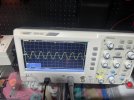
But the thing is, with the generator on or off, with the amp on or off, it is the same; when I disconnect from the power, the only thing that changes is the amplitude of the signal. I tested at the pre-amp level and amp in, but the signal is weirder than that.
Now I have to go board by board and find the issue
But the thing is, with the generator on or off, with the amp on or off, it is the same; when I disconnect from the power, the only thing that changes is the amplitude of the signal. I tested at the pre-amp level and amp in, but the signal is weirder than that.
Now I have to go board by board and find the issue
Serial Number: 220080021Nice! Could you post the serial to the database?
This amp is on my want list but quite a challenge to work on. I've had several on my workbench.

If it is 50/60Hz (can't read scope display), a faulty signal relay is a strong possibility, however, 60KHz = oscillation.50 Hz hum. Broken relay?
Last edited:
You are right, it is 50 Hz, and I tested it at the speakers; maybe the relay is bad, but it is clicking. Tomorrow, I will start to remove the boards. What is weird is that even when it is powered off and not connected to the signal generator, it produces the same wave, only with a different amplitude when I disconnect the cable from the outlet. It is reading the 50Hz from my mains because I am in a 50Hz region.The screen is hard to read (better make a screenshot to USB stick) but this looks like no connection. 50 Hz hum. Broken relay? I never test on speaker terminals but always on the amp's output on its F-2775 board.
Last edited:

I have the exact same waveform on my scope if I just leave its probe on my workbench... And yes, Los Países Bajos also is 50 Hz territory.
Considering the complexity of the AU-X1 I have to warn you for a challenging experience. Just replacing a few semiconductors and electrolytics is not going to help much. Black Flags anyone...? Do read up on this beast, plenty of people have gone before you. This amp is not for the faint of heart.
Considering the complexity of the AU-X1 I have to warn you for a challenging experience. Just replacing a few semiconductors and electrolytics is not going to help much. Black Flags anyone...? Do read up on this beast, plenty of people have gone before you. This amp is not for the faint of heart.
No, not the speaker relay - there are a number of 'signal relays' whose contacts are faulty by now - some of them connect ground paths, if the contacts are bad this doesn't happen, the result is loud hum.maybe the relay is bad, but it is clicking
Very true.Considering the complexity of the AU-X1 I have to warn you for a challenging experience. Just replacing a few semiconductors and electrolytics is not going to help much.
 - the only way this becomes clear is if you actually complete a full restore on one of these, I have done an AU-X1, and an AU-X11 (virtually the same) - just one of each - that's enough for me.
Thank you, I willCheck the safety cap on the switch too.
Yes, this is my intention, a full restoration. I know that it is very complex, and the schematics are missing a lot of information. I just finished restoring a Luxman L-530, and I am finishing the L560. It is bad to work on it because it has no schematics, but I am getting there.No, not the speaker relay - there are a number of 'signal relays' whose contacts are faulty by now - some of them connect ground paths, if the contacts are bad this doesn't happen, the result is loud hum.
Very true.
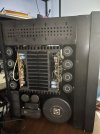
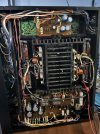
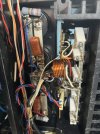
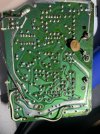
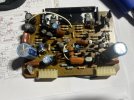
Running my eyes over the amp, I notice that the bleeder resistor is on the filter capacitor. In some videos that I watched, they were on the Driver boards. Another thing is that all soldering is done by the factory, so nobody has touched this amp before. Now I will start to work on the MMC board F-2770, and on this board, there are some, I believe, they are film polyester capacitors ( the black ones ), they say to replace those with COG ceramic caps, visually they look good, no deterioration
Below some pics

Below some pics
Don't be fooled - the Black Flags all need to go, they go 'low value' (open), which severely compromises the stability of the amplifier.I believe, they are film polyester capacitors ( the black ones ), they say to replace those with COG ceramic caps, visually they look good, no deterioration
I just bought several ceramic caps COG to replace these ones, but I am confused, in the F-2917 and F-2918, it shows a 30pF capacitor in the parts list, the black ones, but installed on the board, I have the 91pF. I will go with the value that is installed.Don't be fooled - the Black Flags all need to go, they go 'low value' (open), which severely compromises the stability of the amplifier.
This manual is a mess.


Sui-Yogi
Super Member
Part list , schematics and actual PCB in Sansui hardly follow each other…..go with what you see on your boards (make sure it’s a factory installed) .I just bought several ceramic caps COG to replace these ones, but I am confused, in the F-2917 and F-2918, it shows a 30pF capacitor in the parts list, the black ones, but installed on the board, I have the 91pF. I will go with the value that is installed.
This manual is a mess.
Remember this amplifier left the Sansui production factory working as is.
The schematic sez 91 pF for C12 and -3. In any case, these will not cause your precious high speed unobtanium TO-3 output transistors to blow up. I almost always ignore the parts list because the part numbers (order codes) will get you nowhere.
You can also use 100 pF. It is not critical. 91 pF is an E24 value and availability is poor.
You can also use 100 pF. It is not critical. 91 pF is an E24 value and availability is poor.
Last edited:
I used an 82pF + a 9pF in parallel thinking Sansui must have chosen that value for a reason.You can also use 100 pF. It is not critical. 91 pF is an E24 value and availability is poor.

To the OP - there are a lot of AU-X1 restoration threads which go into some detail about what parts were used, where and why - also details of the stability modifications either devised or described for the first time on here.
There is a post by an AK member (ronito6) which contains links to many of the best threads on the AU-X1 - all you ever wanted to know about AU-X1 restoration - or were afraid to ask.

Last edited:
Similar threads
- Replies
- 14
- Views
- 9K

- Replies
- 17
- Views
- 2K

