• The move to the new server is done. There are some software and database maintenance updates in process. This has us passing the hat around to help out. We appreciate any donations. Seriously, even a dollar helps. The payment page may be found here - https://www.audiokarma.org/support.html

Sansui JPD adventure

Do you plan on / have you looked into replacing the Thyristor for the protection board? I've read that this can be troublesome and often thought of replacing mine or at least ordering a spare. I am not sure what the modern replacement is.
I once looked at the datasheet for the S8X5ECS and it seemed suitable for this because it has the pin out "GAK" it seems to have enough current and voltage ratings and it is still available.
 
Yes, so true. I noticed the difference to and I am also not sure they are original ones. They measure good in the, between 140-160 but I realize that's no sure thing.
I like the Sanyo you're suggesting. Especially because it still has the metal tab. Considering, can never hurt to have some stock from high quality transistors.
Thanks for the information.
So I ordered 20 pairs of the Sanyo sc2344/ sa1011 from Amplab.
Should arrive next week.
Any AK members in Europe interested? Send me an pm, same price just add postage.
 
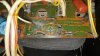
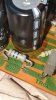
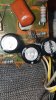
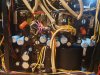
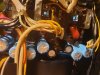
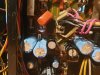
Spent some minutes here and there the last two weeks to let the project continue, although slowly, on the power supply board for the driver board. Because I want to keep this one in original state as much as possible the plan was to take of the capacitors, remove the glue from the board, caps and other touched components.

20210708_212813.jpg 20210707_201326.jpg 20210707_211425.jpg 20210707_211312.jpg

I made a little mistake with removing one of the capacitors. Desoldered one of the legs from a resistor instead from the cap and because of the glue you have to apply some force, pulled one of the leads.
So, that for keeping it original.
Then I remembered I had some Nichicons laying around that I removed replaced on the AU719 and AU417. Same serie, 470 uF-80V and 470uF-63V. So decided to do a little "upgrade" with original components.

20210717_233755.jpg

20210717_233750.jpg 20210717_233742.jpg

Now C07-10 went from 220uF-80V to 470uF-80V, C15-18 the same just 63V and C11-14 got the originals back: 220uF-63V. These are on the schematic 100uF-63V and there is even a solderpad for the smaller leadspacing.
I was really happy to have been able to do this without desoldering all the wires. Just had to remove the EL- transformer and the ground connections on the base plate for the filtercaps and ofcourse remove that to.
 
Have to say, cleaning glue of capacitors is the most intensive job of this whole restoration. And I don't know if I am going to do this again. Could have restored all the boards in the time it took to clean these 12 capacitors. Also noticed a big difference in the glue, on the AU719/417 the glue was hard and dark opposed to here, here it was lighter and more gummi like. I suppose has to do with lower temperatures on the board.
 
So, you're removing components, cleaning off the glue, and replacing the same 40 year old components for the sake of keeping it original? The glue that you're removing is original, so why not keep that as well?
 
So, you're removing components, cleaning off the glue, and replacing the same 40 year old components for the sake of keeping it original? The glue that you're removing is original, so why not keep that as well?
Yes, yes
And I don't know if I am going to do this again. Could have restored all the boards in the time it took to clean these 12 capacitors.
See it as an experiment. With a side effect that when I want to sell it there are a lot of people that are convinced original is better, even to a fault.
The funny thing is : I replaced all capacitors in 4 Sansui's before this one. Measuring the capacitance and ESR from the replaced caps showed that may be 1 on 20 was questionable and 1 in 50 was not measuring well.
So for now all of them measure good, often better then new components except the 1uF on the driverboard.
I have a AU D907 Limited and an AU D707 on the way from Japan that I am going to restore and upgrade full. So also modern output transistors.
The only thing I know is that there are two sides to this. I think it's better to upgrade and replace, I do not believe that much in musical components. But I don't know that much about it.
So this way I learn and educate myself.
In defense of this way of restoring: most components are not made with audio amplifiers in mind, so miniature is not that important and is the biggest advancement from the last 10-15 years together with temperature.
This original capacitors have around three times the volume of modern ones. Less etching, thicker foil. I don't say it sounds better but hope to find out first hand if there is a discernable difference to my ears.
 
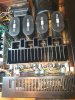
Today the second amplifier from Japan arrived. A Sansui AU-D 907 Limited.

20210720_211504.jpg

Should be working but needs some cosmetic work. The side panels have some little damage, some rust on the EL- transformer.
Front panel is spottles, backpanel has no rust.
Noticed that it had some work done on the driver board. Different trimmer for the fet input pair DC offset. And different jfets without the case!?

20210720_162243.jpg

Luckely as far as I can see without disassembly the outputs are original.

20210720_161007.jpg

Have to finish the standard D907 first before I can enjoy working in this one.
 
Last edited:
Just see now that there are Toshiba c2240/a970 installed for the diamond differential circuit. Mhh, did they work on the driverboard or is this common on the d907 Limited
 
@GrisPato - I don't remember to ever saw 2SC2240 / 2SA970 used in Sansui schematics or service manuals so far....but my practical experience in Sansui's land is pretty much limited, so I can't say 100% they weren't used at all.
What I can recommend - check closely the soldering on those modules and on those transistors in particular and compare with other modules - should give an idea if they are genuinely there or somebody did something there.
From what I remember, I saw a couple of posts around in the forum saying that usual transistors used by Sansui 2SC1845 / 2SA992 were sometimes found leaking - may be the case also here, it's a possibility to justify the work done, if it's confirmed that it was done.
 
Hello,
Nice amplifier. The 2sc2240/2sa970 in the diamond differential is new to me. Sansui used either 2SA1145-2SC2705 or 2SA992-2SC1845 in this application. My AU-D907 came with KSA1013-KSC2383, which I left there. Can you take a close up picture of the 2SC2240 and 2SA970?, If they installed them recently, you have the possibility that those are not the Toshiba ones, which might be a concern. I can send yo pictures of the ones I bought in Bdent if you need a reliable reference to compare.
Another issue that I see is that they have replaced the dual JFET by a pair of 2SK170. I hope they have selected the pair to be matched, or else, you may have issues with DC offset. Also, you need the two JFETs to be in thermal contact. Normally what others have done is to heat shrink the two FETS together and then form the leads to match the hole pattern on the PCB and solder them.
I think you will benefit if you separate this amplifier in a whole new thread as it may become confusing later on about what of the amplifiers you are talking about.
 
Hello,
Nice amplifier. The 2sc2240/2sa970 in the diamond differential is new to me. Sansui used either 2SA1145-2SC2705 or 2SA992-2SC1845 in this application. My AU-D907 came with KSA1013-KSC2383, which I left there. Can you take a close up picture of the 2SC2240 and 2SA970?, If they installed them recently, you have the possibility that those are not the Toshiba ones, which might be a concern. I can send yo pictures of the ones I bought in Bdent if you need a reliable reference to compare.
Another issue that I see is that they have replaced the dual JFET by a pair of 2SK170. I hope they have selected the pair to be matched, or else, you may have issues with DC offset. Also, you need the two JFETs to be in thermal contact. Normally what others have done is to heat shrink the two FETS together and then form the leads to match the hole pattern on the PCB and solder them.
I think you will benefit if you separate this amplifier in a whole new thread as it may become confusing later on about what of the amplifiers you are talking about.
If you just knew how much I have to hold myself back to not open this amplifier more. I did see on the site of amp8 that they have different drivers installed to : Toshiba c2238/a936. And I found some pictures from models produced in the year 1980 that did not have the black flags but the noble styrol capacitors.
On Bumpalump's thread about this model the Toshiba's are also the drivers but he mentions testing the
Diamond differential, a992/c1845.
So is unclear if Sansui used the c2240/a970. Is also the first time I see different drivers in this period then the Nec d382/b537 pairs.
Concerning the jfet pair, the plan is to take them from one of the d707 that are on there way. Luckely the sk170 are aegit replacement, so with some thermal bonding I can use them in the donor amplifier. That is why I only started this story with a surplus in amplifiers. But I am hoping I will still end up with 5 well functioning amplifiers. Would not like to have to leave one incomplete for parts donor.
I will start a new thread for the d907 Limited. Will have to finish the d907 first or at least the CA-F1 that I still have open but almost finished.
 
Last edited:
Yes Amp8, is a great resource if you have an acute eye to spot little details. Unfortunately the site owner does not reveal what substitutes he uses for semiconductors. The input differential JFET in the AU-D907 was typically 2SK97 or 2SK129. Alternatives to substitute for these have been discussed in this other thread. Check it out.
 
Yes Amp8, is a great resource if you have an acute eye to spot little details. Unfortunately the site owner does not reveal what substitutes he uses for semiconductors. The input differential JFET in the AU-D907 was typically 2SK97 or 2SK129. Alternatives to substitute for these have been discussed in this other thread. Check it out.
I have been reading all the threads from amp8 site. Funny thing is, he always replaces the jfet pair and trimmers and never the black flags although often the output pairs are shorted??!!
 
I have been reading all the threads from amp8 site. Funny thing is, he always replaces the jfet pair and trimmers and never the black flags although often the output pairs are shorted??!!

Kind of off-topic here....I take the charge....:bowdown:
I have nothing against the man...in most of the cases he does a good job, with attention to details. And I'm grateful for the pictures found there, which uncovered some details that I posted on the forum some time ago. Kudos for that.
What is puzzling me is the replacement of input JFET's (as GrisPato also said), especially 2SK389 which are not known to be troublesome (I only know about uPA68 being leaking sometimes) and even more for the MOSFET outputs, 2SK405 and 2SJ115.....ok, I know that 2K1530 and 2SJ201 are more rugged and newer than the originals, but....there is a 100-points question here :D....last Sansui amp with MOSFET outputs was AU-Alpha607 MOS Limited, in 1999. By that time, were already available both 2SK1529 / 2SJ200 and 2SK1530 / 2SJ201 pairs, any of them more rugged than the old ones.....still, Sansui opted to go with the "old" 2SK405 / 2SJ115, like they did from the beginning of MOSFET series amps. Wonder why..... after all, they could choose any of the newer ones, that were supposedly even easier to be obtained, right ?
So why replace the originals with something else, if they are still obtainable ? :yikes:
Maybe we won't have a 100% clear answer on this MOSFET choice Sansui made back in the day....but I suspect the ones used by them had "something". Hopefully one day we will find at least a part of the answer.... :)
 
Kind of off-topic here....I take the charge....:bowdown:
I have nothing against the man...in most of the cases he does a good job, with attention to details. And I'm grateful for the pictures found there, which uncovered some details that I posted on the forum some time ago. Kudos for that.
What is puzzling me is the replacement of input JFET's (as GrisPato also said), especially 2SK389 which are not known to be troublesome (I only know about uPA68 being leaking sometimes) and even more for the MOSFET outputs, 2SK405 and 2SJ115.....ok, I know that 2K1530 and 2SJ201 are more rugged and newer than the originals, but....there is a 100-points question here :D....last Sansui amp with MOSFET outputs was AU-Alpha607 MOS Limited, in 1999. By that time, were already available both 2SK1529 / 2SJ200 and 2SK1530 / 2SJ201 pairs, any of them more rugged than the old ones.....still, Sansui opted to go with the "old" 2SK405 / 2SJ115, like they did from the beginning of MOSFET series amps. Wonder why..... after all, they could choose any of the newer ones, that were supposedly even easier to be obtained, right ?
So why replace the originals with something else, if they are still obtainable ? :yikes:
Maybe we won't have a 100% clear answer on this MOSFET choice Sansui made back in the day....but I suspect the ones used by them had "something". Or maybe one day we will find at least a part of the answer.... :)
I had the same line of thinking. Also realize I am still a novice so I will wait for the moment I am able to call myself experienced ( so another 9500 hours to go) to give a more opinionated response.
 
Also realize I am still a novice so I will wait for the moment I am able to call myself experienced ( so another 9500 hours to go)
Well...to be honest, I'm not that sure that I reached yet that number in my last 14 years of "more serious" audio electronics :oops:
 
Maybe we won't have a 100% clear answer on this MOSFET choice Sansui made back in the day....but I suspect the ones used by them had "something". Hopefully one day we will find at least a part of the answer.... :)

Maybe below description is that "something" ? :D
Quoted from here
"
By the way, Masters has adopted Toshiba 2SK405 / 2SJ115 as a MOSFET device.
We have made a prototype of a Z-balanced amplifier by combining a complete pair of MOSFETs of the former Hitachi (currently Renesas) and 2SK1056 / 2SK160, and obtained good results. We will accept orders for people.
In addition, we also support Masters amplifier users who wish to replace MOSFETs. Please contact us as we will charge a reasonable fee.
Characteristics comparison between 2SK405 / 2SJ115 and 2SK1056 / 2SJ160
device Vds-max[V] Id-max[A] Pd[W] Ciss[pF] Case
2SK405
160V 8A 100W 430pF TO-3P
2SK1056 120V 7A 100W 600pF TO-3P
2SJ115 -160V 8A 100W 800pF TO-3P
2SJ160 -120V 7A 100W 900pF TO-3P
By the way, Hitachi 2SK175 / 2SJ56, which was evaluated as a brand-name product, has a high withstand voltage of ± 180V and Idmax8A, but its input capacitance (Cis) is 800pf and 1200pf.
Therefore, the input capacity of 2SK1056 / 2SJ160 has been improved to the same extent as Toshiba.
There is not much difference electrically, and it works by changing some constants in the same circuit.
The audio is interesting and the sound is subtly different.
If anything, 2SK405 / 2SJ115 is gorgeous and warm colors, while 2SK1056 / 2SJ160 is cool colors and gives a tight feeling.
However, this impression is personal to me, so I hope everyone who is interested will enjoy it"
 
Last edited:
Back
Top Bottom