• The move to the new server is done. There are some software and database maintenance updates in process. This has us passing the hat around to help out. We appreciate any donations. Seriously, even a dollar helps. The payment page may be found here - https://www.audiokarma.org/support.html

Single driver full range SPL

Some how this thread has gone off track... I never thought single driver full range speakers would be high SPL , I simply asked how to compare SPL's amoung the various options.

maybe pursuing an equalizer would be a better solution than different speakers.
This is an option worth exploring... The issue i am trying to improve upon is sibilance. The room acoustics are harsh, the shape is very un-symmetrical. I'll do a bit of reading... thanks who!
 
I have a set of AN 12" (just installed them this weekend). so far i like them a lot. very revealing, detailed. however, i suspect they need large cabinets or wide open baffles to work their magic. i have mine in vintage allied-knight catalog cabinets--very big. i'm getting nice bass.

Classic or Super? Which Magnet?
 
Tom, wouldn't this become less of an issue with a TQWT or TL enclosure?

Yes and no: both enclosures mentioned are a type of vented enclosure and while they serve to extend bass they don't increase overall efficiency of the driver chosen in the reproduced band, as a basshorn does. Vented alignments allow the use of more efficient drivers for a given box size and F3 than sealed ones but they don't increase the efficiency of the driver chosen. So in a sense a vented system can have less compression than a sealed one but ultimately the compression is a characteristic of the driver itself.
 
Last edited:
It is a shame and a burdon that I can't walk into a stereo shop and listen to different designs and configurations... those days are gone.
I might build a set for my bedroom to go with my Chinese 300b SET, just to get a point of reference on this type speaker.
 
Yes and no: both enclosures mentioned are a type of vented enclosure and while they serve to extend bass they don't increase overall efficiency of the driver chosen in the reproduced band, as a basshorn does. Vented alignments allow the use of more efficient drivers for a given box size and F3 than sealed ones but they don't increase the efficiency of the driver chosen. So in a sense a vented system can have less compression than a sealed one but ultimately the compression is a characteristic of the driver itself.

In addition--there's more to avoiding compression than efficiency, a low efficiency driver with longer stroke can have less compression than a higher efficiency driver with less stroke; ultimately the system that plays loudest regardless of power needed has the least compression. But efficiency doesn't hurt.
 
strings and wood vibrating and air moving rather than a monochromatic bass note, which is often what you get. Is this worth giving up thumpa thumpa big bass for?
I'm not exactly listening to a Kenner Close and Play. My current setup doesn't have much of an issue with resolving musical passages, and I'm not sure what instrument goes thumpa thumpa, but if a composition includes thumpa thumpa I do want to hear it.
 
Try to find JTR speakers. They may match what you need - sensitivity in high 90s db/W and possible sound pressure of 110 db and higher. They are not a single driver - most are two way with pair of 12-15" bass drivers and horn. Price is not high too.
 
The one-watt at one meter spec for the driver is your basis for comparison. Your existing speakers should have such a rating. For most people, a 3 dB increase in volume is the equivalent of one "click" on a volume knob - the smallest amount of difference easily discernible. A 3 dB increase takes twice the actual power to achieve with a given speaker. It takes a 10 dB increase for most people to be perceived as "twice as loud". A 10 dB increase takes ten times the power. Human hearing is not linear - it is compressed, naturally.
 
Last edited:
The one-watt at one meter spec for the driver is your basis for comparison. Your existing speakers should have such a rating. For most people, a 3 dB increase in volume is the equivalent of one "click" on a volume knob - the smallest amount of difference easily discernible. A 3 dB increase takes twice the actual power to achieve with a given speaker. It takes a 10 dB increase for most people to be perceived as "twice as loud". A 10 dB increase takes ten times the power. Human hearing is not linear - it is compressed, naturally.

Thanks, this was my original question and you answered it well.
 
In the sensistivity deal there are a few pitfalls. With such drastically different speakers I'd wonder if they're relatively comparable.

As well, nominal impedance must be considered if either or both of the speakers are rated in dB/2.83V/m. 2.83V is 2W at 4 ohms but is 1W @ 8 ohms. There appears to be 3dB difference in that case but actually are the same if both are fed 1W.
 
In the sensistivity deal there are a few pitfalls. With such drastically different speakers I'd wonder if they're relatively comparable.

As well, nominal impedance must be considered if either or both of the speakers are rated in dB/2.83V/m. 2.83V is 2W at 4 ohms but is 1W @ 8 ohms. There appears to be 3dB difference in that case but actually are the same if both are fed 1W.

I understand the relationship impedence has on output, but what I don't know is a lot when applying this to an active load of varying impedence by frequency.
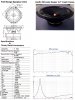
The drivers I'm interested in have a huge impedence spike down low, and the chart shows the impedence spending most of it's time in the 10-15 ohm range, yet the driver is rated as 8 ohm!
an12cfspecs.jpg
 
In addition--there's more to avoiding compression than efficiency, a low efficiency driver with longer stroke can have less compression than a higher efficiency driver with less stroke; ultimately the system that plays loudest regardless of power needed has the least compression. But efficiency doesn't hurt.
`
Like if there weren't enough design consideration variables, here comes Tom and throws a curve ball!!! Why make it easy, if we can make it difficult!!! All kidding aside, like Tom has mentioned, there are many considerations, and once you think you took care of them, here comes another tech aspect to consider, and afterwards, probably another. Hence why speaker building is a mix of science and art.

Anyways, let's go to Speaker Building for Real Dummmies, like me...This is me, and maybe only me, and is based on assumptions...When I see a driver with a sensitivity of 87dB I assume that it's output given room conditions might be around 90dB. Now, this might be an stupidity, but so far I have been very close, using +3-4dB's PRA rule of thumb. Remember that room conditions will influence the speaker final dB output.

If you build an enclosure for an AN12, expect high SPL of 97dB+. Again, this is only my opinion based on what little I have learned about speaker building and playing around with a few DIY designs.
 
With enough magnetic force you can brute force high frequencies from large cones, like Lowther does. The problem is that the same strong magnetic force that gives you the highs also over damps the bass and gives you lousy bass. This is why Voight and Chave put the Lowthers in rear mounted horns, to lift the bass in the range below 200hz where it's rolling off disastrously--horn loading in self defense.

It's always something.
 
With enough magnetic force you can brute force high frequencies from large cones, like Lowther does. The problem is that the same strong magnetic force that gives you the highs also over damps the bass and gives you lousy bass. This is why Voight and Chave put the Lowthers in rear mounted horns, to lift the bass in the range below 200hz where it's rolling off disastrously--horn loading in self defense.

It's always something.
The D130 balanced many of the compromises nicely.
 
But are the compromises good sounding?
Yes, relatively speaking.

In the words of John Eargle...............

"There virtually is no loudspeaker market for which the D130 did not find application. In the 1950's through the 1960's, it was the loudspeaker that defined the home hi-fi phenomenon. It was used in more component hi-fi systems of that era than any other speaker. It was the workhorse driver used in James B. Lansing Sound's first commercial systems for the movie industry. It became a mainstay in the musician's market after Leo Fender incorporated a version of it in his early amplifiers. In the rock era of the seventies, it was common to see walls of D130's providing sound reinforcement at concerts."
 
Back around 1972 I used D-130s, by themselves in vented boxes, as my hi-fi speakers (with a PAT-4, a Fisher SS amp that was a console pull, a BSR turntable with a Shure cartridge) and they sounded pretty good. Subsequently I added Radio Shack horn tweeters to give some zip.

Would they sound good to me now? Who knows? But I suspect that nowadays I'd have more problems with the cartridge and the preamp than with the JBLs.
 
To return to the OP's specific question. SPL at 1 watt/1 meter is the standard way to compare, but it doesn't really deal with the fact that no speaker has uniform output at all frequencies, so speakers with the same SPL rating may have different perceived volumes. And peaks and valleys aside, frequency responses are often tilted, which may also affect perceived volume.
 
Back
Top Bottom