• The move to the new server is done. There are some software and database maintenance updates in process. This has us passing the hat around to help out. We appreciate any donations. Seriously, even a dollar helps. The payment page may be found here - https://www.audiokarma.org/support.html

Speaker Wire, Gauge, etc.

Note that those values are from the electrical code, and are based on not exceeding the temperatures rating of the wire's insulation. Good to know but not really relevant to speaker wire, with speaker wire there's other issues at play.

I totally get it, it was just an example of how much power a particular size wire can transmit. It is funny that the wire used in the cabs of a set of JBL L200's is tinnie tiny maybe 22g or 20 at the most. I'm assuming JBL used this across the board at the time of the build even though the 200's where a lesser offering at that time. An example is that I have an old car that has suspension put on by me that I will never ever even come close to fully loading up but I like the stance. I could have taken a torch to the springs and got the same effect. If you have a big fancy stack of equipment laid out in a room who wants to see some 12-14g Best Buy wire running across the floor. Plus that small percentage difference if any that a better wire may result in is a minor tweak and most everyone on here is guilty of tweaking something with little or no gain but it feels good and may look (cool).
 
Correction noted since it's technically not a constant, uninterrupted voltage applied to + as true DC would be. But it's also not like mains power since it's not a constant higher voltage 50 or 60 HZ wave.

Variable power, variable frequency AC would have been a more accurate way to describe it.

Trying to differentiate it from standard AC mains power, and why AC mains can be higher gauge cable led me to treat our audio signal as if we were dealing in DC, since the concept of using larger cable for longer speaker runs is to prevent power loss like with DC.

Blame it on a 3 AM post. LOL

Keep it simple. You have power gages or lights SHOWING the power being used as you hear it right?? The low frequency you hear is a slower A/C (on a scope) signal Right?? The power gage moves further on these sounds right? The higher frequency(cymbals) do not move the meters as much right? They take less power to reproduce so you can hear them right?? Are you changing volume to hear the sounds even though they are different? NO.

Changing wire diameter will not change this. To a point it will all work just fine or burn up if enough power is used.
 
I like full bodied sound so I guess I need voluptuous speaker cables. Good thing one set is one of those good looking sets of speaker wire, bought real cheap, price of the actual wire that were made all pretty. Don't know if I can tell the difference between those and another equal length, equal gauge, both copper cables. But the pretty ones sure make the system look better during listening sessions when they are visible. And that is important or we wouldn't be grabbing old vintage gear we would go for those plain jane black receivers and such folks make today.

Gotta have at least decent looking cables for it to sound best...

Finally some sense. Looks are important. Makes for bigger smiles too. What percentage of copper is in those cables?? Any Gold??
 
But truthfully....

I think it's the condition of the signal prior to the signal entering the speaker wire. Behind your amps output jacks you have capacitors and the speaker crossover has a capacitor with the speaker wire in between. So shouldn't it be based on capacitance ???

No.Study Ohms law. Capacitors act as filters to frequency depending on their value. You started out very well though. Garbage in- Garbage out.
 
A while back, I had substituted 22 AWG for the 14 AWG that had been in the system. The same length of 20' was used and speaker load is 8 ohm.

22 gauge of this length represents well over the 5% of speaker impedance maximum recommendation of speaker wire and still there was no noticeable sonic degradation. Even bass control did not seem to suffer with the 22 gauge wire but in all fairness, this was not an instant A/B listening comparison.

Truthfully, if the wires were swapped without my knowledge, I'd probably never be the wiser for it and seriously doubt anyone else would either.

Resistance is higher but, until you overpower the capacity of the wire, the audio electrons will move from adam (Atom) to adam(Atom). :oops:When over powered something will fry.
 
Last edited:
Resistance is higher but, until you overpower the capacity of the wire, the audio electrons will move from adam to adam.
For a while, we had two guys named Adam working in my department. I don't recall any audio electrons moving between them, let alone them being able to discriminate audio electrons from... What? Normal electrons? Inaudible electrons?

Mostly the two Adams just whinged about each other, so that's what moved between them: complaints, not electrons.
 
Do you know this from your own personal experience, or are you just making this up as you go along?


Sorry to disappoint you, but milliohms means "thousandths of an ohm." To get to millionths of an ohm, you must use the term "microohm." So, to be blunt, you're like, 1000x off in your statement. But I will say it is a pretty good guess for a pedestrian.


OK, I'll take that challenge. I buy cable in 250' rolls. Your method gives us 500 feet of wire to measure, WAY less than a single mile. 16ga is 4.016mohm/ft. this gives us a predicted total resistance of 2.008 ohms. Not what I would call a dead short. Not 0ohms by any stretch of the imagination. To measure this, I select an old vintage meter that's been out of production for decades, HP3456. I'll set it to the 100ohm range using a 4-wire connection that's been properly nulled in the 100ohm range, this meter has resolution at the 6 ana half digit level of 100uohms, or 0.1milliohm. Reading 2ohms is no problem at all for this meter. Heck, it could even measure just a mere single foot of 16ga and come up with a purdy durn good reading. Again, I take it you've never actually tried doing what you posted here, right?


Well, 14ga has less than half the resistance of 16ga, and 10ga has exactly one fourth the resistance of 16ga. So yeah, 16ga is significantly more resistive than 10ga.

The ampacity of 22ga is said to be 5 to 7A, depending on temperatures tolerated. Let's say 5A. That works out to a 200W amplifier running full tilt boogey. But, this isn't where the cable fuses, just to where the temperature rises a bit. If you want it to burn up like a fuse, it would take 41A for 10 seconds, or 551A for 32ms. 41A is more than 13,000 watts delivered to an 8ohm speaker. I seriously doubt you have an amp big enough to fuse a 22ga wire.

You have your theory down really well and are real articulate with time enough to toss a bunch of numbers into the conversation but to answer your question. Yes I have years of experience testing wires over many miles. The reason you see resistance is the scale you are using your meter. Notice I never mentioned it because I knew someone like you would bring it. You change the scale and I am right. Scale from 2000 to 20and you picked the middle. It adds resistors to the reading right??? YES IT DOES. Get rid of em. Use the most sensitive scale.
In my experience we could measure within 30 feet where a short was on a pair of wires well over a mile long as the resistance would change over a known reference pair. Now For the point of my post no one uses these lengths of wire for audio/music with exception of remote radio broadcasts say from a promotional event of a radio station which we used to do in the 1980's We used very sensitive test equipment to enable music and voice to transmit from the remote locations to the broadcast stations. Over a certain number of feet/miles the line had to be conditioned for the impedance with Inducters to balance the inherent capacitance of the line. To this point which was miles a dead short was readable. So back to audio wire.
Scales matter on this and you know it. I usually use the lowest scale looking for a short. The resistance read on that same shorted wire will change with each scale but you can see a dead short.
As for the milli micro yea you got me. Been a long time since i hit the books.
For the point of the OP statements my points stand true without all the math you pose. The wire length used in audio is too short for gage to matter on perceived audible to the normal human's ear. Any resistance differences in gage will not change it. What was your point other than to try to belittle me?
 
Posters keep showing how bigger AWG has less resistance (true) then extrapolate from that fact that using bigger wire must be better.........even though their systems dont need that size of wire. The modern car has a perfect example of how silly this thinking is. Even economy cars have speedometers that read to 140 or 160 MPH even though most economy cars are either speed restricted to the speed rating on their tires or simply cant go that fast. What is the point of a car with a 140 MPG speedo if the car can only go 115? Oh, I know it is so their owners can think to themselves "thank goodness my speedometer reads to 140 in case I need to take my Kia Rio to the race track".

I have a Realistic 35WPC receiver from 1978 powering some Nova 7s with less than 10 foot runs. I use 16AWG wire because THAT IS ALL IT NEEDS. If I put 12 AWG wire on it there will be zero difference in sound.
I have a pair of those Nova 7'sor 5's I forget. Amazing how good they sound. Do you think they were made by Pioneer??
 
For a while, we had two guys named Adam working in my department. I don't recall any audio electrons moving between them, let alone them being able to discriminate audio electrons from... What? Normal electrons? Inaudible electrons?

Mostly the two Adams just whinged about each other, so that's what moved between them: complaints, not electrons.

It's all theory. No one can see the adams(Atoms):no: moving anyway. Oh crap I shoulda said electrons. Good catch.
 
Last edited:
I seriously doubt you have an amp big enough to fuse a 22ga wire

Great example but you took my point way to literally. But what I said is still right. Never said I had a amp big enough to do it. The point was the gage can only tolerate so much power, but then you knew that and still needed to what?
 
Posters keep showing how bigger AWG has less resistance (true) then extrapolate from that fact that using bigger wire must be better.........even though their systems dont need that size of wire. The modern car has a perfect example of how silly this thinking is. Even economy cars have speedometers that read to 140 or 160 MPH even though most economy cars are either speed restricted to the speed rating on their tires or simply cant go that fast. What is the point of a car with a 140 MPG speedo if the car can only go 115? Oh, I know it is so their owners can think to themselves "thank goodness my speedometer reads to 140 in case I need to take my Kia Rio to the race track".

I have a Realistic 35WPC receiver from 1978 powering some Nova 7s with less than 10 foot runs. I use 16AWG wire because THAT IS ALL IT NEEDS. If I put 12 AWG wire on it there will be zero difference in sound.

I quote this as an example. A bad example. Some argues that since a certain 22awg wire does not melt down during playback it is "enough". Well, keep your head down there in the sand, you won`t be missed. The size of the wiring has nothing to do with melt-downs or "wire-capacity". What wery few audiophiles seems to realize is that even the smallest amount of resistance between the amplifiers output-terminals and the speakers drivers has a big influence on a systems dynamic performance. Wery few hifi-nerds (like "enegineers" and other smart a##es) realises this. A Realistic 35wpc or it`s like will do on doorbellwire, no need to upgrade.

Same vas with powersupplies, they can never be too big, only sufficient.

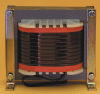
And again; a pic of a zero-ohm filtercoil from Mundorf. It has 6awg wire. Wonder why anyone would come up with a crazy coil like this, they must be way off :P
Some of us might know a bit about this topic, others do obviously not.

m_coil_n.gif
 
I quote this as an example. A bad example. Some argues that since a certain 22awg wire does not melt down during playback it is "enough". Well, keep your head down there in the sand, you won`t be missed. The size of the wiring has nothing to do with melt-downs or "wire-capacity". What wery few audiophiles seems to realize is that even the smallest amount of resistance between the amplifiers output-terminals and the speakers drivers has a big influence on a systems dynamic performance. Wery few hifi-nerds (like "enegineers" and other smart a##es) realises this. A Realistic 35wpc or it`s like will do on doorbellwire, no need to upgrade.

Same vas with powersupplies, they can never be too big, only sufficient.

And again; a pic of a zero-ohm filtercoil from Mundorf. It has 6awg wire. Wonder why anyone would come up with a crazy coil like this, they must be way off :p
Some of us might know a bit about this topic, others do obviously not.

View attachment 932562


HUH? You are saying that no matter what is completely sufficient for an application, it needs more? We are not talking about power supplies, we are talking about speaker wire. I said NOTHING about 22AWG wire either. There is a reason there are guides for wire gauge sizes based on how long the run is...........because engineers have come up with them, you know like the ones that designed the units? Most of the charts ones sees are very conservative and I tend to follow them. Like I said before, if I have a short run of wire with a low power amp, going from 16 to 12G wire, will make zero difference in sound that can be measured. By your reasoning, everybody should use 6AWG wire for all systems all the time.
 
I have a pair of those Nova 7'sor 5's I forget. Amazing how good they sound. Do you think they were made by Pioneer??


They do sound great but I believe they were made by Foster in Japan.

I have a Marantz 2220B coming Saturday that I will be using to run the Novas.......with (GASP) 16 AWG wire. The runs are 4ft and 6ft long. The 14 awg wire was just too much of a pain to work with.
 
They do sound great but I believe they were made by Foster in Japan.

I have a Marantz 2220B coming Saturday that I will be using to run the Novas.......with (GASP) 16 AWG wire. The runs are 4ft and 6ft long. The 14 awg wire was just too much of a pain to work with.

I got up off my hine and looked at the back of mine. I have the Nova 7B which I bought new and ran for at least ten years till they got put aside as I upgraded everything. I do remember that the woofer foams had blown out on the left side and I had swapped them L-R which quickly blew out the second one. I looked over the receipt and the certificate that came with it reads there is a LIFETIME guarantee on these. I carted them to RS and presented it to the manager. He scratched his head shrugged his shoulders and sent em off for repair. I got em back and paid nada. Not sure if they swapped woofers or refoamed. When my son started his hip-hop listening phase he finds em and wires em up to some cheap equipment. I tell em these are not big bad thumpers but he still wanted em. When I get to his room later he has the grills off which was the thing to do back then. I quickly counseled his decision but alas he wanted to be cool. Thankfully the stage subsided and I reclaimed them as well as a older Technics TT I had acquired that he apparently been abusing DJ style. (scratching?)
I still have the original speaker wire on these. It may be 16 or even 18 AWG. These are low power speakers. About 35 watt if I recall correctly and the wire was fine.
Do you have any data on the crossovers? I always kept then on MID because I could not tell a difference on High or Low. Maybe need THICKER wire. :rflmao:
 
Last edited:
I got up off my hine and looked at the back of mine. I have the Nova 7B which I bought new and ran for at least ten years till they got put aside as I upgraded everything. I do remember that the woofer foams had blown out on the left side and I had swapped them L-R which quickly blew out the second one. I looked over the receipt and the certificate that came with it reads there is a LIFETIME guarantee on these. I carted them to RS and presented it to the manager. He scratched his head shrugged his shoulders and sent em off for repair. I got em back and paid nada. Not sure if they swapped woofers or refoamed. When my son started his hip-hop listening phase he finds em and wires em up to some cheap equipment. I tell em these are not big bad thumpers but he still wanted em. When I get to his room later he has the grills off which was the thing to do back then. I quickly counseled his decision but alas he wanted to be cool. Thankfully the stage subsided and I reclaimed them as well as a older Technics TT I had acquired that he apparently been abusing DJ style.
I still have the original speaker wire on these. It may be 16 or even 18 AWG. These are low power speakers. About 35 watt if I recall correctly and the wire was fine.
Do you have any data on the crossovers? I always kept then on MID because I could not tell a difference on High or Low. Maybe need THICKER wire. :rflmao:

Lots of info on the 7B on this forum... the tweeters have a 12dB/octave high pass filter, the woofer has no filter at all. The mid-high-low switch should make an audible change in the sound quality, but it may be subtle. If you haven't changed the 15uf capacitor in the crossover, do it, in mine it made a huge improvement. Electrolytic capacitors over 40 years old are usually bad, and these were no exception. Definitely nothing related to speaker wire. If you have 16 or 18awg wire you're good to go, no need to start getting too anal retentive about speaker wire with these speakers.
 
Lots of info on the 7B on this forum... the tweeters have a 12dB/octave high pass filter, the woofer has no filter at all. The mid-high-low switch should make an audible change in the sound quality, but it may be subtle. If you haven't changed the 15uf capacitor in the crossover, do it, in mine it made a huge improvement. Electrolytic capacitors over 40 years old are usually bad, and these were no exception. Definitely nothing related to speaker wire. If you have 16 or 18awg wire you're good to go, no need to start getting too anal retentive about speaker wire with these speakers.
Thanks for the Advice. I have not fired these up in years. I am planning on using them as extension speakers off my Visio TV in my reloading room. I will put the repair on the list.
 
Back
Top Bottom