

You are using an out of date browser. It may not display this or other websites correctly.
You should upgrade or use an alternative browser.
You should upgrade or use an alternative browser.
Speaker Wire, Gauge, etc.
- Thread starter Thrill Kille
- Start date

sx-70
Well-Known Member
Interesting (well maybe not so interesting) read in the 1290 manual regarding speaker wire.
http://sportsbil.com/ads/l-1290_and_l-1290_ownersmanual.pdf
I'll admit, I got some kimber kable 4PR mostly for aesthetic reasons.
http://sportsbil.com/ads/l-1290_and_l-1290_ownersmanual.pdf
I'll admit, I got some kimber kable 4PR mostly for aesthetic reasons.

I use two 14g cooper speaker wire split then twisted resulting into 11g relative then twist those two pairs into one for the run. These make it so much easier to swap out components and speakers, and certainly (feels) better. I use three strands braided to 9g for subwoofer runs. Total cost for each pair of 12ft cables is $33. In most speaker builds and restos I use 16awg stranded cooper inside the cabs. I do believe that higher end point source highly efficient drivers benefit from expensive silver wire or what have you given the delicate nature of the design.
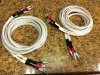
I'm not an electrical engineer, this is what I found online. All this aside I would assume the construction of the wire delegates resistance and of course how long the run is.
100 watts at 110 volts = .909 amps
awg (lamp cord)= 10amps
#14 awg (typical house wire) = 15amps
#12 20amps
#10 30amps
# 8 (stove cable size) = 40amps
# 6 (feed to your 251 or syncro 200) = 65 amps
# 4 70amps (conservative)
# 3 80 amps
# 2 100amps
# 1 110amps
0 (one ought) = 125amps
00 (two ought) = 145amps
000 = 165amps
0000 = 195amps
250 Kcmil* = 215amps
300 Kcmil* = 240amps
350 Kcmil* = 260amps
400 Kcmil* = 320amps
anything bigger than this and you'll need a hydraulic bender and a forklift to drag it around...
I'm not an electrical engineer, this is what I found online. All this aside I would assume the construction of the wire delegates resistance and of course how long the run is.
100 watts at 110 volts = .909 amps
awg (lamp cord)= 10amps
#14 awg (typical house wire) = 15amps
#12 20amps
#10 30amps
# 8 (stove cable size) = 40amps
# 6 (feed to your 251 or syncro 200) = 65 amps
# 4 70amps (conservative)
# 3 80 amps
# 2 100amps
# 1 110amps
0 (one ought) = 125amps
00 (two ought) = 145amps
000 = 165amps
0000 = 195amps
250 Kcmil* = 215amps
300 Kcmil* = 240amps
350 Kcmil* = 260amps
400 Kcmil* = 320amps
anything bigger than this and you'll need a hydraulic bender and a forklift to drag it around...

reydelaplaya
Super Member
Interesting (well maybe not so interesting) read in the 1290 manual regarding speaker wire.
http://sportsbil.com/ads/l-1290_and_l-1290_ownersmanual.pdf
I'll admit, I got some kimber kable 4PR mostly for aesthetic reasons.
Yeah, sounds about like what I would've expected - 16GA for less than 50', and 12GA for beyond that.
Mine are 16 GA 3 conductor copper that I twisted together to be a single conductor at about 12GA. I based them on the DIY White Lightning Moonshine Speaker Cables and finished off with some nice looking banana plugs for speaker terminals: http://www.6moons.com/audioreviews/whitelightning/moonshine.html

They've worked perfectly for me for over 2 years. I've since made a second set for my other stereo with the extra cable I had left over. Overkill for what I run, but they were cheap to make, and I really like how they look.

House de Kris
Loud-n-Deep
Do you know this from your own personal experience, or are you just making this up as you go along?Mathematically measured and engineered but more of a physical fact or fact of physics. Bottom line is wire resistance increases with length no matter how long but putting a value on this resistance it would take miles and miles of wire to see it with a ohm meter.
Sorry to disappoint you, but milliohms means "thousandths of an ohm." To get to millionths of an ohm, you must use the term "microohm." So, to be blunt, you're like, 1000x off in your statement. But I will say it is a pretty good guess for a pedestrian.We are talking milliohms of speaker wire that probably anyone uses. Millionths of a ohm.
OK, I'll take that challenge. I buy cable in 250' rolls. Your method gives us 500 feet of wire to measure, WAY less than a single mile. 16ga is 4.016mohm/ft. this gives us a predicted total resistance of 2.008 ohms. Not what I would call a dead short. Not 0ohms by any stretch of the imagination. To measure this, I select an old vintage meter that's been out of production for decades, HP3456. I'll set it to the 100ohm range using a 4-wire connection that's been properly nulled in the 100ohm range, this meter has resolution at the 6 ana half digit level of 100uohms, or 0.1milliohm. Reading 2ohms is no problem at all for this meter. Heck, it could even measure just a mere single foot of 16ga and come up with a purdy durn good reading. Again, I take it you've never actually tried doing what you posted here, right?Take a full brand new roll of 16 gage lamp cord. On one end twist em together. On the other a ohm meter set anyway you like. You will see a dead short. 0 ohms.
Well, 14ga has less than half the resistance of 16ga, and 10ga has exactly one fourth the resistance of 16ga. So yeah, 16ga is significantly more resistive than 10ga.Anyone concerned about the wire being thick enough for their use has the option of running power formulas at any and all frequencies produced by their amp and see if wire gage makes that much of a difference. I do not think 16 gage will do any less then 14,12,10,8 gage or even #6 ground wire.
Go the other way and 18 probably will not change sound neither will 20 gage or 22. But there are power restrictions and the reason for this as was said in the length of wire. You can amp it up, over power it and fry it but it wont sound that much different. Till it burns up.
The ampacity of 22ga is said to be 5 to 7A, depending on temperatures tolerated. Let's say 5A. That works out to a 200W amplifier running full tilt boogey. But, this isn't where the cable fuses, just to where the temperature rises a bit. If you want it to burn up like a fuse, it would take 41A for 10 seconds, or 551A for 32ms. 41A is more than 13,000 watts delivered to an 8ohm speaker. I seriously doubt you have an amp big enough to fuse a 22ga wire.
Superampman
AK Member
How long does it take an amp to swing peak to peak?Do you know this from your own personal experience, or are you just making this up as you go along?
Sorry to disappoint you, but milliohms means "thousandths of an ohm." To get to millionths of an ohm, you must use the term "microohm." So, to be blunt, you're like, 1000x off in your statement. But I will say it is a pretty good guess for a pedestrian.
OK, I'll take that challenge. I buy cable in 250' rolls. Your method gives us 500 feet of wire to measure, WAY less than a single mile. 16ga is 4.016mohm/ft. this gives us a predicted total resistance of 2.008 ohms. Not what I would call a dead short. Not 0ohms by any stretch of the imagination. To measure this, I select an old vintage meter that's been out of production for decades, HP3456. I'll set it to the 100ohm range using a 4-wire connection that's been properly nulled in the 100ohm range, this meter has resolution at the 6 ana half digit level of 100uohms, or 0.1milliohm. Reading 2ohms is no problem at all for this meter. Heck, it could even measure just a mere single foot of 16ga and come up with a purdy durn good reading. Again, I take it you've never actually tried doing what you posted here, right?
Well, 14ga has less than half the resistance of 16ga, and 10ga has exactly one fourth the resistance of 16ga. So yeah, 16ga is significantly more resistive than 10ga.
The ampacity of 22ga is said to be 5 to 7A, depending on temperatures tolerated. Let's say 5A. That works out to a 200W amplifier running full tilt boogey. But, this isn't where the cable fuses, just to where the temperature rises a bit. If you want it to burn up like a fuse, it would take 41A for 10 seconds, or 551A for 32ms. 41A is more than 13,000 watts delivered to an 8ohm speaker. I seriously doubt you have an amp big enough to fuse a 22ga wire.

What was the demand? SPL/watts? Tchaikovsky's 1812 at 115db?
Speaker sensitivity?
Boston Acoustics T1000 - 90 dB sensitivity, 8 ohm. Amplifier (2) MC240 and MC2505, 40 wpc and 50 wpc. (Test at 50 and 67 wpc)
Didn't play the 1812 but did play The Light Calvary Overture by Franz Von Suppe' which has a fairly wide dynamic range.
Meters on the MC2505 registered full output on peaks which should work out to around 110 dB for a pair of speakers (at 1m). Not sure what that works out for the listening position ~ 13 feet away from either speaker.
I was expecting to hear at least some degradation with the 22 AWG, and was surprised when none was apparent. Roger Russell had stated the 5% resistance figure of wiring to to speaker impedance is actually conservative; with some speakers, wiring resistance may be as high as 10% and still not be readily audible or apparent.
Again, calls like this are very difficult to make without instantaneous A/B. I have an amplifier switcher which could probably be used to make instant A/B listening comparisons between different speaker wiring. I think it might be an interesting experiment to try sometime.
Last edited:

JoeESP9
ESL's & tubes since 83
How long does it take an amp to swing peak to peak?
I believe that's related to slew rate. The higher the slew rate the less time required.

Posters keep showing how bigger AWG has less resistance (true) then extrapolate from that fact that using bigger wire must be better.........even though their systems dont need that size of wire. The modern car has a perfect example of how silly this thinking is. Even economy cars have speedometers that read to 140 or 160 MPH even though most economy cars are either speed restricted to the speed rating on their tires or simply cant go that fast. What is the point of a car with a 140 MPG speedo if the car can only go 115? Oh, I know it is so their owners can think to themselves "thank goodness my speedometer reads to 140 in case I need to take my Kia Rio to the race track".
I have a Realistic 35WPC receiver from 1978 powering some Nova 7s with less than 10 foot runs. I use 16AWG wire because THAT IS ALL IT NEEDS. If I put 12 AWG wire on it there will be zero difference in sound.
I have a Realistic 35WPC receiver from 1978 powering some Nova 7s with less than 10 foot runs. I use 16AWG wire because THAT IS ALL IT NEEDS. If I put 12 AWG wire on it there will be zero difference in sound.
House de Kris
Loud-n-Deep
Posters keep making statements about the needs of speaker cable gauge being related to power output of the amplifier. They fail to realize that the spectral error imprint is THE SAME no matter how powerful your amplifier or how loudly you listen. A half dB variation over a two octave band is going to be there at all power levels.
House de Kris
Loud-n-Deep
I fail to see the relevance to this thread, but I'll play along. If you're saying from a +peak to a -peak (valley), it varies depending on the frequency being amplified. 50Hz is 10ms. 10kHz is 50us. If you're saying from a +peak to a +peak, it's double these times. On the surface, doesn't seem to be related to gauge, which is the topic at hand here.How long does it take an amp to swing peak to peak?
Superampman
AK Member
Hey, I'm here to learn and you appear to know what you're talking about. I brought this up because you gave a run down on resistance to melt down time of various awg wire. My HK Citation XX is capable of 200amp transient peaks so I thought duration time might be relevant to your scaleI fail to see the relevance to this thread, but I'll play along. If you're saying from a +peak to a -peak (valley), it varies depending on the frequency being amplified. 50Hz is 10ms. 10kHz is 50us. If you're saying from a +peak to a +peak, it's double these times. On the surface, doesn't seem to be related to gauge, which is the topic at hand here.
House de Kris
Loud-n-Deep
Ah, that makes sense. HK was the champion of the "high-current" amp designs, and advertised them heavily. We actually had a pretty nice discussion of them a few years ago. Many people feel it is a bogus claim, and just ad copy. I feel it is a very good figure-of-merit to describe an amp's capability and design. But, you never get to enjoy a burst of 200A in real life. This peak current is available only if you short the outputs right at the speaker terminals of the amp. It is a measure of the robustness of this amp. You could use a 1 inch length of 22ga wire, but I'm not sure just how long you'll get the peak current. May not be long enough to fuse the wire. I used to use a 5V 200A DC supply and put short lengths of solder on its outputs to watch it vaporize the solder. The thrill only lasted once or twice.
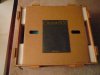
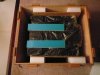
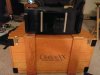
Those Citation amps are very nice. And, the XX is one I wish I could have gotten back in the day. Did you buy it new or used? When new, they came in heavy wooden crates, not cardboard boxes. A beast of an amp. This alone certainly makes you a superampman.
Those Citation amps are very nice. And, the XX is one I wish I could have gotten back in the day. Did you buy it new or used? When new, they came in heavy wooden crates, not cardboard boxes. A beast of an amp. This alone certainly makes you a superampman.
Superampman
AK Member
Ah, that makes sense. HK was the champion of the "high-current" amp designs, and advertised them heavily. We actually had a pretty nice discussion of them a few years ago. Many people feel it is a bogus claim, and just ad copy. I feel it is a very good figure-of-merit to describe an amp's capability and design. But, you never get to enjoy a burst of 200A in real life. This peak current is available only if you short the outputs right at the speaker terminals of the amp. It is a measure of the robustness of this amp. You could use a 1 inch length of 22ga wire, but I'm not sure just how long you'll get the peak current. May not be long enough to fuse the wire. I used to use a 5V 200A DC supply and put short lengths of solder on its outputs to watch it vaporize the solder. The thrill only lasted once or twice.
Those Citation amps are very nice. And, the XX is one I wish I could have gotten back in the day. Did you buy it new or used? When new, they came in heavy wooden crates, not cardboard boxes. A beast of an amp. This alone certainly makes you a superampman.
It is a very nice amp. I bought it off the bay a couple years ago. It is close to pristine. I later got back in touch with the seller for a back story about it. He apparently was the dealer who received it after it was retired from the US audio show circuit in 1980. He said Matti Otala himself calibrated it in preparation.
Superampman
AK Member
Here is an exerpt from the brochure:

maxhifi
Addicted Member
I use two 14g cooper speaker wire split then twisted resulting into 11g relative then twist those two pairs into one for the run. These make it so much easier to swap out components and speakers, and certainly (feels) better. I use three strands braided to 9g for subwoofer runs. Total cost for each pair of 12ft cables is $33. In most speaker builds and restos I use 16awg stranded cooper inside the cabs. I do believe that higher end point source highly efficient drivers benefit from expensive silver wire or what have you given the delicate nature of the design.
View attachment 923587
I'm not an electrical engineer, this is what I found online. All this aside I would assume the construction of the wire delegates resistance and of course how long the run is.
100 watts at 110 volts = .909 amps
awg (lamp cord)= 10amps
#14 awg (typical house wire) = 15amps
#12 20amps
#10 30amps
# 8 (stove cable size) = 40amps
# 6 (feed to your 251 or syncro 200) = 65 amps
# 4 70amps (conservative)
# 3 80 amps
# 2 100amps
# 1 110amps
0 (one ought) = 125amps
00 (two ought) = 145amps
000 = 165amps
0000 = 195amps
250 Kcmil* = 215amps
300 Kcmil* = 240amps
350 Kcmil* = 260amps
400 Kcmil* = 320amps
anything bigger than this and you'll need a hydraulic bender and a forklift to drag it around...
Note that those values are from the electrical code, and are based on not exceeding the temperatures rating of the wire's insulation. Good to know but not really relevant to speaker wire, with speaker wire there's other issues at play.

MikE
Color Me Gone
- DIY speaker "cables" 24awg (5n) 99.999% pure silver / 20awg Teflon. 10' runs.
- Silverline Audio Conductor is made of pure copper and the dielectric is using flexible PVC, outside jacket is in midnight blue approximately ½” in diameter, it consists of seven small groups, one of which is flexible PVC core for absorbing the excess resonance within the cable, the rest six groups divided into three group in red (+) and 3 groups in black (-), each of the group consists multi-strands at a 16 AWG. In other words, 3 x 16 AWG for red and 3 x 16 AWG in black. (app. 12 AWG for each polarity). 10' runs.

Attachments

Last edited:

Thrill Kille
Active Member
The Relevance of this Thread is in my OP. and my post #32 as I explain why I'm doing what I'm doing. Everyone else keeps talking about high voltage and 10, 15, 20 amp this and that. What that has to do with my OP and #32, I just don't know.I fail to see the relevance to this thread, but I'll play along. If you're saying from a +peak to a -peak (valley), it varies depending on the frequency being amplified. 50Hz is 10ms. 10kHz is 50us. If you're saying from a +peak to a +peak, it's double these times. On the surface, doesn't seem to be related to gauge, which is the topic at hand here.

musichal
poet emeritus
The Relevance of this Thread is in my OP. and my post #32 as I explain why I'm doing what I'm doing. Everyone else keeps talking about high voltage and 10, 15, 20 amp this and that. What that has to do with my OP and #32, I just don't know.
At least folks aren't discussing bacon. That's a good sign.
Superampman
AK Member
Relax buddy. If you haven't gleaned all the info you asked for yet, you haven't been reading the thread.The Relevance of this Thread is in my OP. and my post #32 as I explain why I'm doing what I'm doing. Everyone else keeps talking about high voltage and 10, 15, 20 amp this and that. What that has to do with my OP and #32, I just don't know.