• Please note that Audiokarma will be offline briefly for updates early on Monday morning, September 28th.

Starting a 400 restoration...thoughts??

Calvink100

Active Member
Hello,

I purchased a nice late model (77030) Fisher 400 tube amp this weekend. Estate sale, attic stored and missing two input tubes. Very complete, original tubes mainly Fisher, RCA, and telefunken. I just finished the cosmetic cleaning (looks mint compared to the before pictures I posted) and have not brought it up on the variac and plan on doing so before I start the restoration. I am preparing to replace the necessary components and thought I would gain the AK communities insight before doing so because the restoration guides online vary from the basic to the extreme. I think I want something middle of the road.

My project vision for the 400 is to improve overall sound quality by replacing all electrolytic (excluding the cans) and mylar capacitors, focusing on improvements to the aux. and phono stage, and improve reliability of the receiver as far as longevity for the tubes.

I downloaded a document of instructions by Bill Howland for a late model 400 and his component list is as follows:

Capacitors:
.047 uF – 400v (4)
.047 uF – 600v (2)
1 uF – 350v (1)

Resistors:2700 Ohm – 1/2 W resistor (1)

Other:
Silicon Diode 1000v PIV 1A (1N4007 or equivalent) (2)
CL80 current inrush limiter

Does anyone see anything other components to change in order to obtain my project goals?

I know fisher doc encourages 10 ohm 1/2w resistors on the cathodes. What are your thoughts on that?

Thanks in advance!
 
Last edited:
Register to hide this ad
Why would you not want to consider replacement of the can caps -- unless you already have? From a long term durability standpoint, these are as important as replacing nearly 50 year old coupling caps that could leak.

With the inconsistent quality of tubes today, the small cathode resistors are as important in helping match output tube performance as they are acting as a fuse in the event of an internal failure of the tube.

Also, some method of adjusting the quiescent current of each output tube is extremely desirable in getting not only the best sound, but the longest tube life as well.

There are a number of extremely knowledgeable folks here on the Fisher forum, who can answer virtually any question you might have about your 400, from the history of its beginnings, to why the circuits in it are designed as they are, to literally anything in between.

Welcome to the AK Fisher Forum!

Dave
 
Mr Howlands Document is a decent primer for the 400. PRESUMING A WORKING UNIT with Can capacitors that don't leak, electrically or physically, he DOES NOT address updating Safety items like the "Death Cap" (see below), the Bias Supply or using original value coupling caps and grid resturn resistors with new stock output tubes. He did not describe where he used that 2.7K 1.2W resistor (1 of 4 places). It's basic, and doesn't get into a FULL RESTORATION. Piecemealing it will keep it on the bench more than on the shelf working.

What you are suggesting on doing is like taking a 45 year old car that's been sitting for 30 years, changing the oil filter, hot shotting the battery, putting air in the dry rotted tires, and then expecting it to go across country on the interstates. It might make it around the block, but it's gonna run like crap and it ain't gonna be happy about it either.

The following is a genral overview. Not intended as a complete restoration guide. But Most if not all the baiscs are covered (as much as I can remember without a unit in front of me).

The can caps you'll find will probably be ok for the short term, unless it hums when you bring it up (Use a DIM BULB TESTER with a 150W bulb!) then you'll need can's immediately. The POWER SUPPLY MUST be operating 100% for you to get the most out of the rest of the unit.


Overhaul the POWER SUPPLY correctly. Once it's done, then you concentrate on the output section to make sure that it's stable (the bias voltage is highly dependent on the condition of the BIAS supply caps and the Rectifier.

Most of the rehabilitations done here are basically done with Tube longevity in mind, with proper operation AND the ability to use both old stock and NEW stock tubes. Also in the 10 years since Mr. Howland did his STUDENT paper there has been a lot of r&d on the 400, to the point where the Basic Overhaul done today is lightyears ahead of rehab's done even 5 years ago. Having said that.......the 400 I just did, was a basic middle of the road restoration that preserved the original sound, and kept it as original as possible, but upgraded it to be able to use any tube that is currently available, or available in the near future. Plus it will last another 30 years without opening it up except to rebias new tubes.
This should be considered the bare minimum (without the BAL/BIAS board) restoration on a unit you have no or very little operational history on.
See thread "Yet another high serialed 400 rehabilitation.

OUTPUT SECTION.
1.) 10ohm Cathode resistors. Act as fuses when the tube starts to go Chernobyl, and shuts the tube down, thus protecting the OUTPUT Transformer. Plus you can determine tube draw across the resistor. MUST HAVE

2.) 100ohm Screen Resistors. Read this article by Dave Gillespie. It addresses the cathode resistors, screen resistors, and generally most issues that need to be addressed. MUST HAVE.

3.) Change the OUTPUT COUPLING CAPS to .068 to .1uf and the 330K grid return resistors to 200K-220K. This allows the new tubes to operate up to their full ability and the old tubes to work less hard.

PHASE INVERTER SECTION.
See the STICKY thread on Adjusting Phase inverters on a 400. You'll need to do this to get the most out of it. REPLACE resistors with 1% metal films to get the best results. The 400 rehab thread lists them.

MPX section. DO NOT TOUCH EXCEPT FOR 1 CAP! that cap is a 1uf/350V electrolytic. REPLACE IT with a 1uf 400V Panasonic ECQ Film cap or the film cap of your choice. It's tight in there so don't get an ORANGE DROP, it WON'T FIT!

Tone sections replace the electrolytics. I'd leave the EROFOILS ALONE in the Tone Section (the other 2 400V orange drops in HOWLANDS treatise) The one's you want to replace look like little brown dog turds. Any Black plastic caps with stripes (bumblebee type), Get rid of.

POWER SUPPLY.
1.)Replace the BIAS SUPPLY DIAL CAN CAP in the clamp (the big orange cardboard covered one). 2 50V/2200uf electrolytics minimum
2.) Replace the diodes with UF4007's.
3.)Only one of those 2 .01uf caps in the power supply is a "DEATH CAP". From the back of the case the closest one is the "Death Cap" replace with a X-Y cap rated for 300V AC (1000VDC). The other can be replaced with the film cap of your choice.
4.) The 1.2Kohm 7W resistor(BIG GREEN MONSTER) between the Center output tubes is part of the POWER SUPPLY. REPLACE IT with a OHMITE of the Same value but 10W. IIRC it's R41. Based on the 48001 and up manual. The 400 rehab thread has some info on this particular part.

The total PARTS cost for this rehab was UNDER $185.00(including the CAN CAPS from Hayseed Hamfest, and a total mouser order). For an IBAM board or the BAL/BIAS board both of which I highly recommend, add about $10.00 more. If you stuff the CAN CAPS with individual caps you can save about $85-$90 of that $185, Also you can install the individual caps to replace the CAN sections underneath.

If you're gonna get it running, it's best to do it right, at the outset. There are ton's of 400 threads, and ALL of them have the basics, most of which I outlined above. The only "non factory circuit" in that 400 i just did, was the BAL/BIAS board. I consider the Screen, and Cathode resistors as an improvement to the original circuit not a mod. Same with the Grid Return resistors and the output coupling caps.

Just replacing the output coupling caps, the Tone circuit couping caps, the HV rectifier diodes, and one or two resistors is NOT a restoration, but it's a start.
 
Thanks to both of you for responding so thoroughly to my initial post. I think both of your responses truly understand what I want to do with the Fisher (that rarely happens when posting!).

So let me respond to dcgillespie first: I often see two opinions on the cans, some say they rarely fail and others just replace them right away. My plan was to bring it up on my variac and just see if they leaked, however, I might just go with replacing them while I am there.

Next to larry: Great information. I agree, after reading Howland's paper I felt it had useful information, however, it was not as extensive of a restoration I need to do for my non-operating 400. I appreciate your car analogy, my first car was a 66 F-100 truck and it seemed there was a new problem every week to fix for about a year because I never did a complete overhaul!

You totally understand what I want to do with the 400. I want this one done right and reliable because I am planning for this to be my daily driver with my Heresy I's. I love my kx-100 but the thing runs way too hot and there is little information out there if I need to do future repairs.

I am going to digest your advice/information over the next few days as I draw up my parts list. If I have any questions I will post them.

Thanks to both of you....I am glad I posted the question!
 
Cal -- you can find all the information you will ever need about your KX-100 on this forum.

As to the PS cans -- it really depends on how involved you want to be with your equipment. As a general rule, I recommend that you replace them, because due to their age, they WILL go bad at some point if they haven't already. Maybe they're good now, and will last for some time. But if they go bad a year from now, that's soon enough for most people to have wished they had replaced them when they were in the unit a year earlier.

Personally, I'm pretty involved with much of my equipment because I like to be, so in that equipment, I don't always automatically replace the PS caps if they're currently good. With such involvement, I can virtually always catch them before they decide to go. But for equipment that I want to restore and enjoy without any further effort, they automatically get replaced. As a general recommendation then for those who aren't always working with their equipment -- or don't always want to be -- then replace them, and then you won't have to worry about them for another 50 years. The point is, know the involvement level you wish to have. If they're current good (measure good, low ESR, ect.) and you want to watch them, then fine -- as long as you watch them.

I hope this helps!

Dave
 
Hello again,

I have been cleaning, and ordering parts for my 400 restoration. After reading Larry’s “High number 400 rehabilitation” thread (phenomenal pictures and insight on a proper 400 restoration, helpful and inspirational), I have decided to follow very similar steps and perform the restoration and upgrades he described in the thread.

So my current progress is that I SLOWLY brought the Fisher 400 up on the variac all day yesterday starting in the morning and reaching 117v variac input by 5 pm and let the Fisher idle for about three hours at 117v. Plugged my Ipod into the AUX and my Grado headphones into the jack and it sounds GREAT!
A fter 2 hours took some measurements off V17 with my Fluke tester.

Pin 1-366.8 VDC
Pin 2-16.8 VDC
Pin 4-3.1 AC
Pin 5- 3.1 AC
Pin 9 399 VDC

I checked the other output tubes and they were all the same or close to V17 measurements.

Does anyone see measurements that are out of line?

Some minor issues:
-At high volume (no music playing) there is some faint ocean wave sounds in the right channel on AUX.
-The phono section has distinct ocean wave sounds.
-FM mono sounds great, however the FM Stereo sounds terrible, even with an antenna wire.
Questions:
-What causes those wave sounds? Resistors, caps, or input tubes?
-Is the terrible FM quality an alignment issue or poor components on the FM section?

Later I connected speakers and an Ipod for some quick testing. Sounds great, much bigger and richer sound than my KX-100. The trannys ran barely got warm after listening to most of Dire Straits “Making Movies”.

One issue: I did start to notice that the left channel sounded weaker than the right. The left was clear and not distorted, but it was about ¾ the volume as the right speaker. I swapped the output tubes around (as pairs) and the speaker wires (incase it was my left speaker and not the amp). None of these helped. When listening on headphones, both channels are equal and sound great. This would lead me to think it was somewhere in the output section.

Question: Should I try and fix this problem before the restoration? If so, where should I start? It doesn’t seem to be a tube issue...

As I finalize acquiring my component list, the only parts I have not bought yet are the bias board and components that were shown in Larry’s 400 rehabilitation post. I would like to do the same type of bias board. I am not sure of the components to purchase and how the components are wired on the board. Could I have clarification on this part of the restoration?

Also, it seems that due to the new bias controls board C42, R34 and R35 were removed. Am I correct in thinking this?

Thanks in advance!
 
Cal -- you can find all the information you will ever need about your KX-100 on this forum.

Thanks for the advice Dave, I have noticed that since I bought my KX-100 in 2007 there is a ton of information on here. I am looking forward for this to be my next up grade project.:thmbsp:
 
Hello again,

Some minor issues:
1.)-At high volume (no music playing) there is some faint ocean wave sounds in the right channel on AUX.
2.)-The phono section has distinct ocean wave sounds.
3.)-FM mono sounds great, however the FM Stereo sounds terrible, even with an antenna wire.
Questions:
4.)-What causes those wave sounds? Resistors, caps, or input tubes?
5.)-Is the terrible FM quality an alignment issue or poor components on the FM section?

6.) Also, it seems that due to the new bias controls board C42, R34 and R35 were removed. Am I correct in thinking this?

Thanks in advance!

Answers in order of questions

1&4.) If you do not have a shorting plug in the AUX it will sound like a wind blowing thru rushes. At high volume this is normal. It will attenuate a bit with new caps, and resistors when you rehab it.

2&4.) Same as AUX but the phono section has an additional stage of amplification. When you put shorting plugs in it should go away, same as Aux. If it doesn't a rehab on it will help to reduce it in a NO SOURCE mode.

3&5.) This is due largely by 1 capacitor(C210 on the MPX). it's a 1uf 350V electrolytic on the side of the multiplex circuit. Replace it with a 1uf 400V film cap (bipolar is ok here, it won't hurt anything). Problem solved.

6.) YES. The new board is self-contained and compensates for the loss of those parts. You can pull the diagram off the thread "alternate BIAS Board for 800" or words to that effect. Diagram here......... http://www.audiokarma.org/forums/attachment.php?attachmentid=523457&stc=1&thumb=1&d=1404229773
It works well on the 400. Suggest you get multi-turn pots instead of single turn pots. Easier to dial in.
 
Last edited:
Great advice on the shorting plugs, I figured new resistors and caps would help reduce the intensity of the noise, however, I never would have considered the plugs.

I found the thread for the bias board..adding the parts and multi turn pots to mouser list #2.

Also, glad to hear that the stereo issue is that cap, I bought the Panasonic you suggested in your earlier post.

Do you think my weak channel issue will also be solved in the rehab?

Thanks

-Drew
 
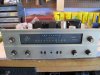
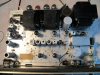
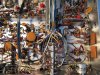
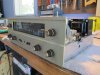
Also here are some pictures of the amp after the clean up. Not a blemish on the face panel, glass (it was so clean I didn't even have to clean behind it and risk wiping off lettering). The chassis is a 8/10, no rust or loss of lettering. Underneath appears to be never bastardized, or repaired.

A good candidate for a restoration!

I made a custom cabinet for my KX-100 out of solid birch (last pic), thinking something exotic like curly or tiger eye maple for the 400 down the road...:D
 

Attachments

  • IMG_0219.jpg
    IMG_0219.jpg
    80.3 KB · Views: 53
  • IMG_0222.jpg
    IMG_0222.jpg
    105.2 KB · Views: 56
  • IMG_0197.jpg
    IMG_0197.jpg
    140.3 KB · Views: 60
  • IMG_0224.jpg
    IMG_0224.jpg
    65.4 KB · Views: 51
  • IMG_0087.jpg
    IMG_0087.jpg
    69.3 KB · Views: 59
May as well do it right and now while you're in it. Listen to the guys here and you won't be sorry. It's like an old car--you want to hear it run, not spend time under the hood. Stuff isn't getting cheaper or more plentiful, either. And the knowledge base is also a limited resource.

My 2 cents that cost me plenty. I've got so much in the rca mark I, I could have bought a Lincoln mark l.
 
I hear you, big buck audiophiles lay awake at night worrying about their out of the box systems, us vintage tube guys need audio therapists to help us with our irrational fears! I guess thats what AK is for!
 
Tube gear is not made any more, at least not like it once was. You're looking at old and proven technology built at a time when America made the very best. Of that, Fisher was one of the top.

Do it once, do it right, do it yourself and learn. Enjoy the process and the rewards. Pass your knowledge on and your 400 will become a family heirloom.

Right now, I'm listening to Ella Fitzgerald on the r2r in the console. Enjoying every note. And, if something goes bad, I know the Fisher group here will help me get it back to snuff.
I learned how to recap amps and tuners from the people here.

I employed professional shops with less than satisfactory results. An AK membership is money in the bank.
 
I couldn't agree with you more. AK is truly a democratic institution within the audio world. If Thomas Jefferson (a great supporter of personal improvement through education and a master at the art of conversation) was alive today and an audiophile, he would have loved the AK forum!

There is something to be said about the way that tube gear was built and designed in the 60's, it was designed to be maintained and repaired when broken. Skillfully point to point wired and assembled with screws and rivets, 60's tube gear just begs to be maintained and troubleshooted by the owner.

I just wish there was more people my age (late twenties), who were into this stuff! I recently was at a picnic and someone asked what projects I was working on and they just GLAZED over when I began telling them about my 400 project...then pulled out their Iphone haha.

It just occured to me, if anybody is on the east coast, there is a great radio show coming up at the Kutztown PA Reddinger's Market heres a link: http://www.dvhrc.info/kutztown.html Great show, good flea market as well.
 
My first tube radio came with my '57 Cadillac. I was 23 when I bought the car. I'm 45 now. More young people are appreciating vintage gear I think than before. It's not their parent's; it's their grandparent's era. Quality never goes out of style. It was an investment then and still holds value today. Solid state from the '70 or '80 will never appreciate like tube gear from the Avery Fisher years.

When I got the car, some of the old car guys wondered why I wasn't driving a '70 Vette or Mustang. It's what I wanted. I didn't buy it for them. I bought it for me.

Hope to see you at the show. I live about a half hour from Quakertown.
 
Nice! A '57 Cadillac convertible was my dream car as a kid. My daily driver in high school ('05) was a 1966 F-100 short bed, black with the chrome trim and a red interior. I had a 427 big block with 4:11 gears and a limited slip rear...it was lost on my Jetta driving classmates. Same thing though, I busted my knuckles on that thing for my interest only.
I luckily found a wife that gets it. Likes old cars, loves tube stereos and records. Its always nice to come home from work and hear Chuck Berry cranked!

Ahh glad to hear you are going to the meet! I live close by Kutztown near Cabelas (I used to skip class and go to the Friday opening to get deals when I attended Kutztown University).
Look for a skinny guy pushing a stroller searching for 7868's, that will be me!

-Drew
 
I used to drive around in a 72 Eldorado and a 71 Coupe Deville. I had them both on the road at the same time. That was about the time I really started to build up my vintage tube gear collection. Now I drive around in a 2000 Grand Marquis (winter car), an 07 Grand Marquis and a 1970 Oldsmobile Cutlass.
 
Last edited:
Just think how much we've spent on gas and electricity! Gotta go nuts somehow.

Drew, not sure which day I'll be there but I will. Hershey for car stuff and Quakertown for radio stuff.
 
WalyFd. Do you use phone books to sit on to see over the dash?????? My neighbor had a 56 when he was a MSGT in the Army back in the 60's. He's 5'3" and had phone book on the seat and wood blocks on the pedals. LOL!!! He got a Hyundai now and when I get in it to drive it's like putting a size 13 foot in a size 3 shoe. Seat has to go all the way back, wheel up so i can clear my knee's, etc. Even have to take off my ballcap as it rubs on the roof. Thank god my S-10 has plenty of room in the cab. I'd kill for a 63 Impala Hardtop coupe with a 409 and 4 spd or a 327 and Powerglide. YUMMY!!!
 
Back
Top Bottom