• The move to the new server is done. There are some software and database maintenance updates in process. This has us passing the hat around to help out. We appreciate any donations. Seriously, even a dollar helps. The payment page may be found here - https://www.audiokarma.org/support.html

SX-1250 Restoration

Well .... the fat lady can't sing yet. :(

Hooked up 5.1kOhm and turn down the volume to lowest. VR2s are set to most CCW position.

R channel - VR1 offset is 2.5mV
L channel - VR1 offset is unstable (jumps around -80mV to +100mV)

Tried turning the VR1 one turn on the L side but it doesn't help. Should I try turning it more?
The concern I have is not that the offset is wrong, it is jumping all over.

Please advise. :confused:
 
First likely culprit for noisy unstable 'dc offset' is the differential amp transistors Q1, Q2 on the AWH-048. Have you replaced those with a Vbe matched pair? It certainly would not hurt to use matched pairs for current mirror Q5, Q6. If Q3, Q4 are noisy that could cause the instability as well.
 
One could try swapping the 2sa798 duals around to see if the problem follows the devices or just do as suggested above.
It could be the DC offset pot as well or the devices or as said above.
 
The manual shows a pair of 2SA750s in the Q1/Q2 positions. They have a reputation for static generation, and you may be experiencing the manifestations of that. KSA992s will work there.

Another area of concern on the AWH-048 boards is C1, the leading coupling capacitor into the differential pair. It could be one of the infamous CSZA "capsistors" if the factory was subbing parts from inventory, and breakdown of that could drive voltages to the differential pair all over the place. C11 is almost certainly a problem child, and since it's tied to the output emitters it could be pulling the voltage around.

Of course, whatever happens to one of the channel amps should probably be addressed in the opposite channel amp, before it becomes a problem.
 
Thanks Gents!
I did change the Q1 and Q2 with KSA992s. But they weren't matched.
Q11 and C11 were also replaced with KSC1845 and WIMA 5% film cap respectively.

@merlynski I will check Q3 to Q6 and replace them with equivalent parts - one pair at a time. Will also find Vbe matching pair for Q1 and Q2.

@rcs16 I couldn't find 2sa798s in the schematics of AWH-048. Which board should I look for them?

@Watthour C1 is a big bulky orange looking myler cap. I could find 1uF 100v equivalent film cap and see if that fixes the issue.
 
Folks ...

Careful inspection of the board showed a cold solder joint on one of the legs of C18. Fixed that and now VR1 offset is stable and I was able to dial it to 0v.

Thanks again for the suggestions. These made me take it slow and check thoroughly at each step. :bowdown:

I will get back to bias adjustment after working on my day job to pay for this expensive hobby. :D
 
Last edited:
Did a lunch break bias tuning. Both L and R channel now set to 0v on VR1 and 100mV on VR2.
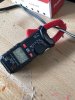
The idle current draw "may be" around 8mA based on this clamp meter.
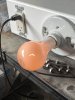
DBT glow as the VR2 bias gets closer to 100mV.

Took off DBT, hooked up a set of speakers and viola! Music! ......

HOWEVER, noticed that L channel has a short burst of faint static after second relay click. It dies off in a few seconds but it is clearly noticeable.
ALSO, the L channel sound is weaker.

I suspect the L AWH-048 board as some issue. The bias issue was just icing on the cake.

Will continue with the plan to fully upgrade the components on it - one at a time.

Here is the list of replacements I am planning to use the followings based on markthefixer list-

bias / vas
2sa858/2sc1439 to-92 ecb 150v 0.5a .5w 100mhz hfe:150 better off if the

512-KSA1013YBU to-92L ecb 160v 1a .9w 50mhz 160-320hfe $0.17 (R=60-120, O=100/200, Y=160/320)
512-KSC2383YBU to-92L ecb 160v 1a .9w 50mhz 160-320hfe $0.17

pre-driver
2sa899/2sc1904 to-126 ecb 150v .05a 1w 100mhz hfe:150

512-KSA1220AYS to-126 ecb 120/a160 1.2a 20w 155mhz 35-320hfe $0.39 (R=60-120, O=100/200, Y=160/320)
512-KSC2690AYS to-126 ecb 120/a160 1.2a 20w 155mhz 35-320hfe $0.40

drivers
2sb630/2sd610 to-220 bce 200v 2a 25w 4mhz hfe:80

512-KSA940TU_Q pnp to-220 bce 150v 1.5a 25w 4mhz 40-140hfe $0.54
512-KSC2073TU npn to-220 bce 150v 1.5a 25w 4mhz 40-140hfe $0.54

Going to save the cost on the output pairs for now.

L and R Bias
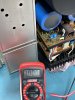
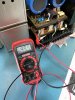
File_000.jpeg File_001.jpeg

Idle current and 200w DBT glow
File_002.jpeg File_003.jpeg
 
Turn the bias down from your 100mV measured on DBT of course, or you are going to be too high on house power.

Edit - in fact, it's been recommended, and I found it to make zero audible difference to run these at 80mV vs 100mV.
 
Last edited:
@the_burmese FYI, an AMPCLAMP meter around a two conductor cable like in your picture will not provide a valid reading, as the current in one conductor is flowing the opposite direction in the other conductor, so the resulting magnetic fields cancel. If you separate the the two conductors (split the plastic between them) and put the clamp around 1 wire only, then you will get an accurate measurement.
jerrycpor is correct about setting the bias back to minimum. You can do testing for function and adjustment on DBT, but must reduce it to minimum before going to full house power. Once on full power set the bias, watch it a bit for stability, recheck dc offset, then try some music. Not meaning to be overbearing, but want you to be successful, and not have to start over by blowing up and letting out the magic smoke.
 
I couldn't find 2sa798s in the schematics of AWH-048. Which board should I look for them?
The 2SA798 is a dual PNP transistor used in a lot of Pioneer power amp designs, and it has a very mixed reputation, but I don't believe there are any in the SX-1250. I did not find any either. It would have been where Q1, Q2 diff amp is on the power amp PCB..
 
Alright, took it off the DBT. Set the VR2 biases to zero (all the way CCW). Brought it back on house power and waited for about 10mins.

Checked the stabilizer board biases - confirmed +/- 65v
Checked VR1 bias on L and R power amp boards - adjusted to 0v
Adjusted VR2 on L and R power amp boards to around 90mV (for now)

Monitor the VR2 for about 5 mins. It goes up another 2-3mV.

Powered off. Connected the jumpers and speakers.

I realized that the left channel issue may be due to volume knob. The left channel makes a very faint sound even though the knob is turned all the way down. And I could tap a little to make it go away.
I am worried that the pot may be damaged from the impact that had caused twisted knobs on this unit. I will try detoxit tonight and see.

Once the volume is turned up, then both channels are making good sound now.

I am still trying to check again for the faint static heard on the L channel right after the second relay click for a few seconds. It is not clear at this moment.
I also found that the VR2 biases takes a while to get to 90mV from cold start. It seems like 3-5mins. Is this expected?
 
Alright, took it off the DBT. Set the VR2 biases to zero (all the way CCW). Brought it back on house power and waited for about 10mins.

Checked the stabilizer board biases - confirmed +/- 65v
Checked VR1 bias on L and R power amp boards - adjusted to 0v
Adjusted VR2 on L and R power amp boards to around 90mV (for now)

Monitor the VR2 for about 5 mins. It goes up another 2-3mV.

Powered off. Connected the jumpers and speakers.

I realized that the left channel issue may be due to volume knob. The left channel makes a very faint sound even though the knob is turned all the way down. And I could tap a little to make it go away.
I am worried that the pot may be damaged from the impact that had caused twisted knobs on this unit. I will try detoxit tonight and see.

Once the volume is turned up, then both channels are making good sound now.

I am still trying to check again for the faint static heard on the L channel right after the second relay click for a few seconds. It is not clear at this moment.
I also found that the VR2 biases takes a while to get to 90mV from cold start. It seems like 3-5mins. Is this expected?

Looks like you have a good handle on it.
The bias being a bit low while still cold is OK, the problem comes if it warms up and runs away. On one I am working on, once I am happy that the bias is stable on full power I like to play music and really warm it up (not hot) then turn off the input , turn down the volume and check the bias again. I have two voltmeters so I leave the mini-grabbers connected to both channels while playing the music, so as soon as it goes quiet, but is still warm, I can read it.
The small rustle sound you are hearing at start up is probably a power supply still settling in. Does the sound last very long? The relay may be clicking a bit fast, is it quicker than 3 seconds?

It may well be the volume control is damaged, the tap to quiet it makes me agree with your assessment.

Keep up the good work!
 
ok i just realized that 1250 used sealed volume pot. Cant clean it. It seems Mark might the right guy to fix the unfixable? :D
 
@merlynski The small rustle sound you are hearing at start up is probably a power supply still settling in. Does the sound last very long? The relay may be clicking a bit fast, is it quicker than 3 seconds?

Nope the sound lasted only a second or two. And it doesn't happen if I do a warm start (power on, warm up, off and on again). The relay is quite faster than original - I'd say it is right about 3 seconds now.
And I used to hear two distinct relay clicks. Now it seems like a single click only.
 
ok i just realized that 1250 used sealed volume pot. Cant clean it. It seems Mark might the right guy to fix the unfixable? :D
I don't know about that, he is very resourceful. I have not seen one on AK that was repaired, but there is always a first time.
Is that a stepped attenuator? Looks like it from a front panel picture. I have not had my hands on an SX-1250 yet. Almost got a fixer-upper this fall, but the seller backed out.
@merlynski

Nope the sound lasted only a second or two. And it doesn't happen if I do a warm start (power on, warm up, off and on again). The relay is quite faster than original - I'd say it is right about 3 seconds now.
And I used to hear two distinct relay clicks. Now it seems like a single click only.

The soft start relay sometimes is so quick is is almost masked by the power switch click, this is not a problem.
The fact that a warm restart does not exhibit the noise problem reinforces my opinion that it is a power supply, because the caps don't have time to discharge on a warm restart.

Did you do a complete rebuild of the Protection circuit?
 
You put a 100µF cap in for C4? That and R16 are the primary timing components for the startup delay.
Lets not get offtrack, finish the power amp stuff, then come back to Protection if necessary.
 
Back
Top Bottom