
That means it is Frat House Approved!Oooh, its got "Delta Sigma Drive"!
... don't know what that means but it sounds cool.



That means it is Frat House Approved!Oooh, its got "Delta Sigma Drive"!
... don't know what that means but it sounds cool.

The cult was here in Canada also... and it still lingers somewhat. When the world discovered PRaT and I discovered nothing.Look, during the dark days of the 1980s LP12 cult nonsense, we didn't get any decent Japanese turntables in the UK. It's only right that the balance is redressed a bit!


Thanks, for the review!I thought I would revive this old thread with a quick review of the New GR2 I bought for my B-Day. My first turntable was (still have it) an old CEC made Marantz 6200 mid grade table that is dead reliable but was "meh" in sound, which I fixed with an AT-VM95ML cart and an Oyaide BR-12 mat- its now decent sounding (comparable to a $600 Audio Technica table).
I wanted something better and went with a Project Debut Pro that was quickly sent right back (overpriced POS) in exchange for a Rega P3. The Rega went through all the usual upgrades of sub platter, belt, PSU, better cartridge, and finally a whole new acrylic plinth (SRM Tech "Azure") using just the RB330 tonearm and motor. This one sounds excellent with a AT-VM540 /740ML cartridges. But it is not easily adjustable so I thought I would try a direct drive TT with detachable headshell and adjustable VTF which leads straight to a Technics table.
I looked at ALL the tables Technics makes and decided that the 1200G was too much coin at over $4K, but the new GR2 at half that looked pretty good- except for that ugly industrial/DJ appearance. I found a guy in Spain who makes wood plinths that slip over the top and cover up the ugly black portion of the plinth, turning it into something I (and the wife) could look at in the living room everyday.
The table arrived and I was surprised that it was built like a Tiger tank- the complete opposite of the Rega minimalist vibe. It turned out to be the easiest table to set up I've ever played with, and the speed is near perfect with no detectable fluctuation (my cell phone app shows 33.34 rpm, 0.015 W & F). I put brand new a VM-540ML on it and loved the sound right away, but yesterday I swapped it for the well broken in VM-740ML (100 hours) that was on the Azure TT. The 740ML is just slightly more refined and subtle- it takes off the edge of the brand new 540ML.
The GR2 has deeper bass, the same clear open mids, and airy highs. I have the Azure hooked up to a Parasound JC3JR phono amp with built in 150pF capacitive load and the GR2 paired with a Schiit Skoll set at 50pF - the capacitive load is very important with the 540/740ML carts, anything over about 220pF total can cause a noticeable 3db bump in the highs. The GR2 is using Blue jeans LC-1 cables and the Skoll set to 50pF, so there is about 100pF total. The Azure arm was rewired by Brit Audio and has a very low capacitance. keeping it around 200pF total with the JC3 Jr.
The Rega P3 based SRM-Tech Azure "space ship" is a nice to look at table that sounds much better than the stock P3, nearly exactly like the 1200GR2, and in the end they both cost about the same, so I'm kind of wishing that I had forgone the Rega experiment and went with Technics first. The Rega RB330 is a better arm but the rest is inferior- the Rega light weight construction and puny motor compares like a plain Chevy to the Cadillac quality of the GR2.
View attachment 3205977View attachment 3205980View attachment 3205981View attachment 3205982


The GR2 has deeper bass, the same clear open mids, and airy highs. I have the Azure hooked up to a Parasound JC3JR phono amp with built in 150pF capacitive load and the GR2 paired with a Schiit Skoll set at 50pF - the capacitive load is very important with the 540/740ML carts, anything over about 220pF total can cause a noticeable 3db bump in the highs. The GR2 is using Blue jeans LC-1 cables and the Skoll set to 50pF, so there is about 100pF total. The Azure arm was rewired by Brit Audio and has a very low capacitance. keeping it around 200pF total with the JC3 Jr.


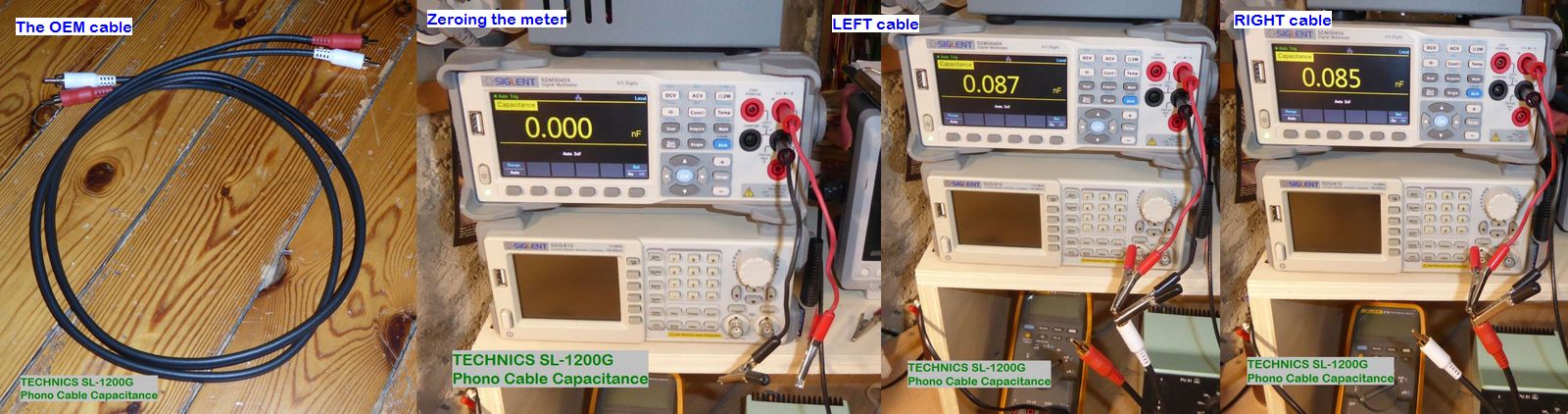
Try a set of Blue Jeans LC-1 cable, they say they have 11pF per foot (I have 39" ones so about 42pf total). Does your phono preamp have adjustable capacitive load? If so set it at the lowest one available (my Schiit Skoll has 50pF, 100,150, and 200 settings to choose from, I use 50pF).That's interesting, @krautmaster !
I have now a Technics SL-1200G turntable on which I installed an Audio-Technica AT-VM540ML :
I measured the capacity of the cables, and found 85-87pF :
I estimated that the capacity in the arm would be circa 25pF, and the input capacitance of the preamp at circa 100pF, so it gives 25+85+100=210pF estimated... I tend to find that the tone is bright (no matter the preamp used, tube or SS), while AT recommends 100 to 200pf for the VM-540ML.
Then I am at best in the high range of total capacitance (maybe over), so reading you, it may be an explanation of this brightness...
Is there a very simple mean to correct tentatively this capacitance, at least for a comparative listening test ?
T
I use the zero pico-farad setting for MC cartridges. --- using old-school Aquioquest cables.Try a set of Blue Jeans LC-1 cable, they say they have 11pF per foot (I have 39" ones so about 42pf total). Does your phono preamp have adjustable capacitive load? If so set it at the lowest one available (my Schiit Skoll has 50pF, 100,150, and 200 settings to choose from, I use 50pF).

Try a set of Blue Jeans LC-1 cable, they say they have 11pF per foot (I have 39" ones so about 42pf total). Does your phono preamp have adjustable capacitive load? If so set it at the lowest one available (my Schiit Skoll has 50pF, 100,150, and 200 settings to choose from, I use 50pF).


The Rega RB330 is a better arm but the rest is inferior- the Rega light weight construction and puny motor compares like a plain Chevy to the Cadillac quality of the GR2.
and/or try setting the cartridge tail down by turning VTF wheel down as low as it will go.

It won't decrease the capacitance at all, but it changes the angle that the diamond contacts the groove... with the nose down the stylus contacts the groove like this \ ... and with the tail down it contacts this way /... which changes the sound produced.I don't exactly see why this setting would reduce capacitance, @krautmaster : would you light me ?
T
It won't decrease the capacitance at all, but it changes the angle that the diamond contacts the groove... with the nose down the stylus contacts the groove like this \ ... and with the tail down it contacts this way /... which changes the sound produced.
Then I am at best in the high range of total capacitance (maybe over), so reading you, it may be an explanation of this brightness...
Is there a very simple mean to correct tentatively this capacitance, at least for a comparative listening test ?
T
Not sure what you mean with "C" and "L" and "Fo" and "Q" (maybe spell them out once?) ... My test records shows a resonant frequency of 8hz with the 740ML on the GR2Total C and cartridge L create a resonant circuit with an MM this is usually in the region of 14-18kHz. As C increases Fo decreases which can manifest as bright sound. Try lowering the 47kR load resistor with another resistor in parallel. This will not alter Fo but will lower the Q of the circuit smoothing the resonant peak. Ideally you would increase the Q so the peak was narrow but this requires replacing the 47kR resistor with a larger one and if you go too far it could cause ringing.
When I set my Grado up I used a couple of trim pots in parallel on the input to tune this then replaced them with fixed resistors once I knew the value.
That seems to be the "Goldilocks region" for most setups.Not sure what you mean with "C" and "L" and "Fo" and "Q" (maybe spell them out once?) ... My test records shows a resonant frequency of 8hz with the 740ML on the GR2
That is well beyond my hearing range, which pretty much drops off a cliff above 12 Khz (old age related)... Most MM cartridges this resonance is around the 14-18kHz region...