• The move to the new server is done. There are some software and database maintenance updates in process. This has us passing the hat around to help out. We appreciate any donations. Seriously, even a dollar helps. The payment page may be found here - https://www.audiokarma.org/support.html

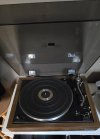
Tell Me About this Turntable

I've always thought that the AS force should increase the closer it gets to the center of the record to compensate for the force being generated by the inward movement of the stylus.....or maybe we're saying the same thing?
Inner groove distortion is a mix of various geometry problems that are prolly not as critical in the outer grooves. A/S setting is one, but alignment may be more critical. I think the tighter radius of the inner grooves makes azimuth misalignment errors more apparent, too.

Anyhow, proper alignment is key to good playback for the whole record.

:thumbsup:
 
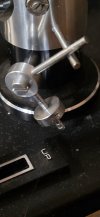
It looks in this photo like the lower rod is defying gravity. Is this an optical illusion or is it tightened in some way that keeps it against the other piece? Mine hangs freely and there does not seem to be a way to tighten it.
Try this: from in front of the turntable, move the tonearm as far as you can to the right. This should allow you to place the AS bar on the FRONT of the bar that extends out from the base of the tonearm. It will now stay in place as the weight on the other side of the bar you have just moved to the front will cause a clockwise force, which pins that bar to the other one.....hope that made sense.
 
I've always thought that the AS force should increase the closer it gets to the center of the record to compensate for the force being generated by the inward movement of the stylus.....or maybe we're saying the same thing?
I think you're right; as the radius of the grooves become smaller the closer it gets to the spindle, the greater the centrifugal force.
 
Inner groove distortion is a mix of various geometry problems that are prolly not as critical in the outer grooves. A/S setting is one, but alignment may be more critical. I think the tighter radius of the inner grooves makes azimuth misalignment errors more apparent, too.

Anyhow, proper alignment is key to good playback for the whole record.

:thumbsup:

Yes, I sometimes wonder about the importance of anti-skate. Some tables don't have a control over it. Even some Midrange unit's. My 50 year old Pioneer Rondo 2000 (AKA PL155A) actually swings toward the spindle and it still works fine. It might ruin the records though.

It may be the only problem with the fixed anti-skate on the earlier Rega RB220 Arms was marketing. In the real wold, fixing it at say 2 grams may have worked perfectly with a tracking weight in the 1.5 - 2.5 g weight. And it's likely most cartridges used would be in that range
 
Ok, so I've figured it out. The anti-skid weight is set. Still getting scratchiness on all of the used records I picked up yesterday. I'm going to run out in a bit to get a new or lightly used record so I can see if the problem is with the old records themselves. I've been trying 1.5 grams, 2 grams, 2.5 and 3. All are scratchy. The cartridge I have usually seems to go with 2.0 but I don't know the manufacturer of the stylus.

My guess is that all efforts to get there through cleaning the records alone will fail and the next step will be a new stylus. Given that I have a good cartridge, I'll limit myself to a stylus alone. The suggestion was made of four specific ones in the 11th post on page 1. Please feel free to chime in as to whether you think I should go with one of those or something else entirely. Thanks.
 
We should stay focused on getting the OP's table up and running; analysis paralysis of AS can be distracting, especially to a newbie.
No offence meant to any participant.
 
I've always thought that the AS force should increase the closer it gets to the center of the record
I don’t know how much AS needs to change for needle position but with all else the same, record playing a tone for example, with the only variable being record speed as it glides past the nail, I would think it would need more AS at higher (outer groove) speeds. But I’m not going to research or ai AS to learn more. I know it is a continuously moving target and tonearm attempts to correct it are a rough, generally fixed guess at best.
 
Just for giggles. Uploaded videos of my turntables. Tracking in the run-out à la part 2 of the Soundsmith video —the Frank Schroeder technique with the needle dropped onto a smooth surface, not the groove.

SME 3009 on a Sony 2251.

Stock OEM Technics arm on 1200MkII.
 
Last edited:
From reading the thread so far, it sounds like this turntable is fine.
The
main problem @Parallax982 has identified after playing a few(?) Records is some crackling and pops.
. When I played them, the sound was good but there was consistent light crackling from both speakers. I
I don't think that's because of antiskate, or any 'set-up' issues.
Occam's razor would suggest that this is attributable to the fact that the OP,
obtained some records at the thrift store.
Let's not over think this.
Other than the crackling, which is likely attributable to the condition of the discs, and not the player, did anything else sound off? Speed/pitch variation, Chanel imbalances? Anything else that struck you as off?
 
My guess is that all efforts to get there through cleaning the records alone will fail and the next step will be a new stylus.
Just be aware that a new stylus can make a record sound better, but the scratchiness you describe is not likely to be affected much by the that new stylus in a positive way. In fact, it might even sound worse since the new stylus should be picking up more information from the groove, including the "scratches" since these are physical defects (damage, caused by another object imparting a scratch in the vinyl) and will be there forever. Once it's scratched, that's it.....you will continue to hear that scratch.

So, just don't think that a new stylus will get rid of the noise you're hearing because it is highly unlikely the stylus that is causing it. It could very well, however, be in part dirt that has collected in the grooves and for that to be remedied I can think of no better method than ultrasonic cleaning. Anything stuck in the grooves that can be cleaned out is likely to improve the playback by reducing noise. I'd say your idea about getting a newer, conceivably better condition record and playing that to see/hear the difference is a very good one as it will tell you something about record condition as it relates to sound quality on your table. I trust you're starting to have some real fun here :rockon:
 
So, just don't think that a new stylus will get rid of the noise you're hearing because it is highly unlikely the stylus that is causing it. It could very well, however, be in part dirt that has collected in the grooves and for that to be remedied I can think of no better method than ultrasonic cleaning. Anything stuck in the grooves that can be cleaned out is likely to improve the playback by reducing noise. I'd say your idea about getting a newer, conceivably better condition record and playing that to see/hear the difference is a very good one as it will tell you something about record condition :rockon:
A good LP cleaning setup is a requirement for any vinyl playback.

:thumbsup:
 
And for the record My CEC BA 600 has a very similar, if not identical, anti-skate mechanism. 20260823_161259.jpg20260823_161025.jpg
Make
a note of the visible groove on the lower arm where the weight sits and the grub screw on the weight for repositioning it.
Please refer to this thread for details.
 
A good LP cleaning setup is a requirement for any vinyl playback.

:thumbsup:
I use a pocket microscope to view before and after cleaning my records. A record before cleaning, when viewed with naked eye, might look super clean. Look at the same record with a pocket microscope and you will probably see hundreds or thousands of tiny white specks of dust/dirt, both on the lands and in the grooves. After a thorough cleaning the number of specks seen should be zero...that is the goal.
 
And for the record My CEC BA 600 has a very similar, if not identical, anti-skate mechanism. View attachment 3823623View attachment 3823624
Make
a note of the visible groove on the lower arm where the weight sits and the grub screw on the weight for repositioning it.
Please refer to this thread for details.
Same anti-skate as the Realistic Lab 300.
Here is mine with a Realistic R1000E cartridge and a low hour Shure Hi Track nude elliptical stylus.
 
From reading the thread so far, it sounds like this turntable is fine.
The
main problem @Parallax982 has identified after playing a few(?) Records is some crackling and pops.

I don't think that's because of antiskate, or any 'set-up' issues.
Occam's razor would suggest that this is attributable to the fact that the OP,

Let's not over think this.
Other than the crackling, which is likely attributable to the condition of the discs, and not the player, did anything else sound off? Speed/pitch variation, Chanel imbalances? Anything else that struck you as off?
No, not at this point. It actually sounded quite sweet other than that. Like some of you have said, there's an intangible quality that's hard to explain. A sweetness that I don't get from Qubuz or other streaming services, even though I've invested in a nice DAC (Geshelli Labs J2 with 4499 chipset and Sparkos opams). I was running the turntable with my Fisher 400 and my Klipschorns. A sweet combination.
 
Just be aware that a new stylus can make a record sound better, but the scratchiness you describe is not likely to be affected much by the that new stylus in a positive way. In fact, it might even sound worse since the new stylus should be picking up more information from the groove, including the "scratches" since these are physical defects (damage, caused by another object imparting a scratch in the vinyl) and will be there forever. Once it's scratched, that's it.....you will continue to hear that scratch.

So, just don't think that a new stylus will get rid of the noise you're hearing because it is highly unlikely the stylus that is causing it. It could very well, however, be in part dirt that has collected in the grooves and for that to be remedied I can think of no better method than ultrasonic cleaning. Anything stuck in the grooves that can be cleaned out is likely to improve the playback by reducing noise. I'd say your idea about getting a newer, conceivably better condition record and playing that to see/hear the difference is a very good one as it will tell you something about record condition as it relates to sound quality on your table. I trust you're starting to have some real fun here :rockon:

It is fun. Ran out today and spent hours going through LP racks. Talking to store owners and just taking it all in.
 
And for the record My CEC BA 600 has a very similar, if not identical, anti-skate mechanism. View attachment 3823623View attachment 3823624
Make
a note of the visible groove on the lower arm where the weight sits and the grub screw on the weight for repositioning it.
Please refer to this thread for details.
That is very similar. Not identical but clearly both machines are from the same family.
 
Back
Top Bottom