• The move to the new server is done. There are some software and database maintenance updates in process. This has us passing the hat around to help out. We appreciate any donations. Seriously, even a dollar helps. The payment page may be found here - https://www.audiokarma.org/support.html

Tell Me About this Turntable

That's your anti-skate, and it should be actuated from the left side of the bar protruding from the tone arm. It ain't working right now.
@UncleAng is correct! Look at the user manual you were provided and you will see how it should be arranged so that it will actually work. Basically, it applies a force to the arm that counters the inward force towards the end of the record, essentially in an effort to keep the pressure on both the inside and the outside of the groove as equal as possible thereby avoiding (or seeking to avoid) inner groove distortion.
 
Hey @Parallax982......I sense just a bit of frustration perhaps creeping into this effort and just want to encourage you to take heart, maybe take a step back too, and you will surely succeed in making this a successful adventure! Especially with the fine assistance of the good folks here who have already provided you with much great information. Your approach is very sound and thoughtful, which is needed in matters such as this because as you say, there aren't a lot of pros available and even when you can find one the price of the service is typically discouraging for those sensitive to monetary outlays. You'll see, it will all come together for you in due time. There are lots of threads on AK that will help you with more specific tasks if and when you find it necessary to move in those directions. There is a literal "universe" of information, for instance, regarding setup of the table, the arm and the cartridge that will make fine-tuning things much less intimidating and I dare say.....FUN! The more you do, the more many find it interesting and intriguing to arrive at the best possible outcome with your turntable......so, carry on, amigo, and have some of that fun!!!

PS - The "scratchy" sound will not likely go away by dusting or using any form of liquid cleaner that you might apply to a brush and then attempt cleaning the record with that, especially if they are caused by physical damages to the record which are typically not resolvable and will cause the pops and ticks you are hearing. You might lower the noise a bit though because the liquid could conceivably, amongst a other things, lower the static electricity that has built up on the record somewhat, but for true cleaning......well, that's a whole 'nuther "universe" that you can choose, or not, to enter should you become sufficiently enamored with the playing of records!!! In short, a vacuum record cleaning machine will help and some feel it is all they require to meet their needs. Heck, some just take the record to the sink and scrub it with water and dish soap and a brush, something like a fingernail brush with fairly soft bristles has done the job on occasion and then just dry it with a towel. That's the very basic cleaning approach though and you can work your way up to what many have done, that is getting an ultrasonic tank and using that methodology (and it isn't really all that expensive or complicated but does require study and learning some basics). Those who do the latter typically never look back.....as in general it is thought to be the epitome of getting records to sound as good as they can. Count me as one of them.......but hey, amigo, it's really all very dependent on what you want and what makes you smile at the end of the day (or record)!

BTW, it is always good practice to calibrate the gyro on your phone but I am guessing you already thought of that. Also, I've had some phones that just don't give consistently reliable results. Try several phones, see if it might not have something to do with yours.....

 
Last edited:
Should look like this..... hard to explain when written,

View attachment 3823513
I have never seen an anti-skate mechanism like that. I guess a torsion bar(s) setup. Wow!

522994f7-8f27-4928-965c-a1bb31c1502b.gif
 
You're correct, as the arm moves across the disc it applies more AS... I guess regardless of VTF?
Are there different bar diameters or lengths for the different vertical tracking forces? That's the only way I know to change torque bar forces (à la old VW bugs).
 
Are there different bar diameters or lengths for the different vertical tracking forces? That's the only way I know to change torque bar forces (à la old VW bugs).
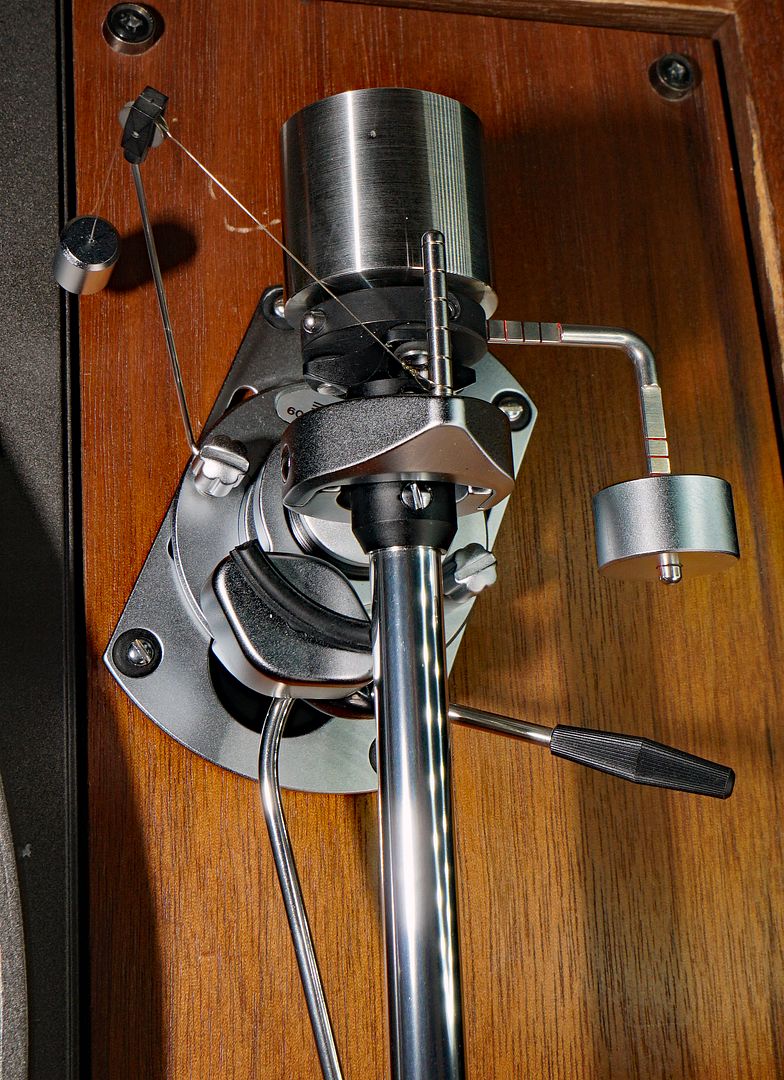
Hey Booch, wondered about that myself.....I see what appears to be a cylindrical weight on one side of the device that might have threads, allowing it to be moved inward or outward which should, or might, affect the force of the bar on the other side......:idea: Hard to say without the manual, but since the OP has that he should be able to identify the form and function of that AS device.
 
Hey Booch, wondered about that myself.....I see what appears to be a cylindrical weight on one side of the device that might have threads, allowing it to be moved inward or outward which should, or might, affect the force of the bar on the other side......:idea:
Very interesting design. The only one that I've seen on a turntable. Talk about "unique" suspension designs ...let me tell you about the French and Citroën.

00914122-8426-4748-98c1-3520416eb887.gif
 
That's very interesting. However, this seems to be one of the manuals that aren't translated properly for us to understand the intended message. I, and maybe it's just me, don't know exactly what "automatically adjustable" means because if it's automatic, then why is it adjustable? Had it said, "adjusts automatically," I would better understand. I'm still wondering if one needs to do anything to that "automatically adjustable" weight seen on the opposite (kinda) side of the bar?
 
Hey @Parallax982......I sense just a bit of frustration perhaps creeping into this effort and just want to encourage you to take heart, maybe take a step back too, and you will surely succeed in making this a successful adventure! Especially with the fine assistance of the good folks here who have already provided you with much great information. Your approach is very sound and thoughtful, which is needed in matters such as this because as you say, there aren't a lot of pros available and even when you can find one the price of the service is typically discouraging for those sensitive to monetary outlays. You'll see, it will all come together for you in due time. There are lots of threads on AK that will help you with more specific tasks if and when you find it necessary to move in those directions. There is a literal "universe" of information, for instance, regarding setup of the table, the arm and the cartridge that will make fine-tuning things much less intimidating and I dare say.....FUN! The more you do, the more many find it interesting and intriguing to arrive at the best possible outcome with your turntable......so, carry on, amigo, and have some of that fun!!!

PS - The "scratchy" sound will not likely go away by dusting or using any form of liquid cleaner that you might apply to a brush and then attempt cleaning the record with that, especially if they are caused by physical damages to the record which are typically not resolvable and will cause the pops and ticks you are hearing. You might lower the noise a bit though because the liquid could conceivably, amongst a other things, lower the static electricity that has built up on the record somewhat, but for true cleaning......well, that's a whole 'nuther "universe" that you can choose, or not, to enter should you become sufficiently enamored with the playing of records!!! In short, a vacuum record cleaning machine will help and some feel it is all they require to meet their needs. Heck, some just take the record to the sink and scrub it with water and dish soap and a brush, something like a fingernail brush with fairly soft bristles has done the job on occasion and then just dry it with a towel. That's the very basic cleaning approach though and you can work your way up to what many have done, that is getting an ultrasonic tank and using that methodology (and it isn't really all that expensive or complicated but does require study and learning some basics). Those who do the latter typically never look back.....as in general it is thought to be the epitome of getting records to sound as good as they can. Count me as one of them.......but hey, amigo, it's really all very dependent on what you want and what makes you smile at the end of the day (or record)!

BTW, it is always good practice to calibrate the gyro on your phone but I am guessing you already thought of that. Also, I've had some phones that just don't give consistently reliable results. Try several phones, see if it might not have something to do with yours.....
Thanks so much for your thoughtful and kind comments. I was getting a bit frustrated. I'm going to tackle the basics again today, after I have some breakfast, and see how far I get with it. I'm curious to learn more about ultrasonic washing. Sounds expensive but you say it's not. Where can I learn the basics?
 
That's very interesting. However, this seems to be one of the manuals that aren't translated properly for us to understand the intended message. I, and maybe it's just me, don't know exactly what "automatically adjustable" means because if it's automatic, then why is it adjustable? Had it said, "adjusts automatically," I would better understand. I'm still wondering if one needs to do anything to that "automatically adjustable" weight seen on the opposite (kinda) side of the bar?
There's prolly a very good reason few turntables had this anti-skating device.

I know the old-school hanging weight with a fishing line changes length as it pivots. Though I don't think that affects the anti-skating force.
 
There's prolly a very good reason few turntables had this anti-skating device.

I know the old-school hanging weight with a fishing line changes length as it pivots. Though I don't think that affects the anti-skating force.

I have more confidence in the hanging weight for anti-skate then a spring that weakens after time. Project still uses it. One of the largest Turntable manufacturers on the planet.
 
I have never seen an anti-skate mechanism like that. I guess a torsion bar(s) setup. Wow

Very surprised you have not seen this type of a/s. There are lots of them around. Both sides of the tonearm, usually two long arms on the pivot with a sliding weight on one to allow settings for different tracking forces. There were also ones with the rotational piece connected to the tonearm by a nylon string but same sliding weight on a pivoting device.

You're correct, as the arm moves across the disc it applies more AS... I guess regardless of VTF?
I don’t think this ‘more as’ is completely correct but I’m not going to get out my Statics/Dynamics text books and relearn the vector calculations to see what really happens. I just think that as the weight is moved up to nearly 90° close to record center the vectored force applying AS would be less compared to the start of the record where the weight was about straight out from the pivot point.
 
I have more confidence in the hanging weight for anti-skate then a spring that weakens after time. Project still uses it. One of the largest Turntable manufacturers on the planet.
The only issue I have is the fixed slots the fishing line can hook into (pun intended!:)). I can't get my SME 3009 to cleanly traverse the entire Tacet test track SKATING test, like my Technics arm can — which has near-infinite adjustment.
For an MC cartridge, I had to go to a heavier anti-skate weight, too. It tracks SKATING with no distortion until the very loudest passage (heaviest modulation).

49edea5d-1a47-46aa-95a3-ef32de6cde9d.jpg
 
Last edited:
Thanks so much for your thoughtful and kind comments. I was getting a bit frustrated. I'm going to tackle the basics again today, after I have some breakfast, and see how far I get with it. I'm curious to learn more about ultrasonic washing. Sounds expensive but you say it's not. Where can I learn the basics?
Just do a search right here in the Turntables forum and you will have all the information (and probably more.....) you need to learn about this and get set up. Many have gotten themselves very nicely set up for less than $150, some even less than that. Many have said this is the single most important thing they have done in enhancing their record-playing experience......I'd be one of those many! However, all that said, you are clearly a ways off of that decision at this juncture. Now, should you become excited about what you're hearing with records and decide to make additional investments in them, then you will probably be well-served to acquire such a tool to protect them and more importantly to enjoy them to the fullest.
close to record center the vectored force applying AS would be less compared to the start of the record
I've always thought that the AS force should increase the closer it gets to the center of the record to compensate for the force being generated by the inward movement of the stylus.....or maybe we're saying the same thing?
 
It looks in this photo like the lower rod is defying gravity. Is this an optical illusion or is it tightened in some way that keeps it against the other piece? Mine hangs freely and there does not seem to be a way to tighten it
Lower rod pivots, upper rod is fixed. Upper rod slides across lower rod as tonearm swings towards spindle.
 
Back
Top Bottom