• The move to the new server is done. There are some software and database maintenance updates in process. This has us passing the hat around to help out. We appreciate any donations. Seriously, even a dollar helps. The payment page may be found here - https://www.audiokarma.org/support.html

The best phono preamp under $1000 (aka the Hagerman Bugle upgrade thread)

Just got my Bugle with the 2210 last week. I‘m very impressed with this phono pre! Blows my original Mani out of the water. I can’t see anything beating it for the price.

Great news!! Shhhh, don't tell Jim H., but when you are feeling a bit flush, you can also upgrade the other two opamps in your pre with OPA2210s (edit: see post #509) for another boost in performance. Then upgrade the power supply to a linear, regulated supply (see post #1) and without touching a soldering iron you'll improve upon an already wonderful phono pre. Very glad to hear you are enjoying your B3 and thank you for contributing to the thread!
 
Last edited:
What I really like here is that the use of the opa2210 drops the noise floor by 6dB! I recall seeing a few posts about the use of the opa2210, in simulation, measuring “higher” in noise and something about it not being designed for audio. But neither of these were true and actually the opposite of the truth. I hope Oranda will reply if I am mistaken..

In real life objective measurements, Jim has shown that it is indeed lower when the opa2210 is installed.

Subjectively we have the above review w TNT! Nice job Oranda and all!

The world is saying nay to the ‘naysayers’ both objectively and subjectively. Ironically so at that.

Not sure what you might be referring to, but the OPA2210 has great low noise specs. Yes, there is a post on this thread questioning its use for audio, but audio use is not only in the application notes, its also recommended for audio use by johnc124@DIYaudio who is a VP and general manager at TI.
 
Props to @oranda as his suggestions reached Jim Hagerman and the opa 2210 implemented into the Bugle MC after Jim measured the performance w ~ 6dB lower noise floor. That was with just one 2210 op amp being installed.

Here’s a recent review, https://www.tnt-audio.com/ampli/hagerman_bugle_opa2210_e.html

Great article! Can't thank Jim Hagerman enough for joining the thread, offering his expertise, and not only testing but also incorporating one of the suggested mods into his fantastic Bugle phono preamp. For those with existing Bugle phono preamps, its very exciting to see that Jim now offers plug-in OPA2210 upgrade modules:


I ordered one and popped it into my Bugle and it works perfectly. Hoping to continue to hear positive feedback for either those with new 2210-equipped Bugles or from those who have modded their older phono pres.

Cheers!!
 
Last edited:
Great news!! Shhhh, don't tell Jim H., but when you are feeling a bit flush, you can also upgrade the other two opamps in your pre with OPA2210s (edit: see post #509) for another boost in performance. Then upgrade the power supply to a linear, regulated supply (see post #1) and without touching a soldering iron you'll improve upon an already wonderful phono pre. Very glad to hear you are enjoying your B3 and thank you for contributing to the thread!
Always something to spend my money on! LOL.
 
However.....this caught my eye on the newest iteration of the bugle (bugle mc):
V3DZ8cC
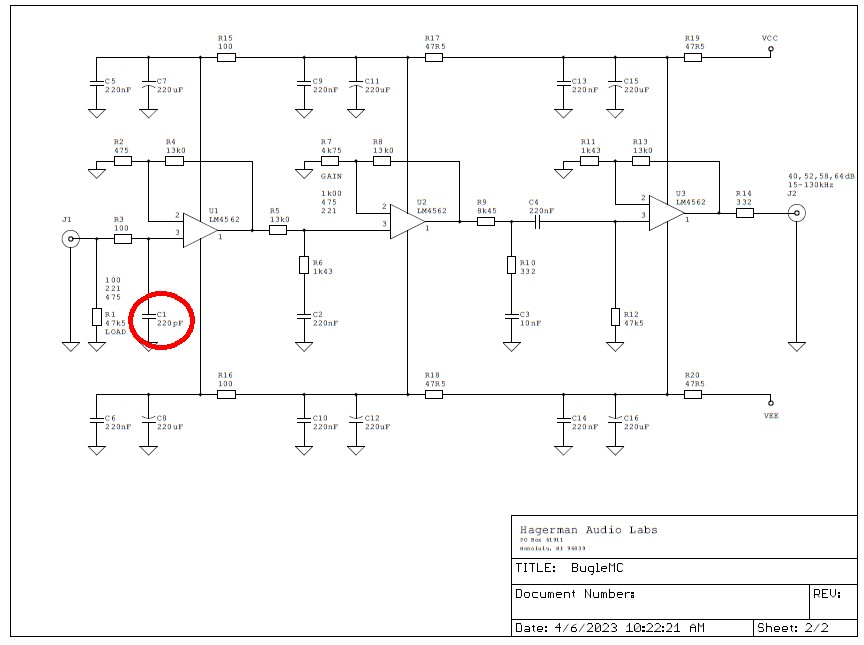
buglemcinputcap.jpg


A 220pF input cap?

I remember Jim saying a few months ago that on the latest bugle versions he put in a 100pF cap:
For the latest version of BUGLE I've placed a 100pF in parallel with R2. This is good and bad, one of those engineering compromises. Good in that it reduces the possibility of hearing WiFi, bad in that it adds 100pF loading to the MM cartridge! Pick your poison.
And in the shop I read 140pF input capacitance (which is plausible, 100pF for the cap and 40pF for the parasidic capacitance of components)

Why now a 220pF cap?
To me, part of the appeal of the bugle was it's low input capacitance, it used to be 0pf (well, there is of course some parasidic capacitance in connectors, pcb traces etc, about 30pF if I measure my clone).
Very low input capacitance is very beneficial to some mm cartridges with MR stylus, especially if they have laminated cores.

I didn't see a switch for the posibility to bypass this cap
 
Last edited:
Great news!! Shhhh, don't tell Jim H., but when you are feeling a bit flush, you can also upgrade the other two opamps in your pre with OPA2210s (edit: see post #509) for another boost in performance. Then upgrade the power supply to a linear, regulated supply (see post #1) and without touching a soldering iron you'll improve upon an already wonderful phono pre. Very glad to hear you are enjoying your B3 and thank you for contributing to the thread!

I've read some op amps with lower voltage noise are more suitable to MC amps, while others with lower current noise are more suitable to MM amps.

Does the OPA2210 offer similarly lower noise levels for both MM and MC cartridges?
 
I've read some op amps with lower voltage noise are more suitable to MC amps, while others with lower current noise are more suitable to MM amps.

Does the OPA2210 offer similarly lower noise levels for both MM and MC cartridges?

I can tell you that the OPA2210 has excellent performance in MM stage use. While I don't use my Bugle for MC, opting to use an SUT or sometimes a Hagerman Piccolo as the first stage of amplification for my MC cartridges, looking at the OPA2210 spec sheet shows a fantastic input voltage noise of 0.09 µVpp making it well suited for that application. Put in perspective, the FET-based, low distortion, low noise OPA2134 measures at a significantly higher 1.2µVrms.

I'm guessing Jim has the empirical evidence to support the data sheets and use of the OPA2210 in both cases.

Are you using MM or MC?
 
I can tell you that the OPA2210 has excellent performance in MM stage use. While I don't use my Bugle for MC, opting to use an SUT or sometimes a Hagerman Piccolo as the first stage of amplification for my MC cartridges, looking at the OPA2210 spec sheet shows a fantastic input voltage noise of 0.09 µVpp making it well suited for that application. Put in perspective, the FET-based, low distortion, low noise OPA2134 measures at a significantly higher 1.2µVrms.

I'm guessing Jim has the empirical evidence to support the data sheets and use of the OPA2210 in both cases.

Are you using MM or MC?

I'm using MM. I thought the more important values for MM cartridges was current noise but I'm just not sure.
 
I'm using MM. I thought the more important values for MM cartridges was current noise but I'm just not sure.

Yes, current noise is one of the important specs for MM use. As mentioned, the OPA2210 excels in MM use. Fantastic transient response and low current noise. Really natural sounding. I doubt you'll be disappointed with it.
 
Okay thank you.

Just be clear, bipolar opamps typically have higher current noise than FET based opamps. The 2210 has low current noise for a bipolar opamp, but its not sub 10fA/√Hz like the better FET opamps. That said, FET based and bipolar based opamps sound different, and obviously I like the way the OPA2210 performs enough to have 2 running in my Bugle used as the MM stage (about 40dB gain) in my MC rig and for my MM cartridge its the stand alone phono pre.
 
Last edited:
Would be interesting to do a blind (dbx) test. For instance OPA2210 vs OPA1656 :)

For sure. The OPA2210 also has very low flicker (1/f) noise, which helps in reproducing low frequencies. Bipolar opamps typically outperform JFETs in this regard, but I'm not sure how commonly those numbers are reported in the opamps spec sheets for comparision. Coupling the low flicker noise and low broadband voltage noise with the overall low current noise make it a fantastic opamp for phono use in general. But the 1656 is one I have not tried, and sometimes you don't know until you get a chance to listen to it.
 
Last edited:
For sure. The OPA2210 also has very low flicker (1/f) noise, which helps in reproducing low frequencies. Bipolar opamps typically outperform JFETs in this regard, but I'm not sure how commonly those numbers are reported in the opamps spec sheets for comparision. Coupling the low flicker noise and low broadband voltage noise with the overall low current noise make it a fantastic opamp for phono use in general. But the 1656 is one I have not tried, and sometimes you don't know until you get a chance to listen to it.
I noticed the low frequency improvement with the opa2210 & with the 1612 op amp.

I wonder how much is involved with the synergy between the op amp and the other components that were used? Why?

Just that I noticed less low frequency differences between the 2210 and 1612 after the final iteration of c4, c6, and load resistors with the ones that you mentioned at the start of this thread.

Before the final version, a swap between the two op amps in u4 would result in a small but noticeable change in low frequency response. After the final update, I hardly notice any change in the low end response. Still prefer the three 2210 in u2, u3 and u4. Greatly appreciate the sharing of your experience Mr. Oranda.
 
Why now a 220pF cap?

I changed this to a 100pF capacitor. Did not update published schematic. Opamp has also changed. I am constantly trying to wring out the best in each and every one of my products, so they do evolve.

This capacitor is here to reduce the effects of nearby WiFi, cell phone, and radio. If you require super low input capacitance, check out my CORNET MM, as it comes in around 10pF. Tubes tend not to rectify (demodulate) RF interference as much (compared to PN junctions) so I didn't add the RF filter.
 
Hi All - glad to see this topic is still generating interest - it's a great device.

I finished my Bugle3 a few months ago, and got sidetracked trying to resolve a "house hum" issue. The best tool for finding hum has been my Cornet2. Once I made progress, I reinserted the Bugle3 in my equipment chain. But realized the gain profile between Bugle3 and Cornet2 is different and seems to be contribution to the Bugle3 sounding anemic and low in oomph. So looking at the installation guide and the forums on the gain topic, I admit I am confused on how to change the gain on the Bugle3.

So the questions are:
1) there are 6 DIP switches, three on R channel and three on left channel. Each dip switch has two independent switches - correct?
2) I assume the orientation for up/down on/off is from the orientation of looking from the "input" end of the board to the output end of the board - Correct?
3) In the installation guide, it refers to switch 0, 1, 2 - does this mean switch 0 is the closest to the input connectors on each channel?
4) So how do I change gain/loading, in dumbed down, used to live in a very small town, kind of way?

Seems like I am very much missing something - any guidance is much appreciated. I'd like to try 40db and 50db to see how that compares to Cornet2 in same equipment scenario.

Thanks all, Chris
 
Just be clear, bipolar opamps typically have higher current noise than FET based opamps. The 2210 has low current noise for a bipolar opamp, but its not sub 10fA/√Hz like the better FET opamps. That said, FET based and bipolar based opamps sound different, and obviously I like the way the OPA2210 performs enough to have 2 running in my Bugle used as the MM stage (about 40dB gain) in my MC rig and for my MM cartridge its the stand alone phono pre.

Sorry for the bump, but are there any concerns using bipolar op amps without any capacitive coupling for the cartridge? I've read that FET op amps are safe w/o any coupling, but I note the Bugle doesn't use any coupling so I'm just wondering whether the concerns are real or make-believe.
 
Sorry for the bump, but are there any concerns using bipolar op amps without any capacitive coupling for the cartridge? I've read that FET op amps are safe w/o any coupling, but I note the Bugle doesn't use any coupling so I'm just wondering whether the concerns are real or make-believe.

There is a thorough discussion of this here:
OpAmp Phono Preamp Compatibility

There are (at least) two discussions in that thread, one about potential physical damage to a cartridge, the other about the effect DC bias current has on cartridge and preamp performance.

You can draw your own conclusion regarding the latter, but it's nicely pointed out that less DC bias is better. As JH mentions, placing a capacitor on the front end of the phono preamp removes DC bias but can also negatively impact sonics. The best solution seems to be to forgo the capacitor and use an opamp with a small (<<100nA?) DC bias current. JFETs measure in the tens (to hundreds?) of pA so they are ideal. That said, the bipolar OPA2210's bias is a rather small 300 pA (typical), and to my ears works quite well without a coupling capacitor.

With regards to physical damage, even input bias currents on the order of a uA would seem to be considerably less than what's needed to alter the lattice arrangement of the permanent magnets in a typical phono cartridge. An email to Ortofon or Grado might give the exact threshold in gauss needed to damage their products if you need more specific numbers, but I think you would struggle to find any evidence of physical damage to a cartridge due to bias currents from a coupled opamp.
 
Last edited:
Back
Top Bottom