• The move to the new server is done. There are some software and database maintenance updates in process. This has us passing the hat around to help out. We appreciate any donations. Seriously, even a dollar helps. The payment page may be found here - https://www.audiokarma.org/support.html

The best phono preamp under $1000 (aka the Hagerman Bugle upgrade thread)

It's true, I love tube "magic". More holographic in my opinion. My entire signal path is tubed, except for the JFET pair at input of Trumpet MC. :)

Definitely love to hear this except now I am going to have to grab a Cornet pcb if there are any left.

I’m listening to some Steely Dan right now via a VPI Scout and the Bugle3 build. If I add some tube magic w a Cornet build I don’t think I will be over the top. Had no idea how good a system could sound with quality equipment.

Thanks Jim for designing such wonderful equipment and helping us out with the builds!

I am addicted now and spending my money on new records. I am blaming KnotScott and Oranda for corrupting me! Ha. Actually I have to thank them both again because I never thought I could have it it so good. Thanks again gents!!!
 
I have a Cornet3 bought assembled during the Kickstarter campaign. I’m curious if anyone here has done a side by side comparison of the Bugle and one of the darlington labs units?
 
I have a Cornet3 bought assembled during the Kickstarter campaign. I’m curious if anyone here has done a side by side comparison of the Bugle and one of the darlington labs units?

Have not compared it to a Darlington but my latest build mentioned a few pages back absolutely sounds fantastic. I have compared it with the Mani and some others. I don’t think it’s fair to compare them as I have roughly $300-$340 in parts alone.

Might be building a Cornet soon though. I think it’s going to be one of those things where one has certain things that it excels and the other has it’s own attributes that it excels.
 
Hello,
I am considering building the Bugle3. Looking at opamps for U1:
OPA2192 has a very low (the lowest)
Bias Current: ±5 pA ..... that's picoampere!

OPA2210
Input bias current: 0.3 nA or about 100x worse?

Has anyone tested OPA2192 at U1?
 
I have a Cornet3 bought assembled during the Kickstarter campaign. I’m curious if anyone here has done a side by side comparison of the Bugle and one of the darlington labs units?

I haven't heard the Darlington, but did have a modified Bugle 3 for a couple of years that I thought was really excellent. I recently completed my Cornet 3 build, along with a LPS, cap and resistor upgrades, and I think it's outstanding.....I'd agree with Jim that it's more holographic, but will also add that I think it has better separation, and a deeper soundstage. It's pretty impressive. Good luck, and please keep us posted on your progress.


Okay now we are going to need an A/B testing with a few video clips to compare the two! You have me interested in buildiMyng one!

I wonder what Jim’s thoughts are on the two? Tube seems to have some advantages.

It's true, I love tube "magic". More holographic in my opinion. My entire signal path is tubed, except for the JFET pair at input of Trumpet MC. :)
 
Hello,
I am considering building the Bugle3. Looking at opamps for U1:
OPA2192 has a very low (the lowest)
Bias Current: ±5 pA ..... that's picoampere!

OPA2210
Input bias current: 0.3 nA or about 100x worse?

Has anyone tested OPA2192 at U1?

Listen to Jim’s advice on the opamps. He designed the Bugle and has measured the noise floor concerning the opa2210. I believe that it is still offered as an option for the current Bugle phono preamp on the Hagerman website.

I have followed Oranada’s advice for opamp choices and currently using the same opamp choices for u2,u3,u4 slots. I’ve tested numerous permutations ( correct mathematical terminology vs combination due to the fact that the order matters w opamp choice) and feel it gives the best possible results for detail, low noise floor, low end bass response as well as high frequency sparkle… all without annoying fatigue. I absolutely hate a forward or fatiguing midrange. The use of the 2210 is crucial for the result.
 
Hello,
I am considering building the Bugle3. Looking at opamps for U1:
OPA2192 has a very low (the lowest)
Bias Current: ±5 pA ..... that's picoampere!

Has anyone tested OPA2192 at U1?
For the same reason I went with the OPA1656. Not quite the same as OPA2192 but very similar in specs
Roughly same voltage noise density as the OPA2210 (2.2 vs 2.9nV/√Hz@10khz) but way lower current noise density (which I think is more important for MM) (400 vs 6 fA/√Hz)
OPA1656 is easy and cheap to get on alie on a dip8 board as drop in replacement. That helped :biggrin:

I think Wyn Palmer also uses the OPA1656 in the latest version of his phono preamp. That's a kit I'd also like to build in the future.
 
That is likely a JFET or CMOS input, and will be much noisier than the OPA2210.
I thought that for a MM phono stage the most important spec is lowest current noise.
“MM stages are highly sensitive to current noise due to the high inductance of the cartridge.”

Which opamp noise parameter is prioritized with MM phono and MM cartridge?
 
Hello,
I am considering building the Bugle3. Looking at opamps for U1:
OPA2192 has a very low (the lowest)
Bias Current: ±5 pA ..... that's picoampere!

OPA2210
Input bias current: 0.3 nA or about 100x worse?

Has anyone tested OPA2192 at U1?

PS. Forgot to mention; Oranda has tried many different opamps in the U2 position. Many more than I have, perhaps 10-12 different opamps. I have tried 5 or six different opamps in U2 and many others in u3 and u4 positions. The opa2210 was recommended by a TI engineer from Texas Instruments involved in opamp design. It produces approximately 6dB lower noise floor than the original opamp used in the factory bugle2 and bugle3. That’s a big difference. Ask Jim H. about it as he measured it and found out the results.

Also, I tested it out with mm and mi carts and it beat out all others when compared. I think it is the lower noise floor. Do you have an opa2210? If so it would be really nice if you could give us some feedback on what you hear when you build your Biugle3.

A lot will depend upon your system, your table and cartridge choice. The better your system, the easier it will be to hear the differences.

I see you mentioned the Wyn model preamp. I have 3 or so pcb’s for that build. But, after reading a bit about printed circuit boards, their design, and phono preamp design theory, I feel that Jim Hagerman’s designs are very concise to keep noise/rfi low. Other engineers like the ones at high end audio companies also talk about keeping their designs very concise w short paths as possible. It’s a big part of of T+A design theory as well as others.

I decided not to try the Wyn build because it is quite large and several boards are used depending upon what you want to incorporate.

Couldn’t be happier with the Bugle 3 build and I dare say that it would take something closer to $1.5-2k to find something that surpasses my current build.

Hopefully you’ll get some feedback from Oranda who I believe will be busy for the next few weeks before he gets a chance to respond.

What capacitors do you plan on using for C4,C5,& C6? I highly recommend the Charcroft Silver Micas. I have 2 working Bugle builds and a switch to A/B them. One has the Charcroft Siver Micas and one has another brand. IMO it is the best choice for C5. It was a recommendation from Oranda as well and proved to be an excellent choice.

I wish Jim would build perhaps 10 maybe just offer custom built MC-4 or Bugle3 w the same caps,opamps, and REY resistors and sell them at $650-$850 or so. Would be very much worth it. Would love to see some reviews on one of these.

 
I decided not to try the Wyn build because it is quite large and several boards are used depending upon what you want to incorporate.
I think the latest iteration is only 1 board for both MM and MC, and with that warp filter or am I wrong about that?
The powerboard is I think easily separated if you want to make a separate/shielded powersupply.
 
I thought that for a MM phono stage the most important spec is lowest current noise.
“MM stages are highly sensitive to current noise due to the high inductance of the cartridge.”

Which opamp noise parameter is prioritized with MM phono and MM cartridge?

Ah, sorry. I've been thinking MC.

Keeping an MM quiet is quite easy in comparison. IMHO, all that truly matters is that the noise floor of phonostage is well below (say 10dB) that of a silent groove. That way, the vinyl decides noise floor, not the phonostage.
 
I thought that for a MM phono stage the most important spec is lowest current noise.
“MM stages are highly sensitive to current noise due to the high inductance of the cartridge.”

Which opamp noise parameter is prioritized with MM phono and MM cartridge?

It's also important to consider 1/f (flicker) noise performance which dominates noise below ~100 Hz and is not easily filtered out. In this regard, the OPA2210 (and most bipolar opamps) greatly outperform CMOS chips like the OPA2192 (which doesn't specify a 1/f noise.) Now, among bipolar input devices, the OPA2210 has an outstanding current noise specification as well as a low broadband voltage noise, making it very well suited for use in the Bugle.

That said, it's easy enough to pop in an OPA2192 and see if it's to your liking. I have not tried that specific opamp, but I've tried many and find the OPA2210 the best to my ear for the critical 1st gain stage of the Bugle. The other opamp I'm enamored with is the LT1358 for the final gain stage. Smooth, clean, dynamic... just brilliant sounding. Give those two a try and let us know your thoughts. Thanks for your questions.
 
What capacitors do you plan on using for C4,C5,& C6? I highly recommend the Charcroft Silver Micas. I have 2 working Bugle builds and a switch to A/B them. One has the Charcroft Siver Micas and one has another brand. IMO it is the best choice for C5. It was a recommendation from Oranda as well and proved to be an excellent choice.

For the C5 10nF cap, it's damn hard to beat a silver mica. They are a bit pricey, but worth it. And among silver mica caps, the Charcrofts stand out. I wouldn't have believed it if I didn't A/B them to CDEs, but the Charcrofts are simply excellent.
 
Latest thoughts with the bugle phono preamp build. I currently have the bugle3 build and have noticed that I am able to get good or very good results from just about any MM cart out there. Some stand out as excellent, but all are at the least really good. I haven’t found a cart that plays terrible unless it has a worn diamond.
 
I want to straighten up the RIAA from my bugleclone, and want to get rid of the neumann pole and the low cutoff.
I'm definately not an EE, so I have some questions just to verify things by the people here who are way more knowledgeable:

upload_2022-11-10_10-34-28-png.2710561


So, based on this post by @wyn palmer and @WizardWG4 :

- to get rid of the Neumann pole, I have to replace R11 with a jumper and change R10 to 8,82K (or whatever I can get closest to). Is that correct?

Based on this post by @wyn palmer :

- C6 (220nF) is responsible for the low cut off? Can I just remove that capacitor and replace it with a jumper? (probably make it switcheable if that's the case)
thanks.
 
I want to straighten up the RIAA from my bugleclone, and want to get rid of the neumann pole and the low cutoff.
I'm definately not an EE, so I have some questions just to verify things by the people here who are way more knowledgeable:

upload_2022-11-10_10-34-28-png.2710561


So, based on this post by @wyn palmer and @WizardWG4 :

- to get rid of the Neumann pole, I have to replace R11 with a jumper and change R10 to 8,82K (or whatever I can get closest to). Is that correct?

Based on this post by @wyn palmer :

- C6 (220nF) is responsible for the low cut off? Can I just remove that capacitor and replace it with a jumper? (probably make it switcheable if that's the case)
thanks.
Shorting C6 is not advised. It also acts to block the DC which is propagated and amplified from the input stage.
I think the latest iteration is only 1 board for both MM and MC, and with that warp filter or am I wrong about that?
The powerboard is I think easily separated if you want to make a separate/shielded powersupply.
Yes, a single board, sort of. Full power supply with AC wall wart, MM/MC, switchable loads for both classes of cartridge, switchable gain steps, warp/stereo/mono. Parallel no selection low cost JFET based input gain stage with a transimpedance + current feedback design that can be switched between MM and MC.
Uses quite a few SMDs , but that's unavoidable these days. No significant current noise, extremely low voltage noise. Extremely high PS rejection. A variant exists that is MC only , current input.
The usual +/-50mdB p-p RIAA accuracy 20Hz-20kHz over all builds, nominally c. 20mdB p-p and it has a high pass 2nd order filter at 3.5Hz, mostly to tame the "effective" 1/f noise from the FETs, their input bias servo, and the ac coupled input at a few hundred mHz.
 
Last edited:
Shorting C6 is not advised. It also acts to block the DC which is propagated and amplified from the input stage.
Thanks for your reaction.
Ok, I understand :thumbsup:
Is there another practical way to get rid of the low cut filter?
Like putting that cap at the input, so in series with pin3 of the first opamp?
Yes, a single board, sort of. Full power supply with AC wall wart, MM/MC, switchable loads for both classes of cartridge, switchable gain steps, warp/stereo/mono. Parallel no selection low cost JFET based input gain stage with a transimpedance + current feedback design that can be switched between MM and MC.
Uses quite a few SMDs , but that's unavoidable these days. No significant current noise, extremely low voltage noise. Extremely high PS rejection. A variant exists that is MC only , current input.
The usual +/-50mdB p-p RIAA accuracy 20Hz-20kHz over all builds, nominally c. 20mdB p-p and it has a high pass 2nd order filter at 3.5Hz, mostly to tame the "effective" 1/f noise from the FETs, their input bias servo, and the ac coupled input at a few hundred mHz.
This is definately a project that i'd like to build in the future when I have more time. Looks like fun.
I have no problem with SMD soldering.
I've never ordered pcb's from a chinese manufacturer by just uploading gerber files etc, so that looks like an interesting thing to do too.

However for now I need a phonopre with riaa that is straight down to 1hz for LF measurements to look at small resonance characteristics of tonearm/cartridges, hence my question :)
 
... for now I need a phonopre with riaa that is straight down to 1hz for LF measurements to look at small resonance characteristics of tonearm/cartridges
Interesting phono requirement & resonance project!

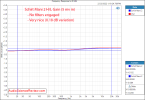
fyi - Google AI indicates mani 2 may work.
"Schiit Mani 2: This budget-friendly preamp uses a fully DC-coupled topology with an ultra-low-noise passive RIAA network. It explicitly features a switchable 1-pole or 2-pole low-frequency filter. To get a straight line down to 1 Hz, you simply turn the LF filter completely off, allowing the DC-coupled circuit to extend tracking to near-DC. "​
​
ASR plot is not straight, and not down to 1 Hz, but some additional info:

1781964799432.png
 
Build a Kirkwood flat unit and apply RIAA in the digital domain if you want it. Input C on that is about 10pF.
 
Back
Top Bottom