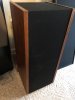
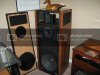
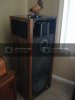
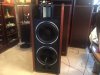
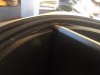
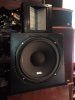
SaturationPt: I think you are more in tune with the various versions of the Monitor cabinet than I am. What do you consider the first version, AMT3s? I have AMT 1A Monitors and then a second pair of AMT Monitors with the Bextrene woofer which came with a fabric surround that had been doped with some goo that had dried up making the surrounds stiff like a starched shirt collar. They were so dry and hard they had actually split. I had to refoam those drivers. I know at one point they made the monitor all in black. They also made a Monitor in a cabinet that kinda looked like an AMT6. What do you consider to be the various versions?
The AMT 1A/B/C/D have the major revision in the letter, but knowing ESS there could well be minor revisions also.
@automojo has at least two versions of the Rock Monitor, they made a ported and sealed version and likely others as well.
In the AMT Monitor, there are many revisions but I like to look at four/five. I'm going from memory now, ... it's been a couple of years. The AMT Monitor and AMT 1-x share the same woofer, passive, and Heil hardware, and chaged around the same time. All AMT Monitors have cast frame 12" woofer and passive and a higher-quality crossover than any other ESS made at the time, but there are several versions of each.
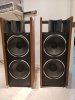
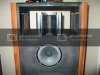
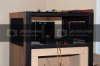
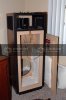
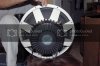
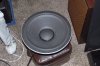
The first AMT Monitors had silver Heil tweeters, an easy tell-tale, later versions have the black ones. The first version also had flat foam-over-styrofoam passives, with pulp-cone woofers, IIRC all with foam surrounds. The second version (might be when they changed to the black Heil) changed to Bextrene woofers, the third version also had Bextrene, both the woofer and passive were then the same cast basket and cone assembly, the passive was simply missing the magnet assembly and coil assembly. Both (I believe) now had the doped fabric surrounds. The Bextrene woofers also have a double dust-cap, likely for rigidity (photo shows the upper/active with only the inner dust-cap) Fourth version is I believe when they went to rubber surrounds, fifth version they tilted the Heil back a few degrees and eliminated the holes in the sides of the upper cabinet area (adjacent the Heil).
I'm not sure where some of the other changes were made, some in specs and some in hardware. I believe that the early monitors were spec'd as the below image down to 30Hz, but later were 25Hz? Might have added mass to the passive radiator (not sure), the spec image below I believe to be version 2.
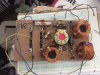
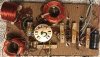
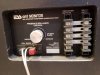
The crossover changed at least once. The crossover was much better than any of the other ess offerings IMO, allowed direct access to the woofer and tweeter (tweeter in later one I believe had capacitor protection, this from memory) without the crossover. The later version (second one in photos below) added more circuitry but I believe that all of the designs incorporated three air-core inductors (not bad for a 2-way crossover), just that the later version has 2 capacitors added. The S/N of the early one shown is around 1500 IIRC (V3, fabric surrounds & Bextrene cones on woofers and passives, flat-mounted tweeter, side-vents, flat platform), later one around 7900 (rubber surrounds, tilted tweeter, no side-vents, boxed-riser). Also I remember that the crossover point was changed between 800Hz and 1kHz, don't remember when that was and which way it went. I'm pretty sure that the early ones were 1kHz (the below spec) and later ones were 800Hz, but if you bought the active crossover designed for the AMT Monitor it was variable anyway or if you bi-amp like many of us do you just find the sweet-spot with REW and go from there.
The ESS AMT Monitor and ESS Rock Monitor shared the Heil tweeter, and the box. Really nothing else. The Rock Monitor was introduced part-way into the production of the Monitor with a simple 3-way crossover, no direct-wire options, and depending on the version smaller stamped-frame woofer and midrange that were purchased not made-to-order. It was only built two years I believe so unfortunately didn't benefit from advances in design like the longer-running models, too bad really because it had great bones. Still, there were multiple versions so maybe if it continued it might have gotten a crossover and driver upgrade and become more like
@automojo has created in his FrankenHeil, great bones can become great speakers.
The other shortcoming in both of these models (IMO of course) is the grille design, difficult to remove completely, difficult to handle, easy to break the frame, just not a robust design. They also have a lot of edges, with the side panels sticking out beyond the woofers and the grille frames having holes not much larger than the woofers, ... "edge diffraction" is certainly a concern. The basic "box in a box" design though? The side panels are applied to what is already a solid-sided box, adding more strength (and weight) to these ~100lb speakers and at least the AMT Monitor version is braced well (not sure on the Rock Monitors). The 1-A/etc. had a similarly often damaged (upper) grlle frame until the last (-D) version which is a little stronger.
Anyway, more than you asked, sorry.