• The move to the new server is done. There are some software and database maintenance updates in process. This has us passing the hat around to help out. We appreciate any donations. Seriously, even a dollar helps. The payment page may be found here - https://www.audiokarma.org/support.html

Using Latex Cement for KLH Cloth Surround Doping

Take a closeup picture of the surround and front of speaker. What speaker is it. Air suspension or ported? What was the reason or problem that led you to using the adhesive? Just want be clear of your goal, and wheater it matches this thread subject. Your using term adhesive. This thread is about sealant to keep air from passing through cloth surrounds, without hardening over time.

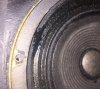
It was reccomended by OP that I check out this thread for what I am trying to accomplish, I am trying to reseal my paper accordion surrounds as I accidentally ripped them on my CTS woofer that is not ported. Here is a picture, let me know if this thread is not what I am looking for.
 

Attachments

  • IMG_6093.JPG
    IMG_6093.JPG
    104.4 KB · Views: 68
I am somewhat surprised and pleased that this thread is still active. There has been a lot of good back and forth in this thread which is healthy and useful. I started this thread because I picked up a pair of KLH 17s and there was no butylene on the surrounds, just cloth. I have not yet doped the surrounds because every time I checked eBay for the sealant there was none or VintageAR was on vacation. I will contact Roy and get some because the end of March is well past and there is no eBay listing for the sealant. I appreciate everyone opinions and experiences. Keep up the good work.
 
Vintage AR is on vacation. Forum member are welcome to contact me for information.

Roy
I'm not seeing the cloth surround sealant on Vintage-AR's ebay store, does anyone know if this is still available, or a suitable alternative? I have several KLH speakers in need of restoration
 
Also, retrovert, are you being serious? is that a viable repair?

Dude, like, totally, without a doubt, for realz.

Google "KLH butylene rubber toluene surrounds", or the same for AR, if you don't believe me:

The original sealant used for cloth surrounds used by Acoustic Research and KLH was butylenne rubber dissolved in toluene. That's all the stuff is.

RoyC explained all of this on Classic Speaker Pages as part of his outstanding and excellent treatise on surround treatements wherein he debunked, with science and actual measurements over time, all of the considerable nonsense and dogma about the purported "benefits" for gasket cement, silicone, PVA in all its forms, etc.

Back to the KLH which always used butylene rubber to coat its cloth surrounds. In 1970 KLH issued Service Bulletin No. 60 discussing how to effect surround repairs:
Date: 12/20/70
Subject Butyl Coating for KLH Woofers and Twelve Point Five Speakers
Product: All Models Using KLH Woofers and Twelve Point Five Loudspeakers
​

KLH is instituting a mandatory procedure to be followed with all speakers returned for service. You will immediately receive a supply of butyl, the chemical used to coat the skiver (surround) of all KLH woofers and Twelve Point Five loudspeakers. You will also receive three one inch paint brushes.

Apply the butyl (with the one inch paint brush) to all speakers brought in for "rattling", "buzzing", or "dissimilar sound" before attempting replacement, Retest a few minutes after the coating is applied.

...

NOTE: The solvent used for the pure butyl coating is Toluol obtainable at any chemical supply house. The butyl container must remain tightly sealed or the solvent will evaporate. Should long term storage thicken the butyl so that it cannot be easily painted on the skiver, careful thinning with Toluol will restore the solution to its original density.
​

NB: Toluol is Toluene.

Solves your problem?

 
I have been an AK member for many years. It seems like a new thread on this topic starts up once a month.
 
I have been an AK member for many years. It seems like a new thread on this topic starts up once a month.

True dat.

Because people keep spreading debunked dogma which sows confusion and destroys speakers. Very sad when someone's heirloom speakers are ruined by PVA Cult or Gasket Cement Cult or Silicone Cult, or any of the others. :(
 
What's really amazing is that I set all of this forth here:

Here's another posting I made with all the linkage already done for you:

Yet, four years later, we come full circle.

A simple search with Google can verify all of that information. I again refer everyone to the "Restoring the AR-3a" document over at ClassicSpeakerPages for plenty of information on sealants which is not based in mindless regurgitation of incorrect dogma.
 
I again refer everyone to the "Restoring the AR-3a" document over at ClassicSpeakerPages for plenty of information on sealants which is not based in mindless regurgitation of incorrect dogma.
Retro, I applaud your insistence to inform others to use the liquified butyl (and nothing else!) that was re-created for this specific purpose. As splendid and wonderful and informative and terrific as the AR-3a restoration manual is, that document is eleven years old and has never been updated, and it still only makes mention of the Permatex and Latex-based products, neither of which anyone should continue to use or advocate.

Re: your comment in post #86, I'm not sure this process is quite as simple as you make it sound - - if so, someone else would have successfully re-created this product and be marketing their identical sealant for this purpose.
 
There was a guy (Vintage AR?) offering this butyl dope on the E-place, I have a jar, unfortunately solidified.
 
There was a guy (Vintage AR?) offering this butyl dope on the E-place, I have a jar, unfortunately solidified.

Add some toluene. That's the magic solvent. Ordinary toluene, available at any hardware store. Don't forget to bring ID in case you get carded.

Start with a small amount and add more as you need to dilute. Easier to add more. If too much is added, leave it out in the sun with the top off until some evaporates.

If you huff it I'll tell your parents and the school principal.
 
Retro, I applaud your insistence to inform others to use the liquified butyl (and nothing else!) that was re-created for this specific purpose.

I just hate to see people destroy expensive vintage speakers which have nothing wrong with them aside from needing a little sealant.

The amount of nonsense is prodigious. Many years ago when I started research this I was nearly seduced by the oft-repeated nonsensical dogma. I now know this would have destroyed my speakers.

Retro, I applaud your insistence to inform others to use the liquified butyl (and nothing else!) that was re-created for this specific purpose. As splendid and wonderful and informative and terrific as the AR-3a restoration manual is, that document is eleven years old and has never been updated, and it still only makes mention of the Permatex and Latex-based products, neither of which anyone should continue to use or advocate..

Ok, but the CSP forums are full of the discussion. Check that out. I linked to a few of them.

Re: your comment in post #86, I'm not sure this process is quite as simple as you make it sound - - if so, someone else would have successfully re-created this product and be marketing their identical sealant for this purpose.

It really is that simple. This is the product RoyC made and sold until he sold his sealant business to Vintage AR!!!

The problem with selling this product is it is not green and it contains a chemical known to the State of California to cause cancer, neurological damage, and three-headed babies. So what company wants to take on the product liability for that, when the world market is maybe a few hundred bottles a year to audiphiles.

Naaah. Better to push PVA which people can eat out of the container.

So only one supplier exists. It's not that the recipe has something seckret or magickal in it. Just rubber and a solvent.
 
Add some toluene. That's the magic solvent. Ordinary toluene, available at any hardware store. Don't forget to bring ID in case you get carded.

Start with a small amount and add more as you need to dilute. Easier to add more. If too much is added, leave it out in the sun with the top off until some evaporates.

If you huff it I'll tell your parents and the school principal.
Thnx for the hint!
You'll need a medium and a seance to fulfill the last.
Btw, my most fondly remembered elementary school teacher passed last year at 103 years. We stayed in touch.
 
Back
Top Bottom