

You are using an out of date browser. It may not display this or other websites correctly.
You should upgrade or use an alternative browser.
You should upgrade or use an alternative browser.
VU meter explained
- Thread starter eljr
- Start date

Register to hide this ad

JoeESP9
ESL's & tubes since 83
Check the link.
https://en.wikipedia.org/wiki/VU_meter
https://en.wikipedia.org/wiki/VU_meter

Daunia 70
Lunatic Member
In simple terms,If the VU meters are continually in the red then the recording will be overly loud which can cause distortion (something that's sadly common nowadays). For a decent recording,they should be fluttering around the middle... But during high or low passages then it's fine for 'em to go higher or lower.
KentTeffeteller
Gimpus Stereophilus!
Yes, and a true VU meter is calibrated to indicate average program levels. They must follow a specific set of guidelines to be called a VU meter. VU indicates Volume Units. An old standard from Western Electric which followed through telephony, cinema sound, and in broadcasting and recording. Most consumer so called VU meters are much more peak meters in their behavior.

JURB
Super Member
https://dl.dropboxusercontent.com/u/29948706/VUMeter.exe
If this will run right on your system, notice how slow the response is.
To use VU or whatever old average responding meter takes a bit of skill. you must listen to the program and decide how much is peak, how much is average and how much distortion you want to tolerate on the peaks.
When digital came along with the rock hard compression, peak reading meters were needed.

steerpike2
Super Member
The 'nice' thing about VU meters is they give a good indication of perceived volume level. If you are mixing songs from several sources and you want your mixed recording to be of uniform volume throughout, the VU meter is the one to use.

Nightwisher
Farer In The Goldilocks Zone
I'm not going to comment on what it is since it's already been explained pretty well, but I will drop a Windows VU meter here for anyone interested: http://www.vuplayer.com/other.php. Works great on newer Windows (including 10) and not just the ones listed.

sKiZo
Hates received: 92644 43.20°N 85.50°W
VU's are fairly useless in a modern day home system, but it's still nice watching the needles flop around. <G>
Mostly where they were handy for the casual user was recording cassette or RR tapes. There, they actually served a useful purpose, as you wanted to set the recording level properly, allowing maximum peaks without spending too much time in the red, which should indicate distortion and oversaturation. Hence, the term peak level readings.
Some meters will have a setting to "lock" the needle at the highest level until you clear it, but those can be deceptive. I prefer to just let the needle cycle, and let the mark one eyeball and brain determine the average peak by watching the meter and adjusting the input level to give you what you know works for best results. Truth be told, that may not be anywhere near where the meters think it should be, as they tend to lose calibration over time.
steerpike2
Super Member
VU's are fairly useless in a modern day home system, ////// Truth be told, that may not be anywhere near where the meters think it should be, as they tend to lose calibration over time.
They are only useless in a setup where no recording is ever done. If you plan on making recordings where you want the volume or perceived loudness to be uniform throughout, they are essential. Computer sotware that does a 'normalise' based on peaks gets you exactly the wrong result.
If your VU meters are losing calibration over time, you are unfortunately the owner of damaged or cheap equipment.

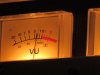

Blue Shadow
Waiting for Vintage Gear from this century
My first preamp had VU meters set to display preamp output level. switchable sensitivity.
sKiZo
Hates received: 92644 43.20°N 85.50°W
They are only useless in a setup where no recording is ever done.
AKA ... most modern audio setups. Even if you're laying down your own tracks, chances are good you're using a software solution and depending on either automatic routines or the internal digital gauges to set levels.
Computer sotware that does a 'normalise' based on peaks gets you exactly the wrong result.
As with VUs, "normalize" has it's place in the home system. I use Audacity's version regularly for a fast and easy fix to the "brick-walling" that seems to rear it's ugly head regularly on digital sources.
If your VU meters are losing calibration over time, you are unfortunately the owner of damaged or cheap equipment.
I agree whole-heartedly, especially if you include any aging "classic" equipment in the list. Especially that which suffered a lot of needle banging courtesy of the stoners who really really liked watching the needles flop about. Like me, fer instance. <G>
Of course, why settle for floppy needles nowadays, when you can have these! Fairly simple to build, and make for a nice winter project when the walls come closing in ...

steerpike2
Super Member
Even if you're laying down your own tracks, chances are good you're using a software solution and depending on either automatic routines or the internal digital gauges to set levels.
Digital displays on a PC screen may still be VU meters, but only if the software programmers know their stuff.
"VU meter" is not a synonym for "moving coil meter"
I think Revox is the only company to use VU meters on their consumer equipmemt. As for the others, they may have stamped the letters "VU" onto moving coil meters, but they were not ASA-standard VU meters.[/QUOTE]
Daunia 70
Lunatic Member
Can't you calibrate the VU meters on certain gear,like on the Pioneer Spec 4. As for sayin' they're useless nowadays is nonsense. OK,so they'll add more cost (that's why you don't see 'em hardly ever now). But at least Accuphase and Luxman still use 'em on their TOTL integrated amps.

restorer-john
Addicted Member
They are not useless.They are a great indicator of balance issues on recordings, especially the physically larger ones. They can look fantastic (Luxman/Accuphase et al), in multiple amp stacks, the VU meters indicate amps that may have issues, they can be used with a steady state wave to generate an accurate voltage when correctly calibrated (as many of them allow for). You know that regardless of the fluctuating impedance of your load, you are dropping a particular voltage over the load when the meters indicate a specific level. This in itself, helps significantly when exercising restraint on the volume position, especially after several drinks.
restorer-john
Addicted Member
Yep several drinks later I was pushing little 6.5" two ways from a big Sony TAN-77es last night. Them big ol' meters were swinging up the far end.

bluesky
Lunatic Member
Chicks dig VU meters........nuff said.
Guys dig VU meters........nuff said

Similar threads

- Replies
- 114
- Views
- 7K


- Replies
- 88
- Views
- 10K

- Replies
- 3
- Views
- 381


