• Check out the Annual AK Secret Santa exchange Program, signup before November 23rd in the AK Charities & Christmas forum!

Wharfedale Owners Thread

I keep saying you are hearing the sound of a speaker voiced by human ears not modeled by a computer.
s
Slightly off topic, but when did Wharfedale change the Dovedale to an unported infinite baffle cab, was it when they went to a three-way design? I admit to being a little unsure of this when it comes to chassis. I note the self build Unit 4 instructions clearly state that the cabinet must be airtight, it actually says 'under no circumstances must these drivers be used in a cabinet that is not airtight'. The result is a very bass-heavy sound. Is there a design difference in the chassis itself? Why would Wharfedale change the wonderful sounding early Dovedale ported design?
 
Earlier this week I dug a pair of Rosedales out of storage in the basement . Hooked them up to a vintage Sansui AU 7500. Let them play quietly for a couple of days to let the caps reform. I've been listening to them all day and I'm struck dumb by what I'm hearing. Forgot they were this good. I guess thats why I kept them. Smooth natural midrange. Superb soundstage. The 15" woofer is really somthing special. It renders the lower registers with such musicality and just keeps reaching deeper and deeper without ever getting muddy or boomy. In such a small cabinet.
Amazing.
I also have a pair of W70D that I haven't listened to in at least 10 years. I remember that I liked the Rosedales more.

Art
 
Last edited:
Earlier this week I dug a pair of Rosedales out of storage in the basement . Hooked them up to a vintage Sansui AU 7500. Let them play quietly for a couple of days to let the caps reform. I've been listening to them all day and I'm struck dumb by what I'm hearing. Forgot they were this good. I guess thats why I kept them. Smooth natural midrange. Superb soundstage. The 15" woofer is really somthing special. It renders the lower registers with such musicality and just keeps reaching deeper and deeper without ever getting muddy or boomy. In such a small cabinet.
Amazing.
I also have a pair of W70D that I haven't listened to in at least 10 years. I remember that I liked the Rosedales more.

Art
The Rosedales will be better than the W70D's. That 15 inch woofer is amazing. There were a lot of modifications made to Rosedales, do yours have any adjustment for mid or highs? The US version is the W70E's and I've been raving about them since I got them. Bass just seems effortless and very natural. Do yourself a favor and recap them. You'll find they're even better than what you hear now.
 
s
Slightly off topic, but when did Wharfedale change the Dovedale to an unported infinite baffle cab, was it when they went to a three-way design? I admit to being a little unsure of this when it comes to chassis. I note the self build Unit 4 instructions clearly state that the cabinet must be airtight, it actually says 'under no circumstances must these drivers be used in a cabinet that is not airtight'. The result is a very bass-heavy sound. Is there a design difference in the chassis itself? Why would Wharfedale change the wonderful sounding early Dovedale ported design?
In the states it came in with the “D” models and that was about a 1965 or so.
 
Yes I believe you're right. The Rosedale is better than the W70D.
Mine do not have tone controls. There is a hand written date on the back. 5/71.
The other pair still buried in the basement is from 72 (I think).
I have 2 pairs, bought from the estate of a Doctor. One owner since new.
I do think I'll recap the Rosedales as they are absolutely worth preserving.

Art
One thing you need to know about the Rosedale with that particular crossover: the woofer is run out of phase from the mid and tweeter. I hand built new W70E style crossovers which have all speakers in phase, and replaced the originals so I could run the Rosedales and W70E's stacked if I ever wanted to. I did keep the original crossovers in case someone wants to put them back to being completely original.
 
One thing you need to know about the Rosedale with that particular crossover: the woofer is run out of phase from the mid and tweeter. I hand built new W70E style crossovers which have all speakers in phase, and replaced the originals so I could run the Rosedales and W70E's stacked if I ever wanted to. I did keep the original crossovers in case someone wants to put them back to being completely original.
That's good to know. Thank you.
I could triple stack my Wharfedales!
That's not likely though, so I'll stick to just updating the stock crossover.
Did you use oil caps in your crossover build?
I'm wondering about the sonic improvements oil caps would bring.
 
That's good to know. Thank you.
I could triple stack my Wharfedales!
That's not likely though, so I'll stick to just updating the stock crossover.
Did you use oil caps in your crossover build?
I'm wondering about the sonic improvements oil caps would bring.
Just used Dayton 100v NP audio caps. Or you can buy more expensive Mundorf if you prefer. You probably would hear any difference between oil and electrolytic
 
Just used Dayton 100v NP audio caps. Or you can buy more expensive Mundorf if you prefer. You probably would hear any difference between oil and electrolytic
The Dayton caps will do me just fine. I do have some Russian PIO caps squirreled away for an Altec crossover build. Maybe I should check to see what values are there.
 
There is a single Wharfedale W25 speaker for sale it can be had for a very good price, it is in good condition. I have a pair of this sweet little speaker and enough parts to assemble two more I don’t need it. The drivers in this speaker are used in both the W35, woofer, and tweeter, and the Tweeter is used in the W45. You can guess where it is :D
 
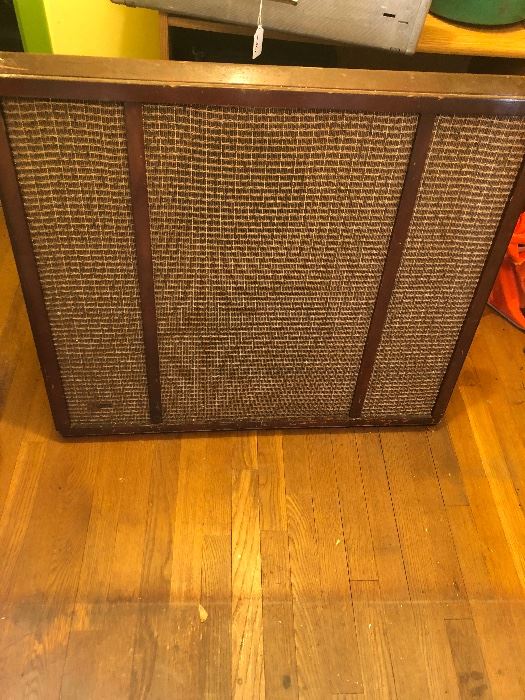
Here is a photo from an upcoming estate sale. I have no affiliation. I will be posting it in Dollars and Sense. The seller lists the model as SFB. I'm just curious, is that Sand Filled Box? It looks more like an open-baffle design. Alas, the sale lists only one. Thanks!
1.jpg
 
'Ive had the Rosedales out and have been listening to them for about a week
What wonderful speakers!
I didn't fully appreciate them when I first bought them about 10 years ago and am glad that I squirrelled them away in the basement.
And am even more happy that I dug them out to give them a listen.

So I went on another expedition do extract the W70D's.
This is what I found.

PXL_20211212_185911929.jpg

I knew that the tweeters had been replaced.
But look at where they are located.
The upper mid and tweeter have swapped positions.
How odd.
Every image I see on the web has the upper mid and tweeter position reversed from mine.

Art
 
'Ive had the Rosedales out and have been listening to them for about a week
What wonderful speakers!
I didn't fully appreciate them when I first bought them about 10 years ago and am glad that I squirrelled them away in the basement.
And am even more happy that I dug them out to give them a listen.

So I went on another expedition do extract the W70D's.
This is what I found.

View attachment 2420295

I knew that the tweeters had been replaced.
But look at where they are located.
The upper mid and tweeter have swapped positions.
How odd.
Every image I see on the web has the upper mid and tweeter position reversed from mine.

Art
Does it say The Radio People anywhere on the back of the cabinet? They were known to make small changes in the design while still using Wharfedale components.
 
Yes these are from Radio People.
There seems to be no end of variations and deviations in these old Wharfedales
 
Starting to rehab a newly acquired set of W70Es and some pics of the process and observations on the physical aspects of things. Also, a physical comparison to the W70'a' and W60DMark II. Wax markings on the 60DII woofer cone back were 12/1969 and the E were 11/1970 so produced about 11 months apart. E's also marked with "p/GB" and u/GB. Hopefully GB means Gilbert Briggs touched these! :D Of course, it could actually say "p/68" for all I know.

New caps in on the xover and ready to go into the speakers shown below. The existing generic ones that were in it upon acquisition are just below for comparison. 2x3uf for the 6uf and 2x4uf for the 8uf cap so that I have the precise matches to factory and not .2 off, plus a little 3M automotive body panel tape to keep any rattles/vibrations/movement at bay.

Many thanks to forum member infullview for helping me get the wiring sorted.

IMG_2381.jpg

Having had the W70 'a' ported all alnico 3 ways and a pair of W60D Mark IIs previously, my initial impressions are that the build quality is substantially less in the W70s.

Case in point, the prior generation of W70Ds were 26lbs more per pair. The W70Es weigh only 1 more pound than the W60Es, so I suspect the W60E may not have been subject to this same change.

There are no similarities in any of the drivers between the D Mark II and the E model I('ve) own(ed). 12" speaker, which appears to have the same 9.5lb magnet as the 15" measured closer to 13" than 12" and the 15" woofer measures more like 14" so I don't think there's that much of a difference. Perhaps a 1.5" or 2" cone difference, as opposed to the nominal 3" as indicated by the advertised nominal sizes. The wonderful fiberglass or whatever green cloth surrounds from the D Mark II have been replaced with rubber on the 15" E woofer, which appears to be soft and pliable, despite the age.

Other things that stand out:
  • Completely different mid-range than the 60DII, which was sublime. I'll see how these are in comparison.
  • Tweeter is different also. Prior 60D MII was round, and more robust, E is square and smaller. Plastic covers on tweeters are a bit different and plating is much higher quality on the DMII.
  • The DMII cabinet, when rapped sounded very nice and dead, like a 1/4" sheet of plywood glued to concrete. Tapping on the W70E gives a more hollow, resonant sound, particularly on the back. The side and top walls are noticeably thinner, also. The back wall is some sort of MDF or particle board, instead of the laminated plywood encapsulating the sand, which when stained looked great. The E is not nearly as well built as the DMII, but is not bad by any means. I think a sand filled back would have been a great addition though, but not sure if that's an improvement in practice.
  • The woofer magnet on the 12" DMII is 'chunkier' and the plating finish is more like a mirror, while the E is thinner, unfinished, lots of machine marks and many square edges of the metal plates rounded off from not having clean cuts like the DMII.
  • The wire gage in the inductors for the E appear to be thinner than the DMII and far thinner than the W70'a'
  • W70'a' had PIO oil caps (AA british military markings) and the DMII and E have the minerva electrolytic non polar caps.
  • W70'a' had all alnico drivers as evidenced by the red magnets. The DMII and E are all ferrite drivers.
  • The W70'a' had air core inductors vs. ferrite cores for the DMII and E
  • The 60DMII has nice square cut rockwool (or some other material) fit and inset perfectly into furring strips for each panel, except the front baffle. The Es have a loose 'blanket' of insulation material stuffed in. Very shabby looking compared the DMIIs, but hopefully not something that impacts sound.
  • The removable items like back, drivers, etc. on the DMIIs have maroon felt on the mating surfaces, which seems like it would help ensure a good seal and eliminate any vibrations. The E doesn't have anything like this with wood on wood mating surfaces and a hard gasket for the woofer basket.
  • edit... The 60DMarkII adjustment pot had a removeable black back cover, to allow easy access for cleaning. The E pots can be taken apart with some metal tabs but would require a dissassembly. Hopefully there's a hole big enough on the case to spray in some contact cleaner and lube with a nozzle tube.
Overall, the 70E feels and looks like a solid notch below the D Mark II in fit and finish and certainly in the cabinet construction. If these physical aspects represent part of the switch from hifi to midfi in the early 70s, this is clearly manifested in a comparison of the two.

The woofer seems to share the same cast construction, and the tweeter is similar, perhaps a bit smaller on the magnet. The mid, however, physical design wise is not nearly as well built. Of the 3 the W70'a' drivers were the most robust. The supertweeter 3 being far larger than either of the E or Mark II models purple dome tweeters. The DMII is round and the E is square for the tweeters.

Will be hooked up to a Fisher 500B and Dual 1229Q turntable, which had great synergy with the D Mark IIs and really had a spooky real 'breath of life' sound for vocals. The W70'a' sounded OK, but more like a rock speaker. Typical ported bass sound (a hollowness, like a mid fi home theatre sub), but could hit deeper than the 60DMK IIs, and with much less finesse. Also, the mids not nearly as lush or even forward as the 60DMIIs and overall refinement and detail a bit lacking for the 70'a' which I quickly got rid of.

Given this model has a totally different build and crossover configuration than my previous models, I'm not sure what to expect, but looking forward to hearing them fully restored and hoping they have the same magic as the DMIIs.

Hopefully they also sound as good and aren't a step back. Will report back after the installation and listening sessions.

 
Last edited:
Playing the W70E speakers with the proper crossovers, the sound is much, much improved over the aftermarket generic crossovers.

Much better mid presentation and far better integrated. A couple of the other drivers were also loose, so that may have helped too. Far more lifelike sound but, so far, not quite as 'tight and clean' in the bass as the DMIIs, but the mids/highs seem reasonably good. The DMIIs had an absolutely killer mid-bass as well as lusher mids that made them killer jazz speakers. These seem to have a flatter, less warm, perhaps more modern sound so far, but not sterile by any means and still on the warm side of things.

Had to dial down the treble just a hair, maybe 1/5th of a turn using the treble pots in the crossovers. Will do some more listening for a few more days before final judgement. As I recall, my DMIIs took several days before they sounded good, as they too had been sitting unused for many a year, as have these.
 
As I recall, my DMIIs took several days before they sounded good, as they too had been sitting unused for many a year, as have these.
I noticed something similar when I rebuilt the crossovers on the Rosedales. It took some time for the old purple tweeters to open up and sound bright again. Not sure if it was the new components breaking in, or the the diaphragm in speakers loosening up and becoming more musical. I agree with your assessment that the 70Es while still warm and capable of reproduce jazz very well do sound more modern. My 70Es have more in common with my old KLH 5's. Wondering, do you find the bass a bit over powering in some ranges?
 
They've actually improved very quickly after having written that post. The prior speakers had fantastic synergy with the Fisher/Dual combo and these do too in spades. The bass has gotten a fair bit less boomy and the mid and treble knobs dialed back 1/4 turn each seem to put them in a good place.

One correction to the above is that I did find a set of cardboard gaskets for the woofer and crossover in the box where the original tweeters were.

Holograpic sound on voices, guitars, piano, organs, etc.. particularly the lower registers. I don't find the bass overpowering, but they are in a fairly tall 10' room, open on 2 sides and they are up on stands. It hadn't even dawned on me to try them on the floor, since the prior 2 pairs both benefitted from being raised just a little bit.

I am very impressed in it's performance for orchestral music in particular. Massive soundstage and incredibly immersive experience. Choir voices are truly angelic.

I think overall, more refined in some ways and I think the added resonance adds a real texture and finesse to wood instruments in particular and on the lower registers. Guitars, oboes, bass, pianos, organs, horns pretty darn well too. The DMIIs have more texture to the bass, lower down in the frequency range. Wondering if playing with some dynamat on the exterior, rear might do anything or if a compromise in the middle might be unspectacular. I'd want it to be reversible, as they are keepers as they sound, so far.

If you like a big orchestra or ensemble in a very big hall, like I do, these speakers are very, very capable at that. The W70Es also did a fabulous job with Brubeck's Take 5 so darn good at Jazz too, only the magic texture is up the frequency range from the DMIIs, which I think is a significant advantage in favor of the W70E on that particular album.

edit.. should also mention the tweeters were replaced with 1 1/8" silk soft dome tweeters by the prior owner that are better than the purple tweeters for sure. Also, some of the magnets that hold the speaker grills on were loose, so reattached with 3m double sided automotive body tape. No worries of rattles from these.

w70e fisher and dual.jpg
 

Attachments

  • w70e fisher and dual.jpg
    w70e fisher and dual.jpg
    107.6 KB · Views: 5
Last edited:
Back
Top Bottom