

You are using an out of date browser. It may not display this or other websites correctly.
You should upgrade or use an alternative browser.
You should upgrade or use an alternative browser.
What speakers work will with the KA-8100
- Thread starter ampman
- Start date
Register to hide this ad

academia50
Active Member
That's not such a basic question... Let's start by pointing out that each speaker cabinet should handle 60 Watts continuous (RMS) power if it's 8 Ohms, or 120 Watts continuous (RMS) if it's 4 Ohms.
But since cabinets aren't rated by continuous power, but by musical power, it should be double that! 120 Watts/8 Ohms - 240 Watts/4 Ohms. That's indicated on the labels. And then there's the price/quality factor: the more you invest in the speakers, the better sound you'll get. The choice is yours.

claneg
Active Member
Actually that specs refers to the Japan model: not always the TRIO model number corresponds to the Kenwood one. So the Jap market version of the Kenwwod KA8100 is the Trio KA7300D.
Audio-Database is a Japanese site.
About the right speaker for this amp, I would advice to avoid low impedance ones.
academia50
Active Member
That might explain why I also found another site that indicated 75 Watts RMS 20 Hz/20 kHz...
In general, all amplifiers from those years (and a few current ones) weren't designed to work with low impedances. The question is: How low is low? A NAD from those years could work with 2 Ohms without damage, others would burn out the output stage because (again) not all of them had protection circuits. I have a NAD 3020 in use; it doesn't have relay protection. I also have a Sansui AU4900, which has relay protection for overloads and short circuits, but I never use it with a pair of 4-Ohm speakers, or two simultaneous pairs of 8-Ohm speakers. Just in case, they aren't that reliable.
To give truly technical advice, ideally we'd know the impedance curve of each speaker; some dropped to 2 Ohms when approaching the low range. But that wasn't specified in the product information, except for a few notable exceptions from brands specializing in speakers, not the Japanese lines. I don't recall if the best Japanese commercial speaker of those years (the Yamaha NS1000) had it. We'd have to investigate. And since I mention it, for that Kenwood KA8100 trio, it would be a good match! Let's not forget that that amplifier has a (DC) circuit capable of reproducing frequencies of almost 0 Hz, which is an oxymoron...
In general, all amplifiers from those years (and a few current ones) weren't designed to work with low impedances. The question is: How low is low? A NAD from those years could work with 2 Ohms without damage, others would burn out the output stage because (again) not all of them had protection circuits. I have a NAD 3020 in use; it doesn't have relay protection. I also have a Sansui AU4900, which has relay protection for overloads and short circuits, but I never use it with a pair of 4-Ohm speakers, or two simultaneous pairs of 8-Ohm speakers. Just in case, they aren't that reliable.
To give truly technical advice, ideally we'd know the impedance curve of each speaker; some dropped to 2 Ohms when approaching the low range. But that wasn't specified in the product information, except for a few notable exceptions from brands specializing in speakers, not the Japanese lines. I don't recall if the best Japanese commercial speaker of those years (the Yamaha NS1000) had it. We'd have to investigate. And since I mention it, for that Kenwood KA8100 trio, it would be a good match! Let's not forget that that amplifier has a (DC) circuit capable of reproducing frequencies of almost 0 Hz, which is an oxymoron...

whoaru99
Epic Member
Hi,
Basic question here. I have the KA-8100/KT-83 system. I am wondering what period correct speakers are a good match for this system?
Thanks.
Are you asking about period correct speakers on a notion they need to be period correct to work properly, or simply because you want to assemble a period correct system?
academia50
Active Member
I'm sure he thinking the first thing, that it will work better with speakers from that same era. Completely wrong, that amplifier will work splendidly with modern or vintage speakers, as long as they are good designs.
Although, thinking about it a bit more, perhaps they would work much better with a pair of JBL L100s than with a pair of Thonet & Vander´s ....
Although, thinking about it a bit more, perhaps they would work much better with a pair of JBL L100s than with a pair of Thonet & Vander´s ....
academia50
Active Member
This is the AI's response. What do you think? Personally, I see a flaw there; Hoffman's iron law hasn't changed. Powerful bass from small cabinets? Powerful isn't synonymous with low frequencies. With DSP, it might be possible to boost 20 or 30 Hz, but at what SPL? A good pair of headphones also delivers those frequencies...
I asked :
Are the best speakers from the 70s/80s better than current ones?
IA Answer :
The short answer is that, technically, current speakers are superior in terms of accuracy, clarity, and frequency range thanks to decades of advancements in materials and computer-aided design. However, the best speakers from the 70s and 80s offer a warm sonic "character" and build quality that many audiophiles prefer for certain musical genres. Advantages of Modern Speakers
Modern technology has allowed for the manufacture of more efficient and precise speakers that surpass older models in several technical aspects:
Advanced Materials: Today, materials such as Kevlar, carbon fiber, ceramic, and magnesium are used, which are lighter and faster than the paper or cardboard used in the past, achieving a more detailed sound with less distortion.
Computer-Aided Design: Computerized modeling allows for the optimization of crossovers and cabinet acoustics, enabling small speakers (such as bookshelf speakers) to produce powerful bass that was previously only achievable with enormous cabinets.
Precision and Fidelity: Modern systems tend to be more "transparent" and neutral, reproducing music more faithfully to the original recording. Appeal of 70s/80s (Vintage) Speakers
Despite modern technology's superiority, many users still seek out equipment from these decades for specific reasons:
Warm and Organic Sound: Many vintage speakers have a sonic coloration that is perceived as more natural or pleasing, especially for classic rock or jazz.
Build Quality: High-end models from that era often used solid woods and oversized internal components designed to last for decades, something now only found in extremely high-end equipment.
Sensitivity and Size: Designed for lower-wattage amplifiers, many were very efficient (high sensitivity) and used large woofers that move air in a way that modern slim speakers don't always match.
Comparison of Disadvantages
Appearance Vintage Speakers (70s/80s) Modern Speakers
High Maintenance: Capacitors dry out and foam surrounds rot over time. Low: Synthetic materials that don't degrade with humidity.
Precision: Lower: They tend to color the sound (a "warm" sound). Higher: Flatter and more detailed frequency response.
Size: They tend to be bulky to achieve good bass. More compact and easier to integrate into your home.
In short, if you're looking for technical precision and ease of use, modern speakers are the best option. If you're looking for a classic aesthetic and a sound with character (and are willing to do some restoration), the best models from the '70s and '80s are still exceptional.
Opinions ? What do you think?
I asked :
Are the best speakers from the 70s/80s better than current ones?
IA Answer :
The short answer is that, technically, current speakers are superior in terms of accuracy, clarity, and frequency range thanks to decades of advancements in materials and computer-aided design. However, the best speakers from the 70s and 80s offer a warm sonic "character" and build quality that many audiophiles prefer for certain musical genres. Advantages of Modern Speakers
Modern technology has allowed for the manufacture of more efficient and precise speakers that surpass older models in several technical aspects:
Advanced Materials: Today, materials such as Kevlar, carbon fiber, ceramic, and magnesium are used, which are lighter and faster than the paper or cardboard used in the past, achieving a more detailed sound with less distortion.
Computer-Aided Design: Computerized modeling allows for the optimization of crossovers and cabinet acoustics, enabling small speakers (such as bookshelf speakers) to produce powerful bass that was previously only achievable with enormous cabinets.
Precision and Fidelity: Modern systems tend to be more "transparent" and neutral, reproducing music more faithfully to the original recording. Appeal of 70s/80s (Vintage) Speakers
Despite modern technology's superiority, many users still seek out equipment from these decades for specific reasons:
Warm and Organic Sound: Many vintage speakers have a sonic coloration that is perceived as more natural or pleasing, especially for classic rock or jazz.
Build Quality: High-end models from that era often used solid woods and oversized internal components designed to last for decades, something now only found in extremely high-end equipment.
Sensitivity and Size: Designed for lower-wattage amplifiers, many were very efficient (high sensitivity) and used large woofers that move air in a way that modern slim speakers don't always match.
Comparison of Disadvantages
Appearance Vintage Speakers (70s/80s) Modern Speakers
High Maintenance: Capacitors dry out and foam surrounds rot over time. Low: Synthetic materials that don't degrade with humidity.
Precision: Lower: They tend to color the sound (a "warm" sound). Higher: Flatter and more detailed frequency response.
Size: They tend to be bulky to achieve good bass. More compact and easier to integrate into your home.
In short, if you're looking for technical precision and ease of use, modern speakers are the best option. If you're looking for a classic aesthetic and a sound with character (and are willing to do some restoration), the best models from the '70s and '80s are still exceptional.
Opinions ? What do you think?
Are you asking about period correct speakers on a notion they need to be period correct to work properly, or simply because you want to assemble a period correct system?
Hi,
Thanks all for the input.
While not entirely someone that wants a "Proper" system in terms of what was available in that time period, it does kinda appeal to me to build a time period correct system. So, my question is about Kenwood speakers from the late 1970s/early 1980s. Back in the day I had various speakers but never a set of Kennies. At this stage of the game, I would like to make a period correct system. KD-5070 - KT-8300 - KA -8100 and Kennie speakers.
I have sets of Bose 901s (Series I & VI), Infinity & Sony speakers and others of vintage and current manufacture but simple want to add to the collection.
Appreciate your help.
Thanks

Although Kenwood made some decent electronics, they weren't known for making good sounding speakers.
If I were wanting speakers of that era, I'd look at ADS (any model), Boston Acoustics (A100/150/200), Polk monitor 7 and 10, and a few others. Kenwood would not be on my list.
If I were wanting speakers of that era, I'd look at ADS (any model), Boston Acoustics (A100/150/200), Polk monitor 7 and 10, and a few others. Kenwood would not be on my list.
academia50
Active Member
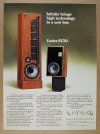
ampman , which Infinity speaker model do you have? They've changed a lot since those legendary ones with electromagnetic tweeters EMIT ... that Polycell tweeter they made as an exclusive It's so soft that the church bells sound just as real as the altar boys' bells...
Attachments
Last edited:
Hi,ampman , which Infinity speaker model do you have? They've changed a lot since those legendary ones with electromagnetic tweeters EMIT ... that Polycell tweeter they made as an exclusive It's so soft that the church bells sound just as real as the altar boys' bells...
I have a pair of RSa which are the two-way system yet have the EMIT technology. Just recently acquired them so do not know how they preform.
academia50
Active Member
Hi
Do you have a multimeter? Test if the impedance ( resistance in reality ) is good (less than 4 ohms, probably around 3 ohms) and connect it! Reviews indicate good sound but some lack of midrange. The amplifier will generate more power with that impedance, so be careful with the volume.
PS: If you don't have a multimeter, try a 1.5-volt battery. All transducers should produce a click (a popping sound when you touch and release the battery), and the click should be similar in both speakers.
Do you have a multimeter? Test if the impedance ( resistance in reality ) is good (less than 4 ohms, probably around 3 ohms) and connect it! Reviews indicate good sound but some lack of midrange. The amplifier will generate more power with that impedance, so be careful with the volume.
PS: If you don't have a multimeter, try a 1.5-volt battery. All transducers should produce a click (a popping sound when you touch and release the battery), and the click should be similar in both speakers.
academia50
Active Member
I don't mind if there are no answers, it comforts me to know that you have surely learned something from my contributions... (I hope so) 
academia50,I don't mind if there are no answers, it comforts me to know that you have surely learned something from my contributions... (I hope so)
Yes, have learned something about the feasibility of creating the system. Will need a bit of time to digest it all and decide what to do.
Thanks.
academia50
Active Member
That's good to know, good luck!

Nordfors
Member
I do not own a KA8100, but I've seen here the collective opionion seems to be it leans towards the "clinical" side sonically, meaning not a warm tubelike sound. Again, I can't say first hand. Given this, it would seem like a warm sounding speaker may have the best synergy. I guess that's another debateable topic. Warm speaker suggestions folks? I'll throw vintage KEF out there.

My speakers in the main rig are the newest component in that system.
In living room I'm running ADS, in the shop are Klipsch, and a bedroom has another pair of ADS.
All Kenwood powered.
They sound fine to me but only the main rig is for critical listening.
I think you find speakers you like and mate the power amp/integrated/receiver.
Enjoy the journey!
In living room I'm running ADS, in the shop are Klipsch, and a bedroom has another pair of ADS.
All Kenwood powered.
They sound fine to me but only the main rig is for critical listening.
I think you find speakers you like and mate the power amp/integrated/receiver.
Enjoy the journey!
Similar threads

- Replies
- 19
- Views
- 3K


- Replies
- 13
- Views
- 4K

- Replies
- 1
- Views
- 85
