• The move to the new server is done. There are some software and database maintenance updates in process. This has us passing the hat around to help out. We appreciate any donations. Seriously, even a dollar helps. The payment page may be found here - https://www.audiokarma.org/support.html

Who here on AK is using 3D printed parts?

Anyone have a file to print pioneer turntable feet PL-514-516-518 etc…
No, but I made something similar that worked well for me. I printed cups that retained Sorbothane balls and used those for the feet. Sorbothane is a viscoelastic material that's very effective at vibration isolation and damping—it absorbs mechanical vibration and dissipates much of that energy rather than simply transferring it back into the turntable. The setup worked very well for me.
 
Anyone have a file to print pioneer turntable feet PL-514-516-518 etc…
I very rarely use other people's designs to print. It has been my experience that few people design things the way I like or with the accuracy I require. You may search for and find the exact thing you're looking for but there's probably only about a 10% chance it will actually be fit for your purpose. The sites where people post designs are loaded with models that are often unprintable or just useless, and are intended primarily for the "designer" to be able to claim he has 1000 designs posted.

If you have a 3D printer, get a caliper and learn to use CAD. Otherwise your printer is going to do nothing but print tugboats and starwars junk, and will soon end up at your next garage sale. Don't use sketchup. It's for architecture and landscaping, not 3D printing. If you want easy to learn and use CAD, try DesignSpark Mechanical. The free version will do 99% of what you'll ever need to make functional parts.

It is not uncommon to go through a few iterations of a design before you get it just right. If you are going to post your designs, post the final one that actually serves its purpose, not the first couple that still need to be tweaked.

 
I very rarely use other people's designs to print. It has been my experience that few people design things the way I like or with the accuracy I require. You may search for and find the exact thing you're looking for but there's probably only about a 10% chance it will actually be fit for your purpose. The sites where people post designs are loaded with models that are often unprintable or just useless, and are intended primarily for the "designer" to be able to claim he has 1000 designs posted.

If you have a 3D printer, get a caliper and learn to use CAD. Otherwise your printer is going to do nothing but print tugboats and starwars junk, and will soon end up at your next garage sale. Don't use sketchup. It's for architecture and landscaping, not 3D printing. If you want easy to learn and use CAD, try DesignSpark Mechanical. The free version will do 99% of what you'll ever need to make functional parts.

It is not uncommon to go through a few iterations of a design before you get it just right. If you are going to post your designs, post the final one that actually serves its purpose, not the first couple that still need to be tweaked.
I got my 3d printer and hated it because it was a creality mess. After maybe close to 50 or so hours of work to get it right, I loved it. For about 3 days. Then I realized I was stuck printing stuff from printables. Then I put myself through about a 4 month Onshape crash course about 5-10 hours a day for for 4 months. Then I loved my 3d printer again. Next is a plasma table.
 
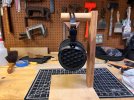
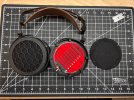
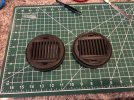
One project so far. I opened up these Monolith M-1060C closed back headphones. The fazors were from thingiverse and printed at the HB Public Library’s Makerspace. I also sewed the double thickness leather headband there. The 3D printed grills came from Etsy. Fun stuff.
IMG_3281.jpegIMG_3280.jpegIMG_3221.jpeg
 
Just starting playing with epoxy resin a week or so ago, some 3d printed stuff got the treatment (the thorens pic, the exact same print, one covered with a red dyed resin) - this stuff is crazy cool and fun to play with. Still learning how to work with it a bit but already the results are sweet.
 

Attachments

  • 20260831_150007.jpg
    20260831_150007.jpg
    135.7 KB · Views: 19
  • 20260831_145950.jpg
    20260831_145950.jpg
    155.3 KB · Views: 20
  • 20260831_145940.jpg
    20260831_145940.jpg
    131.5 KB · Views: 19
  • 20260829_045857.jpg
    20260829_045857.jpg
    112.4 KB · Views: 17
  • 20260827_053850.jpg
    20260827_053850.jpg
    120 KB · Views: 17
One project so far. I opened up these Monolith M-1060C closed back headphones. The fazors were from thingiverse and printed at the HB Public Library’s Makerspace. I also sewed the double thickness leather headband there. The 3D printed grills came from Etsy. Fun stuff.
Interesting! What does converting from closed to open back do to the frequency response of the headphones?
 
Interesting! What does converting from closed to open back do to the frequency response of the headphones?
Good question, but I don’t know. These headphones were highly reverse-engineered Audeze LCD-2 closed back clones for roughly 1/2 price at release. Very successful by all accounts in the headphone community. So after a few years I decided to get the Audeze LCD-XC’s, but liked the LCD-2 closed backs better and for more savings than I paid for the Monoprice clones. I just followed the community following Audeze’s later addition of “fazors” on the ear side. The “fuzzor” red felt is meant to damp reflected back wave from the grills. Cheep, reversible, lighter, and a different flavor of planar driver to enjoy.
 
It's been recommended that I add these here.

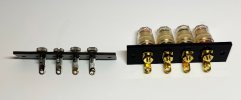
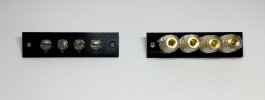
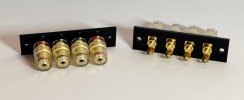
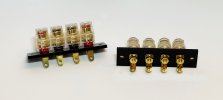
I own an H/K 330a and did a pretty extensive restoration on it. Part of that restoration included upgrading the factory speaker screw terminals to 5-way binding posts. I didn't want to destroy my originals, just in case I ever wanted to go back to factory. After a bit of research, I decided I didn't like the look of the 3D printed options on eBay. I had just purchased a desktop laser cutter from a friend and figured this was a great way to learn to use it.

After some trial and error (I'm not an engineer), I ended up with cast acrylic plates to hold the binding posts.

I think they turned out great. (closeup pics by @QUiKSR20)

IMG_0428.jpeg

IMG_0200.jpeg

IMG_0696.JPGIMG_0695.JPGIMG_0684.JPGIMG_0685.JPG
 
Everything I do requires multiple iterations. I wanted some Kelvin clips but nothing online was quite right. In fact, a lot of things labeled Kelvin clips were just add-ons for existing clips. I started out with two pieces that snapped together and were annoying to print. Then I went to a one-piece flexure pivot design. It's not there yet, but I'm getting close.

DSC_4185_proc.jpg
 
Everything I do requires multiple iterations. I wanted some Kelvin clips but nothing online was quite right. In fact, a lot of things labeled Kelvin clips were just add-ons for existing clips. I started out with two pieces that snapped together and were annoying to print. Then I went to a one-piece flexure pivot design. It's not there yet, but I'm getting close.

View attachment 3837226
Just think 10 years or so ago this would not even have been possible for most people. Now we can make a prototype, modify it, throw it the trash and make another in 30 minutes. In the past that would have cost hundreds of dollars and taken weeks to get done. I go through several version normally too. Very rarely do I get it right the first time.
 
Yes. I work in manufacturing. I print prototype parts before we job out the real thing. Being able to do fit checks as we design has saved us so much time. Before, we would have to wait weeks for a vendor to make a part (metal or plastic).
 
We also do prototype parts at work but quickly realized that some parts we thought were impractical to produce that way were actually quite functional. Now we do both prototype and production parts. I think we're up to three printers that run most of the time.
 
After some trial and error (I'm not an engineer), I ended up with cast acrylic plates to hold the binding posts.

View attachment 3837174View attachment 3837175View attachment 3837176View attachment 3837177
Acrylic tends to be brittle and will crack if subjected to much mechanical force, such as tightening the screws that pass through it. In the early days of 3D printing, just after people realized that plywood was a stupid choice for printer frames, many companies started selling cheap printers with frames made from laser cut acrylic. They had a tendency to break easily and quickly and disappeared from the market after a year or so of people sh** posting about them in the internet forums.

Those parts are pretty simple. I would 3D print them using ABS or PETG filament, both of which are much tougher than acrylic. Or use some FR4 PCB material. All you have to do it cut it to size and drill a few holes.
 
I don’t have the physical capacity to do any of this, but I’ve watched a crap load of videos, and I think that the average person can have this ability in their own home fascinating.
My SMGs have 3d printed supports.
 
We also do prototype parts at work but quickly realized that some parts we thought were impractical to produce that way were actually quite functional. Now we do both prototype and production parts. I think we're up to three printers that run most of the time.
Yes, we print some of our smaller specialized parts for production when they don't have to be metal (or pretty).
 
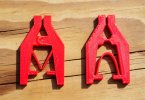
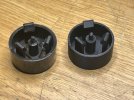
I have a Pioneer SX-680 that came with missing snap-in feet. I was able to print these replacements that are almost identical to the originals. The should also work on SX-580, SX-780, and SX-880. Took measurements of the one that I have, built it into a CAD program, exported it as 3MF, and Orca took it from there.

I used generic PLA. Is that the best? Beats me. But it worked well. Once they print, all you need are pads.

Left is original, right is new.

Attached the zipped 3MF file for those who are interested.
 

Attachments

If you want those feet to last, I'd reprint them in PETG, ASA, or ABS. PLA softens at very low temperatures, and absorbs moisture from the air and turns brittle. The snap-in bits will snap off. Never use PLA for anything that you want to last a long time. PLA is best used for tugboats, starwars junk, and anything else that will likely be thrown away 15 minutes after it comes off the printer. I hear that it works well as support material for PETG prints, and one of these days I'll try it, after I have reviewed the procedures for clearing clogged nozzles on my printer.

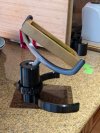
Here's my latest- a ball mount for a sand art frame that allows it to be positioned at any angle (which allows you to control the speed at which the sand falls in the water). You position the frame, then twist the lock ring at the base. If I can find a suitable spring, I'll eliminate the lock ring. This prototype is printed in PETG.

ball mount frame holder.jpg
 
If you want those feet to last, I'd reprint them in PETG, ASA, or ABS. PLA softens at very low temperatures, and absorbs moisture from the air and turns brittle.
Thanks for mentioning that. I had no idea. At work we recently switched from a printer that only printed ABS to a Prusa XL that has 5 heads and prints everything. I've been using PLA for nearly all our projects. I'll have to switch to PETG for our production parts.
 
Back
Top Bottom