• The move to the new server is done. There are some software and database maintenance updates in process. This has us passing the hat around to help out. We appreciate any donations. Seriously, even a dollar helps. The payment page may be found here - https://www.audiokarma.org/support.html

Why re-cap speakers?

These threads are tiresome.

Nobody's mind is ever changed. Those on one side stay entrenched, those on the other preach from the mount. I thought the OP's question was pretty simple, "Why recap speakers?" Well, when they go bad, when they've exceeded their expected lifespan; when you want to tweak your speakers.

But here we are, back to the old recap vs. never recap; cheap vs. boutique caps debate. It's an exercise in futility.


... Anyone still over at the redneck camouflage speaker grill thread??
 
The only A/B I do is here, and always in the same room, in the same chair. And I do a "lot" of it. At first it may show obvious differences at a given frequency and instrument if the music has that. After that it takes a lot of listening to sort the whole thing out. Lots of time, lots of different music.
Yes a speaker has this or that personality. But why? Is this missing? Or does it have to much of that? Or does it have everything but in all the wrong places?
A/B tells me the something, but not the what, why or where.
I think familiar long term auditory memory can be very good. But not past a few seconds if I'm not familiar with something. Maybe that's the whole point of A/B.
 
These threads are tiresome.

Nobody's mind is ever changed. Those on one side stay entrenched, those on the other preach from the mount. I thought the OP's question was pretty simple, "Why recap speakers?" Well, when they go bad, when they've exceeded their expected lifespan; when you want to tweak your speakers.

But here we are, back to the old recap vs. never recap; cheap vs. boutique caps debate. It's an exercise in futility.


... Anyone still over at the redneck camouflage speaker grill thread??

Why recap? Because we can. It's our Mt. Everest, out Matterhorn. We do it for the challenge, and the hope of fulfilment.

Naw, to me, new caps sound better, which makes the music sound better. That's all I'm after. A pleasing experience, with the best equipment I own. My own ears.
 
Last edited:
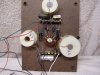
Well I did my first speaker recap today on one of
my four 40 year old speakers. I did the one that sounded
the worst of the 4. the mids and tweets sound much better.
I didn't really notice much change in the bass but these speakers
have always had very good bass. I'll be doing the other 3 now.
I'll get a pick of the recapped board next time. I forgot this time.
It must take the new caps a few seconds to work because that
speaker sure sounded bad for the first few seconds.
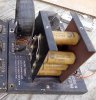
100_6139 (2).JPG 100_6349.JPG
 
I'm a believer in caps of the same value and (roughly) construction changing the sound. I've swapped caps on more than one set of speakers or component, and I think I've heard a difference.
One of the things I have noticed; whenever someone does a A/B measurement test between different caps, they never seem to use an FR measurement. It's almost always running sine or square waves through a scope. Do any of these people know you can run FR sweeps with a calibrated mic, just like you would when testing a speaker, and save the results? After that, it's a simple matter to run those same sweeps after swapping the caps. You then just overlay on set of FR measurements over the other. The difference there is, of course, if a cap varies +/- 5%, 10%, or often 20%, your are probably going to see it in the unsmoothed FR measurements. I have. It was mere 1-2dB changes, but those are certainly audible dependent on frequency.
 
Largely agree with the cap replacement. However the older the cap, the closer it is to failure.

Changing a woofer shunt capacitor that's in spec is unlikely to be audible. However, replacing a series tweeter cap with newer film types may result in an audible improvement. But not always, depending on the tweeter. And I've got a little question with the heat issue. Voice coils, resistors, capacitors can be subjected (and subject) to some pretty toasty temps when the volume's up. Just like an amplifier.
Thank you!

I almost started a thread, "Can a capacitor be bad, but measure good?" My reason? I recently thought I had fried one of my KEF 104/2's when I accidentally inserted the tube on my Saga, incorrectly. The Saga was off, the amp was not and I got a loud POP from the right speaker. Shut everything down, inserted tube correctly, powered on and heard some distortion from said speaker, until it quit completely. No sound at all.

Since I already had the Falcon cap kit, I figured this might be a good time to replace them. :rolleyes: I checked each cap (Fluke DVM) as I pulled them and they were all within spec. (more or less allowing for age). However, with the new caps installed the speaker now works again. :dunno:

I really couldn't tell a difference in SQ (old vs new caps) as, prior to the Saga, I was driving them with a less than adequate (for these speakers) 65w receiver. They do shine with more power though.

Other than the above, I've only recapped one set of Norman model 8's. I used Sonicaps and they did improved the SQ. My ADS were made with quality caps and I feel no need to replace them.

Oops! I lied. Just remembered that I also recapped a pair of NHT SuperOne's, with Dayton caps. I preferred the originals as the Daytons make them too bright. For my tinnitus ears anyhow.
A well known issue with the Dayton caps yet because they are rather cheap they are popular among many otherwise intelligent people.
 
I long time ago, I recapped my Cornwalls with a Crites kit. Then I reversed them and put the originals back in... then swapped again.

I was trying to get strings to sound “right” from Cornwalls... I finally ended up with the original crossovers back in them and bought a pair of B&Ws to listen to strings on. Cornwall for wind, B&Ws for strings, original caps within spec.

I’ve also recapped others and been happy with the results.

I applaud the “hands on approach” to this hobby.

Futz with the caps if you want to, claim they’re better or worse. Hell, don’t forget to wrap your crossover in plastic wrap and tin foil ( gotta shield from the intergalactic EMF gamma rays ) ... do whatever you want to with YOUR speakers.
 
some speakers have beautifully made crossovers, most speakers do not. I don't know if it's the hidden-in-the-box thing but a fair number of vintage speakers have crossovers that look like they were assembled by junior high kids from random parts on hand & a hot glue gun. Ascetics aside, since many of the bits used were not top drawer to begin with it is reasonable to assume 20 or 30 years out they may not be operating at peak performance levels. Sometimes this will manifest itself as a dead driver, more often than not it's a slow drift towards muddy sound, like someone thru a blanket over it. I'm about to redo the crossovers on some a Bozak's, Those would be in the well-made camp but 50 years out, paper caps get funky while the drivers themselves are still excellent. Once done I will A/B one to the other but a I'm pretty sure the differences won't be hard to spot. 'We'll see.
3F1A0551-CAB4-4621-90D5-B5448510BEA9.jpeg
 
A well known issue with the Dayton caps yet because they are rather cheap they are popular among many otherwise intelligent people.
Interesting because when I went into my Speakerlab 1's to do a recap after more than 35 years I asked for recommendations here and someone suggested the Daytons, which I used. The results are good.
 
The author of that extensive list wrote it assuming he could hear all those differences in sound qualities. He never established that he, or anyone else, could actually hear such differences. When ever people have tried to determine that – with scientifically valid methods – they couldn't.

That's why I think his capacitor comparison is worthless.
 
The author of that extensive list wrote it assuming he could hear all those differences in sound qualities. He never established that he, or anyone else, could actually hear such differences. When ever people have tried to determine that – with scientifically valid methods – they couldn't.

That's why I think his capacitor comparison is worthless.

You can't be serious. Tony Gee is highly respected in the audio world. For you to dismiss him outright does not reflect well on your opinions.
 
I occasionally read the Humble Homemade cap reviews, just to keep up with new comparisons. I also get ideas on what caps to try, from the Polk Audio Forum. Those guys are very enthusiastic about upgrading caps.

After a recap, and after I A/B a stock and recapped speaker, I go back to Humble, and read the descriptions on the caps I've tried. So far, Tony's cap descriptions and mine own tests, have mirrored each other very closely. I'm actually surprised with the similarities, of what I've heard, and Tony comments. I now have great faith in the Humble findings. :)
 
The author of that extensive list wrote it assuming he could hear all those differences in sound qualities. He never established that he, or anyone else, could actually hear such differences. When ever people have tried to determine that – with scientifically valid methods – they couldn't.

That's why I think his capacitor comparison is worthless.
He says he can hear the difference in caps. He's building speakers. Listens to speakers all day long. Changes parts all day long. Has all the stuff right there in front of him to play with. It's what he does. Good work if you can get it.
I don't think his observations are worthless.
 
The author of that extensive list wrote it assuming he could hear all those differences in sound qualities. He never established that he, or anyone else, could actually hear such differences. When ever people have tried to determine that – with scientifically valid methods – they couldn't.

That's why I think his capacitor comparison is worthless.

Well when you can give an example of any crossovers you have personally worked on that didn't involve Dayton caps, and any side by side comparisons than you would have a valid point....

Have you personally ever listened to any better quality caps? I have... and have many threads up to prove it...

So when you get some REAL EXPERIENCE than you will have REAL ADVICE to give.. If not, what is your point?
 
The author of that extensive list wrote it assuming he could hear all those differences in sound qualities. He never established that he, or anyone else, could actually hear such differences. When ever people have tried to determine that – with scientifically valid methods – they couldn't.

That's why I think his capacitor comparison is worthless.

with scientifically valid methods

LOL im seriously cracking up...

Yes they do, the materials used, the closer in tolerance, running in parallel to build to exact values..

This is not snake oil, I really want to know what brands of caps you have used. Do you even solder?
 
Back
Top Bottom