• The move to the new server is done. There are some software and database maintenance updates in process. This has us passing the hat around to help out. We appreciate any donations. Seriously, even a dollar helps. The payment page may be found here - https://www.audiokarma.org/support.html

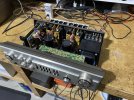
Yamaha CA 1000 power circuit board caps?

The coupler/de-coupler switch needs to be removed , disassembled and cleaned. Easiest slide switch in the amplifier to properly clean. The switch contacts are notorious for getting badly tarnished..
I have been deep in a Luxman L100u. It was shotgun restored, yes almost every part by an “engineer” prior owner. Mismatched, improper, wrong orientation, you name it. But just got it back and stable yesterday afternoon. Will get back to the Yamaha soon. Does (can) the switch short when dirty/corroded? This yamaha was near spotless internally and no other signs of corrosion elsewhere.
 
I have been deep in a Luxman L100u. It was shotgun restored, yes almost every part by an “engineer” prior owner. Mismatched, improper, wrong orientation, you name it. But just got it back and stable yesterday afternoon. Will get back to the Yamaha soon. Does (can) the switch short when dirty/corroded? This yamaha was near spotless internally and no other signs of corrosion elsewhere.
1697211562538.jpeg
 
Tarnish - black oxide. Contact cleaner will improve it. I just open and use metal polish. Takes 2 mins to look shiny new. Ipa flush and D100, back together again.
Find the same oxide in Dual Tuntables, Technics turntable mute switches, and Yamaha is bad for it. From the wafers to the slides.
Got it, still don’t understand how a bad contact could cause a short unless it’s full of conductive goo?
 
Drifting off topic, thinking out loud...been somewhat puzzled by that black coating on transistor legs. I've seen some examples under magnifying lamp where it looks to have been applied, ie, OEM smooth finish with square edges... other examples where it appears as soot, irregular coating. Google tells us silver sulfide is produced when silver reacts with hydrogen sulfide (aka rotten egg gas), the above is certainly not the result of some environmental reaction, especially when comparing to my silver tea set... So the black coating was applied as some sort of low noise feature(?) to reduce effects of stray fields(?) would make some sense if low noise transistors were targeted for such treatment.

Somewhat related, have you noticed yamahas "low noise" resistors, mounted standing giving minimum exposure to one leg with the other leg coated so as to reduce effect of fields.
 
So the black coating was applied as some sort of low noise feature(?) to reduce effects of stray fields(?)

Somewhat related, have you noticed yamahas "low noise" resistors, mounted standing giving minimum exposure to one leg with the other leg coated so as to reduce effect of fields.
I doubt that the coatings you mentioned can have any effect on noise. If it was for shielding stray fields with a coating of one leaded part will not be effective because the transistor lead is soldered to a track and connecter to other component without any of the supposedly shilding coating.
I have seen some transistors that indeed look like their leads were painted with some black coating, and even xraytonyb talks about this in several of his videos in his youtube channel. If the manufacturers indeed coated the leads of transistors, i speculate that it may have been to prevent corrosion or some related chemical efect of the atmosphere on the component.
Carbon film resistors designed to be mounted vertically came out with pre-formed leads from factory (Panasonic) and they had some light color varnish on the long lead that was bent, my speculation is that the varnish acted as an insulator, which makes sense because their use in portable electronics made quite densely populated boards ad shorts could occur if the leads bent.
My understanding is that most of the low noise characteristics of transistors has to do with the design of the junctions themselves which is way over my head. For resistors, there is a big difference between noise characteristics for metal foil and metal film (more quiet), versus the carbon film and carbon-epoxy composite types.
 
Correct on all counts.

Coatings were in all probability to prevent corrosion due to heat and humidity. Active component noise is also a mostly intrinsic property unless the component (transistor, diode, etc.) is operated very close to radio lines (Receiver, transmitter, etc.).
 
Thanks for the input guys, learning all the time. Yamaha did make an effort with shielding, eg, CA-800/-1000 (function, tone,filter, volume boards) the CA-1010/2010 function board which houses the phono stage but I suppose cost v benifit eventually kicked in... For my own learning, I'll keep an eye on which transistor types have the black legs and which don't.
 
For my own learning, I'll keep an eye on which transistor types have the black legs and which don't.
That’ll be good info … I’ve also come across those Xistors with black legs and only upon pulling out the magnifying glass stopped myself from trying to clean the assumed corrosion. Come to think of it, discoloration due to corrosion isn’t uniform in color or texture and looks more like small brownish/blackish dots/stains.

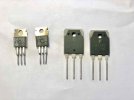
In case of new old stock (NOS) parts, you get something like below. On the right, you have 2SA1146 (B-50) with light oxidation due to age, especially humidity and, on the left you have 2SD476 (C-6) with the leads only lightly cleaned. This level of corrosion can be completely cleaned with mild abrasives.
D7D2819C-DA17-4E83-8813-26CA5F8F4875.jpeg
 
Tarnish is a black coating of silver sulfide and is conductive.
Okay, I finally got around to pulling the coupling switch and it was clean as can be. I rubbed the contacts down and hit them with d100. Put everything back and it plays fine for about 10 minutes and then the crackle on both speakers. Turn it off for a minute and it plays fine. Decouple and it’s silent. Guess it’s coming from somewhere in the preamp section or power to the preamp? Going to monitor the preamp out for a bit. I can’t remember when I rebuilt the power supply if I replaced the transistor (s) in the low voltage section. Something is crapping out. It’s a real snap, like destroy your speakers type…
 
Okay, I finally got around to pulling the coupling switch and it was clean as can be. I rubbed the contacts down and hit them with d100. Put everything back and it plays fine for about 10 minutes and then the crackle on both speakers. Turn it off for a minute and it plays fine. Decouple and it’s silent. Guess it’s coming from somewhere in the preamp section or power to the preamp? Going to monitor the preamp out for a bit. I can’t remember when I rebuilt the power supply if I replaced the transistor (s) in the low voltage section. Something is crapping out. It’s a real snap, like destroy your speakers type…
If you haven’t solved the problem, check the output relay. Experience has shown that a bad relay can produce the effects that you describe. You can monitor the signal going into the relay, and what is coming out. Or, visually inspect the relay. Usually the relay cover can be easily removed by squeezing the cover from opposite sides, which causes the other two sides to bulge away from the base enough to free the retaining tabs, and the cover can be lifted off.
 
If you haven’t solved the problem, check the output relay. Experience has shown that a bad relay can produce the effects that you describe. You can monitor the signal going into the relay, and what is coming out. Or, visually inspect the relay. Usually the relay cover can be easily removed by squeezing the cover from opposite sides, which causes the other two sides to bulge away from the base enough to free the retaining tabs, and the cover can be lifted off.
The relay was one of the first parts replaced. After completely resoldering the connector board on the back it hasn’t reoccurred. There was nothing visually obvious on this board under a magnifying viewer and yes, I reattached the grounding wire. When this happens there is a loud snap, crackle and pop… plus the the woofers extend outward - both speakers. Prior it sounds fantastic and looks that way on the scope with all voltages good.

The entire power regulator board has been replaced. The mode switches, power filters, diodes, all the known bad transistors plus entirely recapped with everything 10uf and under in the signal path films. It’s quite abrupt and like destroy your speakers bad. Everything physical cleaned and continuity tested.

It’s played 3 or 4 hours now clean. The prior time it was after playing all day. I assume this is why it was sold. Clean as new and not a physical indicator of heat or damage. Driving the amp with a separate preamp it’s clean and solid.

I have repaired and restored almost every notable unit and brand and 100’s of them so assume my technique and skill set is good. This one is a head scratcher

 
The relay was one of the first parts replaced. After completely resoldering the connector board on the back it hasn’t reoccurred. There was nothing visually obvious on this board under a magnifying viewer and yes, I reattached the grounding wire. When this happens there is a loud snap, crackle and pop… plus the the woofers extend outward - both speakers. Prior it sounds fantastic and looks that way on the scope with all voltages good.

The entire power regulator board has been replaced. The mode switches, power filters, diodes, all the known bad transistors plus entirely recapped with everything 10uf and under in the signal path films. It’s quite abrupt and like destroy your speakers bad. Everything physical cleaned and continuity tested.

It’s played 3 or 4 hours now clean. The prior time it was after playing all day. I assume this is why it was sold. Clean as new and not a physical indicator of heat or damage. Driving the amp with a separate preamp it’s clean and solid.

I have repaired and restored almost every notable unit and brand and 100’s of them so assume my technique and skill set is good. This one is a head scratcher
Yes, that is a head scratcher. Intermittent fault but only after hours of operation. Maybe there is a power supply dropout that you can catch with a scope. Or, it still happens and the power supplies are solid; at least the problem space is narrowed. Good luck!
 
Every part except for a couple resistors on the power board have been replaced with new high quality parts. All caps, all silicon, diodes, rectifiers and most of the resistors. It doesn’t impact the amp section, only the preamp. Guess I need to figure out a way to monitor and record the regulated low voltage that drives the preamp side of the house, input and output.
 
When you say all caps, does this include the ceramic and clear polystyrene caps as well?

EDIT: and not only in the signal path as you stated earlier.

Nashou
 
  • Like
Reactions: mbz
When you say all caps, does this include the ceramic and clear polystyrene caps as well?
Also the polar tants? used in the function, tone and filter boards.
dying tants typically cause a wind type noise though I'm not familiar with other tant failure modes

It doesn’t impact the amp section, only the preamp. Guess I need to figure out a way to monitor and record the regulated low voltage that drives the preamp side of the house, input and output.
The regulated 50Vdc supply feeds both the preamp boards and the front end of the power amp boards (as +/-50 pins).
If a psu problem then would expect some disturbance when running the CA-1000 as a power amp.

Since problem is intermittent you probably need a meter with a hold function.

Thinking out loud, since both channels equally affected, could this be a GND issue ??
 
When you say all caps, does this include the ceramic and clear polystyrene caps as well?

EDIT: and not only in the signal path as you stated earlier.

Nashou
I stated all signal path caps under 10 uf replaced with Wima films. All electrolytic’s replaced otherwise. Not all of the ceramics, but a number of them. All the tants would have been replaced with wima’s if 10 uf or smaller, otherwise Nichicon UKL’s. Replacing the rectifiers didn’t solve the problem. Resoldering the connector and coupler boards did appear to do so. It’s played all day for two days now without an issue. I don’t as a rule replace polystyrene caps.

None of the solder points on the connector or couple boards appeared to be bad, but I resoldered them all anyway.
 
I stated all signal path caps under 10 uf replaced with Wima films. All electrolytic’s replaced otherwise. Not all of the ceramics, but a number of them. All the tants would have been replaced with wima’s if 10 uf or smaller, otherwise Nichicon UKL’s. Replacing the rectifiers didn’t solve the problem. Resoldering the connector and coupler boards did appear to do so. It’s played all day for two days now without an issue. I don’t as a rule replace polystyrene caps.

None of the solder points on the connector or couple boards appeared to be bad, but I resoldered them all anyway.


Weird how we chase a problem and its as simple as re-soldering some connections etc. I guess this is why @Sparkplug always suggests this when some posts an issue with a unit !! :thumbsup:

Athanasios
 
Back
Top Bottom