• The move to the new server is done. There are some software and database maintenance updates in process. This has us passing the hat around to help out. We appreciate any donations. Seriously, even a dollar helps. The payment page may be found here - https://www.audiokarma.org/support.html

Zilch's AK Design Collaborative - Econowave Speaker

Thanks Russell,

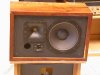
My really bad pic/desturbed below is what I'm thinking of tossing together for
now then building new cabs in the summer using the parts from my 4628B into
some CV D9 cabs I have, there roughly 5 cu ft tuned to 40 hz, so I think the
2225H's should live in there respectably and all the other parts fitting, I'll redo
the front baffles obviously and mirror image them at the same time. :screwy:

(No CV's will be hurt in this hostile takeover, as there are no drivers in the cabs)


At first, I thought you had new KPM pics to show us. :)
 
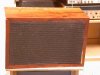
Center channel finished.

The center turned out to be much easier than it seemed like. With the 6 inch square waveguide being so small, it seemed like 2-2.5 KHz would be a better place to crossover to the Selenium driver. I questioned Zilch, and he referred me to some earlier posts where he and skywaverider had played with the smaller waveguide, and it performed quite well with the standard EconoWave crossover/compensation. Plus JBL uses 1.6 KHz with it in some applications.

That settled it, then. Better to keep it standard if it works there. After getting it playing, I tried looking at the FR's off axis. Didn't see any great degradation in the low frequencies as the mic was moved off axis. Great little waveguide, with it's only sore spot being that it covers 90 degrees vertically.

Next project is the completion of the two rear channel speakers, plus the stands they will mount on. They will use the 8 inch square waveguide, and it may need some different compensation. That sounds like fun.
 

Attachments

  • centerbare.jpg
    centerbare.jpg
    64.6 KB · Views: 102
  • centerdressed.jpg
    centerdressed.jpg
    93.1 KB · Views: 39
COOL JACK!
Hope to show mine soon.

Question regarding PC board etching:
Does the developer or the etching solution make a lot of fumes?
I'm having trouble coordinating a place to do mine, and I think I might go for it in the apartment.
 
COOL JACK!
Hope to show mine soon.

Question regarding PC board etching:
Does the developer or the etching solution make a lot of fumes?
I'm having trouble coordinating a place to do mine, and I think I might go for it in the apartment.

I learned to etch boards in mama's kitchen many years ago. Neither product has nasty vapors, nor makes lots of fumes. The ferric chloride, if that is what you are using, doesn't smell like the garden, but it is tolerable. Just remember that ferric chloride can stain anything it comes into contact with. Flush it with lots of water as you dump it into the sink or toilet after etching.
 
So, will a simple highpass like a cap on the input take care of that? :dunno:

Passive crossovers on the input and output of an amp will be additive. If you put a cap on the input and drive a passive speaker level crossover then the level in teh crossover region will be lower, possibly by an unpredictable amount. Possibly this could be worked out but to be certain to have the desired crossover frequency and slope and adequate loading on the amp, the crossover should either be entirely on the input of the amp or the output of the amp should be loaded across the entire frequency range.

One way to achieve this is to provide a dummy load on the amp output to simulate the missing driver.


example:

If you want to drive the EWave horn only, from a tube amp using the passive eWave crossover, place an 8 Ohm power resistor in place of the woofer at the passive crossover's LF output. This maintains adequate loading on the amp.
Place a cap on the input of the amp that will provide a first order slope with a crossover point at least an octave below the passive speaker crossover's rolloff point. The input cap will block some of the bass and allow the tube amp to retain some headroom but its rolloff will be at a low enough frequency to not affect the output voltage of the amp in the range that you'll be using to drive the horn.
 
More "ambience."

4430 is 100° x 100°.

So's your PT L200s.

[Those don't hurt a bit.... :D ]

Well, probably not a sore spot for you, but I prefer the 90 degrees horizontal X 40 degrees vertical dispersion of the original 6 inch by 12 inch waveguide. Guess that's why they make Chevrolets and Buicks.
 
Thanks!
I wound up getting the Etching solution from Capital Electronics, the place you mentioned in your tutorial thread, in your neck of the woods.


I learned to etch boards in mama's kitchen many years ago. Neither product has nasty vapors, nor makes lots of fumes. The ferric chloride, if that is what you are using, doesn't smell like the garden, but it is tolerable. Just remember that ferric chloride can stain anything it comes into contact with. Flush it with lots of water as you dump it into the sink or toilet after etching.
 
If you want to drive the EWave horn only, from a tube amp using the passive eWave crossover, place an 8 Ohm power resistor in place of the woofer at the passive crossover's LF output. This maintains adequate loading on the amp.
That's appropriate for active biamping, perhaps, but those doing passive will be using the LP section for driving their woofers, in which case it's a cap in series with the HF amp's input and an inductor plus load resistor across it's output in addition to the passive highpass filter? :scratch2:
 
I'm not sure I agree with this.

If you run your tube amp into the high pass section full range, your bass frequencies
will be attinuated by the cap, then pass through the coil (2nd order) to ground so the
tube amp does have a load on it in the bass frequencies. That's how I see it anyway.

I've ran passive biamping with tubes doing just highs with no problems in the past. :dunno:
 
Been a long time since I've popped in here - got real busy at work.:thumbsdn:

I've played with different types of foam, messed around with the x-over a bit etc......etc. :no:

Also have been popping different amps in and out; diy amps and commercial as well.

I stumbled on a Adcom GFA 5400 at the dump - needed a little to get it going but I got it making music. Ya know, I've removed all my mods to the speakers and the thing sounds right to me:music: This amp from the dump has the perfect power level and tonality for my ewave set up. I think I'm happy:banana:

Thank you to the pioneers of the project!
 
MartinQ, I'm in the same boat - up in Canada. What is the part number for the Pyle Pro horn at MCM? (53-970?). I'm going to order the drivers from Parts Express - are there any horns at PE that will work for this? Was $30 at a walk-in JBL pro service center/dealer? I'd go for that if they had them.

packrat, sorry for the long delay but I'm just catching up on the thread now. Not sure if your questions have already been answered, but I'm going ahead anyway.

The Pyle PH612 (Pyle Horn 6" x 12" ?? ) is MCM # 53-970. It currently lists for $11.29 but they are have 12% off till Dec 23rd.

From Parts Express you could try the Dayton H10RW 10" Round Waveguide. PE # 270-310 and $11.51 each.

The $30 price was from a local pro-audio shop who has a dealer account with Soundcraft Canada (the Canadian JBL distributor). Soundcraft will not sell to the public, and they don't have any of these units in stock. So yes, it would be $30 +tax, but you would have to wait a few weeks for the shipment to go from JBL in the US >> Soundcraft >> closest local dealer >> you.

At this time it would be faster and cheaper to order from MCM who would ship it to you direct.

Hope that clears things up a bit and answers your questions.
 
Anyone considering passive speaker level biamping with tube amps should carefully think about what that means to the loading of the amp.

For example in the case where a passive highpass filter is used between a speaker and the output of the tube amp, and the tube amp receives a full range input signal, the tube amp is unloaded (open circuit) for the portion of the frequency range below the HP crossover. Running a tube amp unloaded can be a really bad idea for the amp, and it definitely wastes voltage swing, since the amp will use up its voltage headroom amplifying an unloaded signal.

I don't even want to think what this does to the stability of a feedback amp with marginal bandwidth.

I think most people will have figured this out but I want to make sure that nobody is running passive crossovers and tube amps in a manner that is dangerous or wasteful.

Seems like I remember this being addressed earlier in the thread, or perhaps another, where Zilch refered to a qwip in one of the JBL active crossover's manuals concerning this. I forget what the "cure" was. Except I thought it was only an issue with active crossovers?

Russellc
 
I'm not sure I agree with this.

If you run your tube amp into the high pass section full range, your bass frequencies
will be attinuated by the cap, then pass through the coil (2nd order) to ground so the
tube amp does have a load on it in the bass frequencies. That's how I see it anyway.

I've ran passive biamping with tubes doing just highs with no problems in the past. :dunno:

Usually, it'll work fine, without any thing needed.

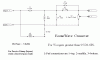
If you DO need anything, you just need a "token" load at LF... something like a 30 ohm resistor with the appropriately sized coil to get you near the normal lowpass frequency (say, 1KHz, that's close enough), wired across the input of the highpass section, would provide loading for the amp down to DC.

It doesn't HAVE to be the same impedance as the HF load... just enough to prevent oscillation. And a 30 ohm load will require less current down low from the output transformer, than a normal 8 or 16 ohm load... which will reduce saturation effects, and hence, the total sound should be "cleaner"...

In fact, I'd go about 4 times what the tap on the amp wants... if you're running a 16 ohm tap, 50-64 ohms, for an 8 ohm tap, 25-30 ohms would be fine... just select the appropriate coil (any of the online speaker crossover calculators can make short work of this- just pick first order, 1KHz, and use the resistor value as your "woofer" impedance) and you're set...

Regards,
Gordon.
 
That sounds like a really good idea Gordon,

Cheap and elegant solution, even if it wasn't "needed" may be a better config anyway. :)
(Would also provide constant low pass impedance)

-----------

(EDIT)

For those who want to implement this approach, here's an example of Gordons suggestion.
 

Attachments

  • Wooger_G_lp_load_md1.GIF
    Wooger_G_lp_load_md1.GIF
    9.9 KB · Views: 80
I meant to write this a couple days ago but got busy. I want to comment on Bauhausler's Advent Ewaves he brought to the SMAC meeting last weekend. First they are a very tidy solution. The cabs are in great shape so they are good looking speakers. The sound is what blew me away. For such a small cab up on stands, the bass was increadable. Deep and tight. It really filled the room well. The woof and horns really blended well, I could not tell which one was making noise. The horns were clear and detailed with a nice warmth to them. No horny sound what so ever. At one point, I walked in the room and could not see the speakers through all the people standing between me and them, and they sounded like MUCH larger speakers. I am very impressed. Good job B. Cheers.
 
That's appropriate for active biamping, perhaps, but those doing passive will be using the LP section for driving their woofers, in which case it's a cap in series with the HF amp's input and an inductor plus load resistor across it's output in addition to the passive highpass filter? :scratch2:

Yes. If I understand you correctly. I was trying to simplify the example by referring to the entire ewave crossover being driven by the amp powering the horn. Of course the out of band bass energy not blocked by the cap on the amp input could be shunted out of the amp output to the power resistor with just an inductor rather than the R/C combo.

Last night a couple of SMAC/AK members came over for a variety of audio activities. Two lent out tube amps came back home. One SE 300B amp left on loan to drive a pair of Altec Magnificents. A repaired Theta transport went home with its owner. My shop laptop came home wit ha new CD burner.
We listened to the Ewaves and to the Linn DMS Isobariks. I have to say that there were more similarities than differences. The Linns have more bass authority in the comparison. But then they each have a pair of Kef B139 woofers in Isobaric configuration, so they'd better be able to do something better than an Advent woofer in a particle board box.
I think the ewaves have dispersion at least as good as and possibly better than the Linns.
I'll have to compare some more, but Idon't think I need to start building shipping crates for teh Linns yet.
I do need to get some grilles built for the EWaves, as they're going out on loan to a musician next week and they'll need the protection for the drivers.

Now I have to go figure out some semiconductor pinouts and get this Phlame Linear 700 II off my bench once and for all.
 
That sounds like a really good idea Gordon,

Cheap and elegant solution, even if it wasn't "needed" may be a better config anyway. :)
(Would also provide constant low pass impedance)

-----------

(EDIT)

For those who want to implement this approach, here's an example of Gordons suggestion.

That will work fine for most amps. Consider that some tube amps have marginal stability and perform better with a uniform load impedance. Feedback levels and phase margin are factors.
 
If an amp had problems with the 32 ohm then I'd consider it a marginal design.
Heck that's enough just for the rises in impedance at fs in most woofers anyway.

But to be safe on an amp like that, 16 ohm and 2.5 mh should be a solution then.
 
Back
Top Bottom