• The move to the new server is done. There are some software and database maintenance updates in process. This has us passing the hat around to help out. We appreciate any donations. Seriously, even a dollar helps. The payment page may be found here - https://www.audiokarma.org/support.html

Zilch's AK Design Collaborative - Econowave Speaker

I work in a high end cabinet shop and we have CNC machines that can do things in an instant. I also make cabinets in my basement at home with a small number of tools including a descent table saw and router and I can produce the same quality cabinet, it just takes longer.
 
I work in a high end cabinet shop and we have CNC machines that can do things in an instant. I also make cabinets in my basement at home with a small number of tools including a descent table saw and router and I can produce the same quality cabinet, it just takes longer.

I have access to a machine shop and I use it some times for metal work that would be tedious to do with my band saw, DP, grinder and small sander. I'm sure I could work out a way to do these holes on a Bridgeport mill in a jiffy. Against Jackgiff's advice I did order one of the drill press operated scribe type circle cutters. Maybe that can be used to make a scribe line for a jigsaw to follow. Or maybe it will just make a mess. I'l ltry it on scrap first.
I have a *special reason* to prefer simple tools and techniques for this project but that cat stays in the bag for a while longer.
 
Simple is often more difficult, paradoxically.

I'm dubbing OLDSKL's manual circle cutter OLDSKL's Cesar Jig. In the 1955 Jules Dassin film Rififi, Dassin plays a safe cracker named Cesar le Milanais. To crack a safe noiselessly (30 minutes of the film elapse without a word spoken) he assembles a manual cutting jig to score a hole through the side of the safe.

It was a different time and place. Can you imagine burglars in neckties now?

rififi1.jpg


This is the kind of cutting point I'm talking about. I whittled this out of a 1/4" eye bolt based on the shapes of commercial lathe cutting points I've used.

attachment.php


attachment.php

That's It, I'm gonna wear me a neck tie next time I'm boring speaker holes!:scratch2:

Russellc
 
I have access to a machine shop and I use it some times for metal work that would be tedious to do with my band saw, DP, grinder and small sander. I'm sure I could work out a way to do these holes on a Bridgeport mill in a jiffy. Against Jackgiff's advice I did order one of the drill press operated scribe type circle cutters. Maybe that can be used to make a scribe line for a jigsaw to follow. Or maybe it will just make a mess. I'l ltry it on scrap first.
I have a *special reason* to prefer simple tools and techniques for this project but that cat stays in the bag for a while longer.

Couldn't you make a large hole in a piece of ply in the machine shop, then use that for an outside jig for your router. That way you can use the jib over and over. Like someone is doing (I can't find it) with tall bent side cabs for an ewave project. While you are at it, you could make a jig for 8, 10, 12, and 15" drivers. Then just clamp it on and route away.
 
I just bought a keyhole hand saw, wish me well.

It appears that I will be attacking the AR 2-ways with it, they show definite promise for "midrange magic" with the conversion. The Pioneer CS-R300, not, I think they will stay stock as period Japanese "Baby JBL" clones for ref purposes. I didn't hear anything in the way of good midrange potential in testing one as a provisional E-W that justifies the cost and trouble of E-W'ing them compared to the AR's and I lack the experience to "fix" whatever may be amiss (assuming that the stock woofer is actually capable of good midrange performance).
 
Last edited:
Couldn't you make a large hole in a piece of ply in the machine shop, then use that for an outside jig for your router. That way you can use the jib over and over. Like someone is doing (I can't find it) with tall bent side cabs for an ewave project. While you are at it, you could make a jig for 8, 10, 12, and 15" drivers. Then just clamp it on and route away.

Yes, but I'm trying to avoid processes that require a router. It's worth the trouble to develop a technique that requires only a cheap hand jigsaw.

I hope to have the newest pair of Large Advent ewave conversions done in time for the June SMAC meet @ your place (/hint)
 
Zilch, I am now doing some test with eminence kappa 12a, the spl is 99.2, I tried the xover with >95 db for woofers, but the HF D210ti db is still low in volume, the kappa woofer has alot of midrange frequency so it over powers the Hf D210ti driver , i need to bring it up the D210ti volume more for it to be level on the graph( Im using true RTA), I may need about a -3db, can you tell me the values for R1 and R2 and Cap for a -3db to use instead of using r2 25ohms and r1 16ohms with 1.5uf cap
 
Yes, but I'm trying to avoid processes that require a router. It's worth the trouble to develop a technique that requires only a cheap hand jigsaw.

I hope to have the newest pair of Large Advent ewave conversions done in time for the June SMAC meet @ your place (/hint)

Cool, I hope they are done by then. If you need any help, let me know. Cheers.
 
jrock7, you may need to use a baffle-step-compensation circuit (or at least the same circuit topology). The Kappa12A has a bit of a rising response (it's 1-2 dB louder at 1K than it is at 100 Hz)... so, maybe a 1mh choke in parallel with a 2 ohm resistor, in series with the woofer, might help a bit. That should "shelf" it down a bit, from 300 Hz and up.

After doing that, you'll probably have to make less adjustment on the horn circuit than it might seem now.

Also, with the peak at 2KHz-3KHz on the Kappa12A, you might want to add a Zobel circuit to the low pass. Something like 15uf and 8 ohms (in series with each other, then in parallel with the woofer) might be a good starting point.

After you do the shelf and the Zobel, you might find that you no longer need to mod the highpass...

Regards,
Gordon.
 
Last edited:
Zilch, I am now doing some test with eminence kappa 12a, the spl is 99.2, I tried the xover with >95 db for woofers, but the HF D210ti db is still low in volume, the kappa woofer has alot of midrange frequency so it over powers the Hf D210ti driver , i need to bring it up the D210ti volume more for it to be level on the graph( Im using true RTA), I may need about a -3db, can you tell me the values for R1 and R2 and Cap for a -3db to use instead of using r2 25ohms and r1 16ohms with 1.5uf cap
I'm with Gordon regarding the lowpass as the place to tackle this problem:

http://www.eminence.com/pdf/kappapro-12a.pdf

It says 97.1 dB, if that's your woofer.

I had to go back to the 2004 Selenium catalog to find the specs on D210Ti, but it says 107 dB (on HL14-25) vs. 109 dB for D220Ti (no horn, presumably):

http://www.seleniumloudspeakers.com/site2004/

What was the Parts Express part number for D210 Ti? What did they call the sensitivity?

In any case, if you go to P. 1, you'll find my measurements of the two:

http://www.audiokarma.org/forums/attachment.php?attachmentid=80291&d=1203832069

BAH, the legend reverses them, but D210Ti is the lower one, and you can see D220Ti is about 3 - 4 dB "hotter" at the high end, meaning that D210Ti is already undercompensated on the >95 dB E'Wave crossover, which we have previously determined is maxed out, so there's little value in trying to squeeze more SPL out of it with less comp, which will just roll off the VHF more.

Bottom line: if you can't tame the woofer well enough to balance as Gordon suggests, move up to D220Ti drivers and save the D210Tis for another project.... :yes:
 
Last edited:
gordon W, sounds a lot better but I think, it may need a about 2db to balance woofer and HF driver now. also , when using the resistors on the woofer what wattage do you recommend for the 2 ohms for the baffle step comp and the zobel 8 ohms resistor, since more power will be going to them. Are the 10Watt resistor ok to use?
 
Passive Radiators?

Has anyone done an E'Wave with a passive radiator instead of a bass port? I've been making myself more knowledgeable about them (a little knowledge can be dangerous), and have several speakers that utilize them: Polk & Klipsch. What I can't find is any "formula" or rule of thumb for determining the "right" configuration.
 
Modified OLDSKL Cesar Jig makes a hole

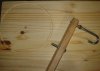
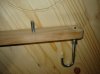
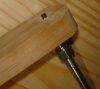
I just made up and tested a version of the manual circle jig we were discussing. I used 1 X 2 stock for the arm and machine threaded hardware for the pivot and cutter. The cutter 'blade' is about3/32 wide and is shaped like the previous post. It really doesn't want to go across grain. I was using a soft pine board and a lot of force. The blade tore the wood when going across grain. On the second attempt I'll grind the cutter narrower. I'll also take a shallower bite with each pass. I assume this will behave differently on birch plywood, which is harder and has a finer grain. It might be best to use this method to make a hole on the *back* of the stock, cut the hole through with a jigsaw and sand out the irregularities, leaving the front face with a clean edge. The chips actually wouldn't matter for my purposes, as I intend to veneer the board, but why make repair work when you don't need to?

attachment.php


attachment.php


attachment.php
 

Attachments

  • Dsc04631.jpg
    Dsc04631.jpg
    135.8 KB · Views: 265
  • Dsc04632.jpg
    Dsc04632.jpg
    31 KB · Views: 260
  • Dsc04633.jpg
    Dsc04633.jpg
    29.9 KB · Views: 258
Has anyone done an E'Wave with a passive radiator instead of a bass port? I've been making myself more knowledgeable about them (a little knowledge can be dangerous), and have several speakers that utilize them: Polk & Klipsch. What I can't find is any "formula" or rule of thumb for determining the "right" configuration.

Read this AK FAQ on Passives by DNewman04 yet?
 
Are the 10Watt resistor ok to use?
Should be fine. If you find it gets warm when playing, use two at twice the value in parallel, or half the value in series.

gordonW is a choke the same an inductor?
Yes.

The chips actually wouldn't matter for my purposes, as I intend to veneer the board, but why make repair work when you don't need to?
Looks like you're trying to cut the hard way.

Think "parting tool." You're going to need a sharp point to slice the fibers cleanly across the grain; grind a rake on it.... :yes:
 
thanks Zilch, Iooks like will have to try a different woofer from the Kappa 12a, kinda too much work to get it right. what specs in a woofer should I look for , if I wanted it to mate well with the D210 ti econowave. any tips? ( fs, qts, xmax, qes, gms, freq range response values etc....)
 
gordon W, sounds a lot better but I think, it may need a about 2db to balance woofer and HF driver now. also , when using the resistors on the woofer what wattage do you recommend for the 2 ohms for the baffle step comp and the zobel 8 ohms resistor, since more power will be going to them. Are the 10Watt resistor ok to use?

10w is OK for both resistors. Unless you're planning to put more than 200w/ch into them... if so, then 20w resistors would be good.

And yes, choke = inductor = coil.

Regards,
Gordon.
 
Yeah, I've been poring over it now, rather than skimming it like before. It answered most of my questions, but is there a way to calculate the proper MMs of the PR? (for a given tuning frequency, Vb, etc.)

Truthfully, I have the formulas... but I find myself just using BassBox to do the passive radiator calculations. Just a really useful program for such...

And yes... there definitely COULD be an advantage using a PR in an E-wave system. The woofer is playing up to 1KHz... that's a lot of midrange "bouncing around" inside the cabinet... which might "escape" through a port, but will definitely be stopped by a PR (no direct "hole" to the outside)...

Regards,
Gordon.
 
Back
Top Bottom