• Please note that Audiokarma will be offline briefly for updates early on Monday morning, September 28th.

Zilch's AK Design Collaborative - Econowave Speaker

Thanks for your responses, I have decided (after much waffling) to go with the QSC waveguide. Even though it still "pending" as an official waveguide it seems like a few have had success with it. I am going to make a horrible generalization and say that I tend to like the sound of larger horns over smaller. I am going to mate this with my LE14A's in something like a 5 cu ft cabinet like Duffinator did.

Now I need to decide whether to go with the B&C DE250 or try the bolt on D220ti. It seems like one of you has used the LE14A/QSC/DE250 combo with some success, I just can't find who it was. If any of you have tried this combo and made it work could you please let me know what modifications you made to the crossover? Please?:)

Zilch just went over this a few posts back at my request. Right now, there is a version that is a few components different with the original crossover, but all is still in flux.

I'm using the QSC w/ DE 250 on a 5 cu ft cab and JBL 2235H. I have the standard <95 db version, both resistors are 16 ohms, L-pad at about 1 o'clock. I'll wait to change to something else when the smoke clears. There is also a LR version that is still being finished off that I would like to try too.

Russellc
 
I wasn't sure how to search the thread for this because I'm not really sure how to describe it. I have my crossovers put together and I'm trying out the wave guides by placing the wave guides on top of a pair Boston A150s and running wires staight to the woofer from the Waveguide crossover.

I'm hearing a very high frequency signal that really makes my ears ring (even hurts a little) after a few minutes. The L-pad seems to tame it if I turn them way down, but then I loose the rest of the mids and highs.

Any ideas?

Thanks,
Doug
 
I wasn't sure how to search the thread for this because I'm not really sure how to describe it. I have my crossovers put together and I'm trying out the wave guides by placing the wave guides on top of a pair Boston A150s and running wires staight to the woofer from the Waveguide crossover.

I'm hearing a very high frequency signal that really makes my ears ring (even hurts a little) after a few minutes. The L-pad seems to tame it if I turn them way down, but then I loose the rest of the mids and highs.

Any ideas?

Thanks,
Doug

Is it a constant tone? Might be oscillation from the amp. Check the wiring on the crossover boards carefully against the schematic.
 
Jbl 6" 90 x 90 wg

A question about the JBL 6" 90 X 90 WG: has this been confirmed as 'official' with the D220Ti and standard Ewave crossover or is there a different XO version preferred?
 
Is it a constant tone? Might be oscillation from the amp. Check the wiring on the crossover boards carefully against the schematic.

I'll recheck the wiring. I'm using crossover boards from Zilch so the wiring seems pretty straight forward.

I'd have to say that I feel the tone more than I hear it and it doesn't seem to oscillate. If there is something, and I wont rule out that I might be imagining it, it is a very high frequency.

I'm wondering if my preamp might be generating the frequency? I've changed amps and CDPs and haven't noticed a difference. Both horns seem to produce the same frequency. I'll try it using a reciever this weekend. If no one else has noticed anything like this it must be coming from my system somewhere.

Thanks
 
A question about the JBL 6" 90 X 90 WG: has this been confirmed as 'official' with the D220Ti and standard Ewave crossover or is there a different XO version preferred?
Standard.

I am running D2500Ti-Nd on them in the Bose 301 "Joke-That-Turned-Out-Not To-Be-One" with a tweak to R2, I believe it is. It seems that the response of these waveguides varies in detail depending upon whether they are baffle mounted vs. freestanding, as I have previously noted.

You've got the gear to shake this out; I'm buried in the DE250/QSC/DC300 right now, which sounds mighty good in the PE KD cab, ported and tuned to 30 Hz. I'll have to drag out the DQ-10s to verify, but I believe the answer to your question about horizontal offset is in-line with the baffle front as if mounted in the same plane, inverted polarity per standard eWave connection. I'm going to try and pull the highpass a bit (100 - 200 Hz) lower today. :dunno:

I'm hearing a very high frequency signal that really makes my ears ring (even hurts a little) after a few minutes. The L-pad seems to tame it if I turn them way down, but then I loose the rest of the mids and highs.
eWave high-frequency response extends fully out to 20 kHz; you may be first hearing some spurious oscillation in your system that has always been there.

Of note: the fair sex can hear detail up there better than us gorillas and are thus well suited to the analysis of higher frequency issues.... :yes:
 
Last edited:
I wasn't sure how to search the thread for this because I'm not really sure how to describe it. I have my crossovers put together and I'm trying out the wave guides by placing the wave guides on top of a pair Boston A150s and running wires staight to the woofer from the Waveguide crossover.

I'm hearing a very high frequency signal that really makes my ears ring (even hurts a little) after a few minutes. The L-pad seems to tame it if I turn them way down, but then I loose the rest of the mids and highs.

Any ideas?

Thanks,
Doug

Well, I think it is all in my head, maybe I'm catching a cold. The ringing in my head is present with different speakers and in my standard speakers.

Does the L-Pad change the XO point for the waveguide or the volume or both?

And it's true, I'm not use to so much detail on the top end. Opens up a whole new range of listening.

Thanks!

I'll provide some pix when I get it into a permanent setup.
 
The 8-Ohm ones work on the 6" square waveguide using a JBL-design highpass filter.

You're on your own with those, alas.... :pity:
 
Duals:

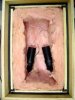
PE KD trapezoidal cabs get dual 2" ducts 10" nominal length, tuning to 30 Hz with DC300 woofer. They would have fit on the baffle, but noting that doing that would preclude rear-mounting HPM-100 woofers (under study), I brought them in the back, instead. Next cab, I'll mount them a bit further apart, as the woofer magnet just touches the elbow flange when they're toed in like this, and I'd prefer not to snug them up to the rear panel:

attachment.php

Yes, I'd call that "heavy fill," using R-13 on the rear and sides to expand the virtual volume. I should probably tack it down in the area of the duct entrances so I don't have to toe them in to keep them away from the fiberglass surface.

Foam Edge Damping:

attachment.php

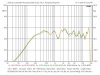
A measurable difference; w/foam edging = Green, none = Orange. Note that the vertical scale is expanded to 5 dB/division, and that, either way, on-forward-axis response falls within one division:

attachment.php

Compare to Quad here:

http://www.audiokarma.org/forums/showpost.php?p=3264967&postcount=48
 

Attachments

  • Duals.jpg
    Duals.jpg
    71.8 KB · Views: 381
  • Foam Edge.jpg
    Foam Edge.jpg
    45.1 KB · Views: 381
  • DC300 Foam.jpg
    DC300 Foam.jpg
    62.3 KB · Views: 384
Last edited:
DE250/QSC/DC300/PE KD Trap Cab:

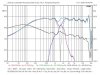
As Jack concluded in his earlier work with them, DC300 is a bear. As may be seen in the lowpassed woofer response of the two crossover examples appearing below, it has three "glitches" in our desired crossover region that must be mitigated. Do we find them in the factory curves?

http://www.parts-express.com/pdf/295-320s.pdf

Round #1:

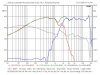
Using Jack's suggested highpass filter components, I implemented a notch filter on the lowpass to smooth out the rolloff. Minimum phase is overlaid on the crossover curves.

attachment.php


attachment.php

Round #2:

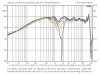
The same notch filter, tweaked a bit, with the highpass frequency lowered.

attachment.php


attachment.php

There'll be a Round #3, as I want to try a tank filter rather than this notch, but it appears that I have succeeded in hitting the target forward axis and crossover frequency.... :yes:
 

Attachments

  • DC300 XO.jpg
    DC300 XO.jpg
    68.1 KB · Views: 373
  • DC300 Map.jpg
    DC300 Map.jpg
    68.9 KB · Views: 379
  • DC300 XO2.jpg
    DC300 XO2.jpg
    68.2 KB · Views: 358
  • DC300 Map2.jpg
    DC300 Map2.jpg
    69.1 KB · Views: 371
Last edited:
Greetings,

Been lurking and reading for awhile now. I am considering doing the Ewave treatment to a set of Acoustech HT-75 towers. Heres a pic of one of the speakers.

acoustech.jpg


Ignore the poweramps, TV, stand, etc. Old pic. The Acoustech's sound great for movies and such but the horns are quite strident with music and SACD's.

I have D220ti drivers, a pair of Dayton H07E waveguides as well as a Behringer DCX2496 active crossover here ready to go. Obviously I would like to biamp. Wondering what would be the recommended settings on the DCX to start with. Crossover type, slope, etc. The Dayton has a rec lowest crossover frequency of 2200 so where to start.

I am about to retro fit the waveguide and drivers into these cabs and it appears that I may be able to do this and have it be reversable in case I hate it.

Anyway, I humbly request XO slopes advice from the gurus here to get me started.

Thanks much.
 
thanks! - I found this post linking to QSC after purchasing the horns - how far down are folks getting the 10"x14" waveguide to xover?
 
I have D220ti drivers, a pair of Dayton H07E waveguides as well as a Behringer DCX2496 active crossover here ready to go. Obviously I would like to biamp. Wondering what would be the recommended settings on the DCX to start with. Crossover type, slope, etc. The Dayton has a rec lowest crossover frequency of 2200 so where to start.
The trick with D220Ti is to cross high, between 2.5 kHz and 3.0 Khz, 2nd order, which mitigates the overly forward midrange, then use a parametric shelving filter to do the high frequency compensation.

Brandon provided 4th order DCX settings for his B&C DE160 No Quarters, which may be helpful, as well. They're in his "What's Brando Cooking" thread on AVS forum. :yes:

thanks! - I found this post linking to QSC after purchasing the horns - how far down are folks getting the 10"x14" waveguide to xover?
Bandon's (Augerpro's) Driver Valult includes polar measurements for the QSC waveguide. Similar to the JBL, it's losing vertical pattern control below 2 kHz. The QSC's larger size is due to the built-in roundover; in terms of the pattern-establishing flare, it's smaller than appearances.

We're talking tradeoffs here. By Geddes waveguide analysis, the concept of "cutoff" is an artifact of outmoded horn theory; it'll go as low as the driver and sound quality permit. To make that determination, I'd run it on an active crossover, dial the frequency around, and listen. Where does QSC cross it?

Next back-order item - pipe insulation - get it quick, before it's gone!
I'm not suggesting it's good or bad, but the foam clearly has a "signature," and that's a familiar one. The proof will come with moving the baffle forward stepwise, and finally, rounding over, though I doubt I'll go that far at the cabinet edges. I will be doing that to the woofer cutout, however, if only for aesthetics.

Regarding which, it appears, once again as Jack has previously found, that flush front mounting the woofer and waveguide provides a good alignment. Can't do that with the QSC and stock cutout in the PE Trap cabs, (Jack made new baffles to accomplish it,) but rear mounting with clamps gets the hardware out of the roundover region. It'd be possible to recess the woofer forward a bit, as well, maybe 1/4" to meet a 1/2" roundover.

Is it audible? On a preliminary basis, I'd say yes, it matters, but I'll rely on WiredGuy, who can actually hear the top end, for that determination.... :dunno:

480064/8673=55.3516​
 
Last edited:
By Geddes waveguide analysis, the concept of "cutoff" is an artifact of outmoded horn theory; it'll go as low as the driver and sound quality permit.

When a horn (waveguide) is providing an acoustic load, a few beneficial things happen. One is increased efficiency, another is reduced excursion (and therefore reduced distortion) and yet another is relatively constant phase. At frequencies below that point, the device (whether you call it a waveguide or a horn) is more reactive, and one side effect of this is its apparent acoustic position seems to move. That's hard on polars because of the moving phase relationship between sound sources. I think the benefit of reduced excurison and distortion are pretty self explanitory. So I think in practice, there are a multitude of reasons to be careful of going too low on a horn, since it becomes more reactive, loses pattern control and increases distortion.
 
Last edited:
Back
Top Bottom