

You are using an out of date browser. It may not display this or other websites correctly.
You should upgrade or use an alternative browser.
You should upgrade or use an alternative browser.
Zilch's AK Design Collaborative - Econowave Speaker
- Thread starter Zilch
- Start date

Bauhausler
Rational Subjectivist
HA!
Your DQ eWave is jealous....
Listening to the Advent with PH612/D210Ti8 on one side and the DQ-10 with QSC/DE250 on the other, there's a BIG difference in the bass. The woofers should be the same except the metal frame one is a fresh refoam with no breakin. I think the low bass is much stronger in the Advent cab, which is a bit larger. The DQ-10s might end up sitting on +1 'helper' woofers on the bottom in larger cabs.
I doubt the DQ-10s will be done soon. I have a bunch of vintage restorations to complete in the next month and only so many hours.
Both finished now and playing. Man, this ewave stuff is a lead pipe cinch. Great sound for around a hundred bucks and a pair of thrift shop speakers.
Hey, lurkers: this took 2 lazy afternoons and it sounds OUTSTANDING. Get your parts and start Ewaving.
Last edited:

similost
Rockin and Rollin....
JUst a couple pictures for those that haven't made it around to my build thread..
So excited thinking about hearing these. If I can't get to work tomorrow a fair chance I'll be listening to them tomorrow night.. OK.. well.. short of some glue drying, I may not be able to listen to them both, but maybe one..


So excited thinking about hearing these. If I can't get to work tomorrow a fair chance I'll be listening to them tomorrow night.. OK.. well.. short of some glue drying, I may not be able to listen to them both, but maybe one..

hhibrownsbac
Super Member
I can see Simi now, he will have a grin from ear to ear. They are gonna sound great. These things never cease to amaze me. Whether its the 2225H with DE610s OR the 2235H with the BMS 4555s every time I get a chance to listen to them I just have to sit back and say Hell Yeah!!!!! Id love to try out those woofers you got.


Russellc
Addicted Member
JUst a couple pictures for those that haven't made it around to my build thread..
So excited thinking about hearing these. If I can't get to work tomorrow a fair chance I'll be listening to them tomorrow night.. OK.. well.. short of some glue drying, I may not be able to listen to them both, but maybe one..
Very cool, and nice pink slippers too!

russellc
Russellc
Addicted Member
I can see Simi now, he will have a grin from ear to ear. They are gonna sound great. These things never cease to amaze me. Whether its the 2225H with DE610s OR the 2235H with the BMS 4555s every time I get a chance to listen to them I just have to sit back and say Hell Yeah!!!!! Id love to try out those woofers you got.
what are you using for a crossover on the 2235H and 4555 setup?
Russellc

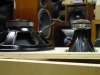
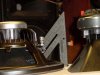
There are certainly measurable differences, and we can't depend upon the physical alignment alone; the actual acoustic centers may vary considerably from there.I'm sure there are measureable differences, but I'm curious if there are also audible differences?
On some horizontal plane in the vertical space, the drivers are phase aligned, and yes, the difference is audible. The objective then becomes to aim the tilt of that plane such that it falls within the waveguide's directivity and a desired listening window.
It's easy to see why that could be a more difficult task with the QSC than our standard eWaveguide. Well, maybe; who can guess where the Kappalite's acoustic center might fall...?

Last edited:

juniorJBL
SUB 1500 :)
who can guess where the Kappalite's acoustic center might fall...?
with the cd being farther back does it pull it down or push it up?
Up.
Draw an imaginary line (or a real one) connecting the assumed acoustic centers of the two drivers. That establishes the "tilt," as the physical axis is perpendicular to it. Differential driver phase and delay then alter the angle.
Textbook, when it's "right," the forward axis is normal to the baffle at the midpoint between the sources, but that locates it below the waveguide axis, so we tilt it upward a bit such that the forward plane and waveguide axis coincide at a design listening distance. See the measurements of Markus's Geddes Nathans in the "Horn vs. Waveguide" thread on DIY audio. The alignment is textbook, so the optimum listening height is not the waveguide axis or above.
You can see from my polar map experiments that the -6 dB "window" bounded by the influence of the vertical nulls is only +/- 10 - 15°, so it's important to optimally steer the plane. That's fairly easily accomplished using active delay, but not so easy passively, relying on filter phase to make it happen, as that also alters the frequency response.
It's easier, and the result better, if the acoustic centers are approximately in line from the outset, which is why I'm rear-mounting the woofers in the trap cabs. In 4425 and 4430, JBL moved the horn forward to bring the drivers' acoustic centers into physical alignment.... :yes:
Draw an imaginary line (or a real one) connecting the assumed acoustic centers of the two drivers. That establishes the "tilt," as the physical axis is perpendicular to it. Differential driver phase and delay then alter the angle.
Textbook, when it's "right," the forward axis is normal to the baffle at the midpoint between the sources, but that locates it below the waveguide axis, so we tilt it upward a bit such that the forward plane and waveguide axis coincide at a design listening distance. See the measurements of Markus's Geddes Nathans in the "Horn vs. Waveguide" thread on DIY audio. The alignment is textbook, so the optimum listening height is not the waveguide axis or above.
You can see from my polar map experiments that the -6 dB "window" bounded by the influence of the vertical nulls is only +/- 10 - 15°, so it's important to optimally steer the plane. That's fairly easily accomplished using active delay, but not so easy passively, relying on filter phase to make it happen, as that also alters the frequency response.
It's easier, and the result better, if the acoustic centers are approximately in line from the outset, which is why I'm rear-mounting the woofers in the trap cabs. In 4425 and 4430, JBL moved the horn forward to bring the drivers' acoustic centers into physical alignment.... :yes:
Last edited:
similost
Rockin and Rollin....
Well Zilch.. Mine are completed.. and WOW.. just kind of speechless right now..
All I can say is THANK YOU for all the help, and for FINALLY talking me into trying something other than what I was set on keeping and listening to... It did cost me ton of money though, but I am convinced it was worth every penny...
Here's a picture, and a link to my little review..
http://www.audiokarma.org/forums/showpost.php?p=3442029&postcount=178
Here's a link to the complete project thread....
http://www.audiokarma.org/forums/showthread.php?t=276485

All I can say is THANK YOU for all the help, and for FINALLY talking me into trying something other than what I was set on keeping and listening to... It did cost me ton of money though, but I am convinced it was worth every penny...
Here's a picture, and a link to my little review..
http://www.audiokarma.org/forums/showpost.php?p=3442029&postcount=178
Here's a link to the complete project thread....
http://www.audiokarma.org/forums/showthread.php?t=276485
Last edited:


Duffinator
Spin The Black Circle
He needs some JBL 2452H-SL CD's. :yes:Nice work Similost! Now to think about how to upgrade them