

You are using an out of date browser. It may not display this or other websites correctly.
You should upgrade or use an alternative browser.
You should upgrade or use an alternative browser.
Zilch's AK Design Collaborative - Econowave Speaker
- Thread starter Zilch
- Start date
Yes, and you can also switch to shorter legs....
Ah, yeah...they are just cheap Ikea legs (8-inch) which has the middle of the waveguide at 36 inches above the floor. I can also get the legs in 4 and 6 inches.
Whats the optimum height?

skywave-rider
Slumming in Akihabara
...
The forward vertical lobe is symmetrical about the +7.44° (from the midpoint between woofer and waveguide) axis, the -6 dB "window" being ~+/- 12.5°.
[The Zilch effect is apparently not operative with this freestanding waveguide, indicating that it may be a baffle-derivative phenomenon....]
That's interesting.

It's just trig to figure this out. At my 44" mic distance, the forward axis is 0.75" below the waveguide center. At twice that listening distance, 7'4", it's 5" above waveguide center. At thrice, 11' listening distance, it's 10.75" above waveguide center, according to my calcs. Set your waveguide height according to your typical listening height and distance.Ah, yeah...they are just cheap Ikea legs (8-inch) which has the middle of the waveguide at 36 inches above the floor. I can also get the legs in 4 and 6 inches.
Whats the optimum height?
Speakergeek fun: Open the three plots attached at Post #11376, above, in separate tabs and click between them to watch the vertical nulls progressively intrude upon the response as the vertical displacement increases from 10° to 15° to 20° above and below the forward axis....
More fun? Here's Wayne's video:
http://www.pispeakers.com/misc/Vertical_Nulls.wmv
Last edited:

PioneerGuy75
Certified Lurker
Most any 12" woofer that is not designed as a subwoofer will play high enough. If you like the bass those speakers make, then go for it.
You don't have to do anything to the Yamahas to verify that the combo will work to your liking -- merely bring out the woofer leads and connect to the eWave driver/waveguide/crossover and listen to how it will sound. If you like the result, then you can commit to modding the cabs as required to complete the build. :yes:
Thanks Zilch!!
Do you have any reccomendations? Horn type etc? Like I say this will be my first attempt!
Thanks again!

Just build the regular eWave -- JBL/Pyle/Dayton 12" x 6" waveguide, Selenium thread-on D220Ti, Jack's <95 dB crossover (PC board optional) ... slamdunk done.
It's all in the summary linked from Post #1 of this thread. Click "First" at the top or bottom of this page to go there.... :yes:
It's all in the summary linked from Post #1 of this thread. Click "First" at the top or bottom of this page to go there.... :yes:
PioneerGuy75
Certified Lurker
Thanks!!

Sunday we will be building the eWave-O-Arrays. I got the JBL 6x6 WGs today and I found a eWave crossover pair I built for my ESS eWaves. Once I got them right, I redid them with better components. So I have the origanals.
I've been playing with the Edge program and I have two choises. 1. use the OB comp filter to make the responce flat from 150 to 1500hz on an 10" wide baffle board or 2. use a 24" wide baffle board and have a little less flat responce without the OB comp filter.
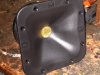
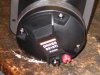
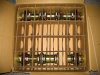
Here are shots of the 6x6 wg and D210 and the drivers. The wg will look good in the midst of all those drivers.
Zilch: I see that you have mounted your woofs from the front and the back. Which do you prefer? I was thinking about mounting from the back and using a 1/2 round over bit on the front of the driver hole. Do you have any thoughts about how that may effect the responce? Cheers.
I've been playing with the Edge program and I have two choises. 1. use the OB comp filter to make the responce flat from 150 to 1500hz on an 10" wide baffle board or 2. use a 24" wide baffle board and have a little less flat responce without the OB comp filter.
Here are shots of the 6x6 wg and D210 and the drivers. The wg will look good in the midst of all those drivers.
Zilch: I see that you have mounted your woofs from the front and the back. Which do you prefer? I was thinking about mounting from the back and using a 1/2 round over bit on the front of the driver hole. Do you have any thoughts about how that may effect the responce? Cheers.
Attachments

von.ah
Schultze!
Still no measurement gear other than the RS SPL meter and 1-octave RTA...but I have the Ewaves in new cabs and they sound good to me...
Peerless 830634 in 4.5 feet sealed.
How are you liking those woofers? I think they sound great, even in 1.5 cu.ft. sealed.
 Three times the volume must let them go quite low... :thmbsp:
I rearmount woofers to help compensate for the depth of waveguides like the 152i. That's not the case with the shallow 6" square one. It's mostly about how difficult it is to get the forward axis steered where I want it to be with a minimalist crossover.... :yes:Zilch: I see that you have mounted your woofs from the front and the back. Which do you prefer? I was thinking about mounting from the back and using a 1/2 round over bit on the front of the driver hole. Do you have any thoughts about how that may effect the responce?
Well, that makes the build a lot easier. This will be the first short line array I've heard. All the others are tall floor to ceiling standers. They just don't sound right to my ear. I don't really understand the sound patterns of an array, but I'm about to find out.

Clmrt
Just thrilled.
How are you liking those woofers? I think they sound great, even in 1.5 cu.ft. sealed.
Nice and low. I'm listening to some Telarc soundtracks and the drum thwacks do indeed carry some weight.
I just need to watch the throttle on bass-heavy programs.

Wow, that's a significantly lower high-pass frequency on the D220, than the standard Ewave.
Does it still sound OK under high power/high SPL with that filter? To my ears, the D220 sounded fine on the (larger) Pyle PH714 horn, even run down to 1200 Hz or so... but some had complained, IIRC, that the D220 was "raspy" when run that low in some applications...
Regards,
Gordon.
I'm beginning to think a lot of "how it sounds" has to do with matching the waveguide throat entrance angle to the driver exit angle. The .zma shows the resonance of this combination is occurring clear down at 720 Hz, and you can see we're working at least an octave above there and cutoff in the raw response curves, orange vs. red here:Does it still sound OK under high power/high SPL with that filter? To my ears, the D220 sounded fine on the (larger) Pyle PH714 horn, even run down to 1200 Hz or so... but some had complained, IIRC, that the D220 was "raspy" when run that low in some applications....
We ended up a little higher than that, actually, at 1440 Hz:
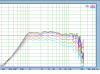
Brandon (Augerpro) just demonstrated (0° - 60°, 5 dB/vertical division) that using a different driver (Beyma CP285), this waveguide can maintain horizontal pattern control down to ~1 kHz, which is why I'm thinking the exit angle thing:
730267/11392=64.1035
Attachments
Last edited:

Russellc
Addicted Member
Still no measurement gear other than the RS SPL meter and 1-octave RTA...but I have the Ewaves in new cabs and they sound good to me...
Peerless 830634 in 4.5 feet sealed.
Are you planning on advancing with the measrement system? I've got a bunch of software, a dayton mike so far. Need the M-audiomobil pre or some other mic pre/phantom power and I'm diving into the "Flex your PCD mettle" big time.
If I would just quit building this DIY Pass amp stuff! I wanted the F-5, done, then the B-1, completed during the F-5 build and done first, now those pesky Pearl 2 phono boards and matched fets are in the drawer, and I'm already looking at DIY Pass pres with gain.:sigh: Slow and steady wins the race.
Russellc
Russellc
Addicted Member
Nice and low. I'm listening to some Telarc soundtracks and the drum thwacks do indeed carry some weight.
I just need to watch the throttle on bass-heavy programs.
Glad you are enjoying them. Nice build, werent you having a little trouble getting your first E'waves to sound right, or am I confusing you with someone else's E'waves? If correct, what made them sound right, or was this build just a big improvement over the first?
Russellc
Russellc
Addicted Member
I'm beginning to think a lot of "how it sounds" has to do with matching the waveguide throat entrance angle to the driver exit angle. The .zma shows the resonance of this combination is occurring clear down at 720 Hz, and you can see we're working at least an octave above there and cutoff in the raw response curves, orange vs. red here:

We ended up a little higher than that, actually, at 1440 Hz:

Brandon (Augerpro) just demonstrated (0° - 60°, 5 dB/vertical division) that using a different driver (Beyma CP285), this waveguide can maintain horizontal pattern control down to ~1 kHz, which is why I'm thinking the exit angle thing:
Whic forum/thread did Brandon display this in? I'm heading over to the "No quarter" thread now....? I know he was wanting to try Beyma's CP 385....
Russellc