• The move to the new server is done. There are some software and database maintenance updates in process. This has us passing the hat around to help out. We appreciate any donations. Seriously, even a dollar helps. The payment page may be found here - https://www.audiokarma.org/support.html

Zilch's AK Design Collaborative - Econowave Speaker

Dennis, the others explained how it's implemented. The reason to do it is because caps can become "sticky" at 0v. If you bias them up above 0v, the caps will be able to recharge more quickly. At least, that's the very basic idea behind them, AFAIK. IME, charge coupling makes a more noticeable difference in sound than swapping in various boutique caps.
 
We've got a lot of work done here on designs using the venerable QSC 152i waveguide, but it's gone and likely ain't coming back.

Could we start to build consensus on a replacement for use in the E-wave variants already designed and tested?
 
We've got a lot of work done here on designs using the venerable QSC 152i waveguide, but it's gone and likely ain't coming back.

Could we start to build consensus on a replacement for use in the E-wave variants already designed and tested?
Sorry to derail the discussion, but have you got anything more on the QSC 122i conical waveguide, especially crossover/CD EQ wise? Thanks. :thmbsp:

The 122i and 152i waveguides are both available in the UK still, albeit under a new part number. It's exactly the same thing - QSC just changed the numbering system. I'll find the number again if you're interested as the US dealers may still be carrying it. :yes:
 
OK, I just got off the phone with Dave at QSC. The HPR 152i speaker (which uses the waveguide that we've used here) has been discontinued...BUT...it was replaced with the HPR 152f which uses the same waveguide. The WGs are back ordered and will be in stock at the end of March. Here is the QSC part number.

Part discription: HORN,HF,HPR152F Part number: PL-000446-GP
 
Last edited:
Sorry to derail the discussion, but have you got anything more on the QSC 122i conical waveguide, especially crossover/CD EQ wise? Thanks. :thmbsp:

The 122i and 152i waveguides are both available in the UK still, albeit under a new part number. It's exactly the same thing - QSC just changed the numbering system. I'll find the number again if you're interested as the US dealers may still be carrying it. :yes:

I've read that the drawback to using a conical waveguide is that is doesn't limit dispersion in the vertical plane.
 
Include "Greg Timbers" of JBL in your search. He is credited with the development of the technique.
correct, you can read a bizzillion posts about Gregg Timbers and his efforts at charge coupling over on Lansing Heritage forum, much info there on that!

russellc:yes:
 
OK, I just got off the phone with Dave at QSC. The HPR 152i speaker (which uses the waveguide that we've used here) has been discontinued...BUT...it was replaced with the HPR 152f which uses the same waveguide. The WGs are back ordered and will be in stock at the end of March. Here is the QSC part number.

Part discription: HORN,HF,HPR152F Part number: PL-000446-GP

But, it will require a serial number of a unit to purchase as per the website, correct?
 
But, it will require a serial number of a unit to purchase as per the website, correct?
I don't know how it works in the US, but over here I just phoned up the nearest dealer, gave him the part number and they arrived a couple of weeks later. Getting a serial number might not be too difficult...ask someone who's selling a pair on ebay?

Djnagle, that's what I was on about. :thmbsp: Same part, different part number. There's a QDC PDF document which I now can't find which lists all the old and equivalent new part numbers. I'll try and find it again.
 
The part number I posted is for the new part off the new HPR 152f speaker. Dave said, just like you, just call a dealer and order the part.
 
Inching forward

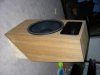
Making some progress on my econowaves, here's a pic with drivers in but no finish on the veneer. Selenium D220/PH612, Dayton PA380 Pro 15". Started as a JBL L200 clone but drifted toward a more modern look. Put some 2-ply teak veneer on, and based on my tests on scraps, will likely give it 2 coats of Watco teak oil, and after a week of drying, 2 coats of oil-based satin polyurethane. The base of the cabinet will be flat black stone textured. Black grills coming too. Struggling to get the time to work on them, can't wait to get them done!
 

Attachments

  • 2011 Feb 08 003resized.JPG
    2011 Feb 08 003resized.JPG
    66.1 KB · Views: 135
I've read that the drawback to using a conical waveguide is that is doesn't limit dispersion in the vertical plane.

That's been pretty heavily discussed/debated. That (and center-to-center spacing) are considered drawbacks. ON THE OTHER HAND! Only a conical can have on-axis flat response AND matched power response at the crossover point. If you match on-axis, you'll have a power response dip, with an asymmetric waveguide.

Also, typical asymmetric waveguides don't load as low in the vertical plane as they do in the horizontal, which means you get more off-axis energy around and about the crossover (in a typical design, AKA Ewave) and some ripple before the directivity kicks in.

No free lunch!
 
That's been pretty heavily discussed/debated. That (and center-to-center spacing) are considered drawbacks. ON THE OTHER HAND! Only a conical can have on-axis flat response AND matched power response at the crossover point. If you match on-axis, you'll have a power response dip, with an asymmetric waveguide.

Also, typical asymmetric waveguides don't load as low in the vertical plane as they do in the horizontal, which means you get more off-axis energy around and about the crossover (in a typical design, AKA Ewave) and some ripple before the directivity kicks in.

No free lunch!

Thanks for that Badman, good stuff.
 
Hi Wayne, I have been casually reading stuff like this for some years now and always had this question:

Does it really matter if I only sit in one position?

I have a large room and sit 15' from the front of my speakers and the speakers are generally about 10' apart with 5' from the outside of each speaker to the wall.

Couldn't I use horns that are 30 x 30 degrees if I don't move about the room?
 
Hi Wayne, I have been casually reading stuff like this for some years now and always had this question:

Does it really matter if I only sit in one position?

I have a large room and sit 15' from the front of my speakers and the speakers are generally about 10' apart with 5' from the outside of each speaker to the wall.

Couldn't I use horns that are 30 x 30 degrees if I don't move about the room?

I suppose, sure. Especially if outdoors (no reflections) or if in a room that is treated to be highly absorbent. That way any spectral imbalance from off-axis radiation that isn't uniform won't be reflected back at you.

That does kind of go in the other direction though, sort of defeats the purpose of using a speaker with uniform directivity. The whole point of using a speaker like this is to provide uniform coverage, a wider "sweet spot".

If you don't care, if requirements don't include wide coverage but rather allowing a pinpoint listening spot, then the design becomes much simpler. Just make a speaker with good on-axis response and point it at you.

But again, in this case, it is more important that the room be treated to absorb reflections as much as possible because reflected energy will not have the right spectral balance. Anything coming back at you off the walls will sound bad and color the direct sound.

I suppose to some degree this is true anyway, but when the power response is right, then reflections are balanced at least, and a certain amount probably improves the impression of realism by providing ambience. You just don't want it to be way off in tonal character.
 
I have come to the conclusion that while a constant uniform directivity speaker is certainly desirable but if dealt properly as Wayne stated, a horn/driver combination that is deemed "beamy" can sound outstanding. The round Edgar Tractrix for example. While it is arguably a focused critter can provide the most realistic and detailed imaging I have ever heard when set up properly.

I've had similar experiences with other horns deemed by some to be unusable without addressing this and found their on-axis presentation very satisfactory also if massaged a bit.

I'm not disregarding the quest for uniform directivity at all but personally, I think that listening habits do play a role in it's importance so it's all relative.

"Beamy" is not a four letter word IMO unless your primary design goal is to make a speaker that isn't.

RC
 
I'm with you RC. I've had two pairs of Bruces 350hz horns and really liked the imaging. I have a large room with curtains on both side walls, accustic tiles on the ceiling, and carpeting. Not many reflections there.

Thanks Wayne. It all makes sense now.
 
The best imaging I have ever heard was in Geddes' system. Rock solid soundstage/imaging with the advantage of being able to move/relax. I've never heard a salad bowl horn based speaker come close.
 
Back
Top Bottom