• The move to the new server is done. There are some software and database maintenance updates in process. This has us passing the hat around to help out. We appreciate any donations. Seriously, even a dollar helps. The payment page may be found here - https://www.audiokarma.org/support.html

Zilch's AK Design Collaborative - Econowave Speaker

Does pointing out that there is a dip on axis for a design intended to be listened to off-axis qualify as bashing? Probably not, but you've managed to convince people that it's a problem because you have put yourself in a position of subject matter expert to many people on AK. You are doing comparisons that are very distinctly biased in that you are only pointing out the bad on one side and the good on the other.

Look. I respect what you and Wayne bring to the discussion, but it's not been objective or unbiased and because of that, my respect level is dropping. As Russell pointed out, Geddes can be a prick, but don't you think there should be an attempt to get over that?

Gordon brings up something important in that by mentioning coaxial speakers, he shows that there is more than one way to achieve hi-fi results and everyone does, in fact, have compromises. Hell, even within one giant company like JBL/Harman, there are multiple high end speakers being produced, each attempting to create the ultimate speaker, each believing that given an unlimited budget, they couldn't make a better speaker. Yet, each has a wildly different take on what that ultimate speaker is. Geddes chose minimized reflections, minimized diffraction and concentrated on power response horizontally. His studies apparently showed them to be more important, I would surmise. Apparently, Wayne's studies have shown that anomolies in the vertical domain are more important than the areas that Geddes concentrates on. And perhaps he is right, I don't know. I haven't seen the data, subjective or objective and the only pair of speakers from his company I heard werent nearly as ideally setup as the Summas. If I had to make a rash judgement, I would qualify his as non-competitive, but that would be completely unfair and probably way off the mark and I'd be falling into the same thing I am critizing you for.
 
Its hard to deny the popularity on this forum of the Econowave. Moreover,
many knowlegeable members have built them and been extremely impressed. correct me if Im wrong but I dont think Ive encountered even a lukewarm response. Most have been shocked at it even before tweaking it, some without the proper crossover or compensation.

Now I have never heard Geddes speakers, but would sure like to. I trust Zilch on the measurements, but like to hear things myself. I didnt believe him for a minute when he told me the Econowave would out play the Altec A7 in my basement system. Well, he was right.....but I still enjoy the Altecs none the less......but the Econowaves are the better all around speakers, and they cost less than half as much to put together. Would the Summas out play them? I dont know. I am sure on one area, Econowave is truly inexpensive, and truly gives good performance. Summa may also be a good performer, but it doesnt have this low cost thing going on. Geddes prices arent ULTRA high, but this econowave top for 150 is cheap! When fired up, people are just bowled over with the sound as well, and that really gives it a smile factor, almost like you're getting away with something!
 
I don’t understand the current obsession aimed at outdoing Gedde’s waveguide work and his products with the EWG. It’s pretty clear to me that the EWG stands on its own. Geddes’ approval isn’t necessary to the existence of the EWG project and continual comparisons and criticisms don’t add anything and probably detract.

Objective, minimally biased discussion of overall design goals, the means of achieving them and the various benefits and tradeoffs involved strikes me as perfectly valid subject matter for a thread like this. However, recent and some past posts indicate maybe something less than objectivity has entered into the discussion esp since commercially available products have been involved. I find it esp curious that some are compelled to criticize Geddes’ work/products w/o ever having heard it. Something really powerful must be at work here…

Bottom line: I hope to be doing the EWG thing soon and it sure would be nice to have a live thread available as a reference and sounding board.
 
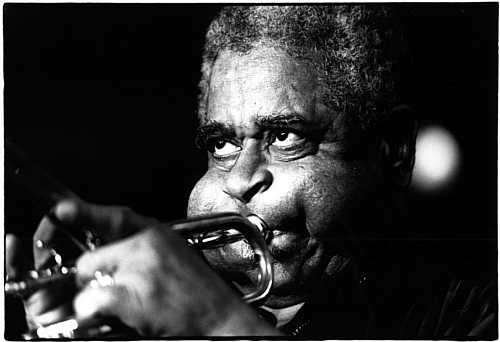
Listening to Diz and he just yelled:
BABALOOOOOOOOOOO!

Just something loud to annoy, amuse and pierce the silence.
Dizzy_Gillespie.jpg
 
Constant directivity, power response and the reverberent field

One thing that I've noticed over the years is how different people rate the importance of flat power response, constant directivity and a uniform reverberent field.

Some people place no emphasis on it whatsoever, and the only thing they look for is on-axis response. Since they usually have speakers with uneven off-axis response, they usually focus more on room treatments when the in-room sound isn't quite right. Speakers like that only sound right in one spot and are heavily influenced by room conditions.

Other people build or buy speakers having flat power response, good response on and off axis. While they usually still set them up to limit early reflections, the reason they do that is not to make the reverberent field more uniform but strictly to improve imaging. Speakers like that tend to sound good everywhere in the room, sometimes even down the hall. They have a much wider "sweet spot", and sound good in a large area of the room. This is because the spectral balance is uniform coming from any angle, so therefore any reflection also has balanced timbre.

What has surprised me lately is the recent converts that seem to pay attention to the reverberent field, but who tend to disregard half the equation. I can understand why this happens, I suppose, because getting the vertical part right is much harder. Some say it isn't as important as horizontal directivity, but the fact is that reflections from the floor and ceiling are every bit as much contributors to the reverberent field as are reflections from the walls.

As for me, I think it is desirable to make off-axis response as uniform as possible in both the horizontal and vertical planes. I prefer a much more narrow vertical pattern, as it reduces reflections from the ceiling and floor.

Uniform off-axis response provides a more spectrally-balanced reverberent field, and the advantages, I think, are clear. This is the whole point of constant directivity horns - waveguides - so I think most of the people interested in them would also be cognizant of these ideas.
 
Wayne, would it be correct to say that the real problem you have with Geddes' waveguides is that it has a 90 degree radiation pattern and not that it's round? It could be a 90x75 asymmetrical horn and run into the same problems, no?

Also, if you could expand on the audible effects of the null at 7.5 degrees when listening to the speaker 15 degrees above that null, I'd very much appreciate it. I will probably be listening to the Summas again soon and would like to know what I'm listening for.
 
The problem I have with round horns is they are physically tall and they generate a pattern that covers a large vertical angle. Both are undesirable. The physical height prohibits close driver spacing, bringing the nulls closer together. The tall pattern makes a lot of energy to be directed at the floor and ceiling, causing excessive reflections. Worse than that, the sound vertically off-axis is highly abberant. The end result is reflections that are loud and have poor spectral balance. Angling inward from the nearest side wall doesn't help much if the slap from the ceiling is the biggest problem.

When auditioning a speaker, if you want to try to judge its off-axis performance by ear, listen for the difference between the direct sound and the reflected sound. Walk around the room. Stand up and sit down. Listen in various places.

Speakers with poor off-axis performance will sound distinctly different in different places in the room. When you move in the room, either vertically or horizontally, the sound will change tonal characteristics. Remember phase shifters and flangers, popular in 1960's and 1970's music? It sounds a little like that when you move through a null. The more a speaker avoids this, the better its off-axis performance. Ideally what you would want is a speaker to sound exactly the same anywhere in the pattern, and as you move to the edge of the pattern and outside, the sound diminishes without changing its tonal balance. This is the point of having uniform directivity.
 
What is the audible effect of destructive energy when listening from within the area where the power response is correct? In other words, if you have speakers with a null at -7.5 degree and you are listening at + 7.5 degrees or 15 degrees above that point, what is the audible impact of that null?

It may not be audible at all when it is not directly on your listening axis. Even if it is it still may not be depending on the severity and the mix of direct and reflected sound in the room.

Rob:)
 
That's true. If you take a speaker outdoors, for example, where there are no boundary reflections then you don't have to worry about the quality of off-axis sound. That is, unless of course you are arraying speakers where interactions between their polars come into play. But that's a different discussion.

If you put speakers in a room with tall ceilings and diffusive and/or absorbent material on the walls, then the off-axis sound is less noticeable than if the listening room has the typical 8 foot ceiling and little on the walls to diffuse or absorb the sound.

If off-axis sound is not important to you, if you only care about the performance on axis, then constant directivity horns and waveguides may not be important to you either. The whole purpose of the technology is to create a sound field that is uniform over a wide area rather than strictly on axis.
 
i got all my parts, both from JBL and PE, last night, brought 'em to work this morning, and just finished putting them together in a temporary paper tray. i can't wait until i hook 'em up to the horns! :D i'm planning on building a classic looking external wooden boxes for them.
 
So, from what I can gather, the issue with the null on the Summas is that it limits placement flexibility and if you were intending on mounting them so the acoustic center was over your head by 10-12" or more, it would be wise to flip them over or tilt them down to put you safely within the uniform pattern. When properly set up, there is a good possibility that the shallow vertical null would be a non-issue. Did I get that right or did I make some assumptions that I shouldn't have?
 
just out of curiousity, what is the source for the 7.5° null point.

using the equations provided, it would seem that would require the drivers to be spaced much more than they are in practice, or the crossover frequency would have to be much higher than what is used.

for a quick example, assuming a crossover frequency of 1130hz and 18" center-to-center driver spacing, i calculate the arc between the nulls to be 0.68 radians or ~39°, half of which is ~20°. this crossover frequency and ctc spacing are just my wild arse guesses, but to get to 7.5°, the crossover frequency would have to be up near 3khz or the driver spacing would have to be around 44"; or, did i botch the math?
 
The acoustic centers of the CD and woofer are offset in the design. The woofers is closer than the tweeters which tilts the response up. The overall coverage pattern is 15 degrees. It's ~ 30 degrees, IIRC. There would be nulls at 22 or so degrees above center and 7.5 degrees below. At 12' or so, that would make the nulls above a 6' tall persons head and around there ankles if their speakers were setup with the center point at their ears while sitting.
 
The acoustic centers of the CD and woofer are offset in the design. The woofers is closer than the tweeters which tilts the response up. The overall coverage pattern is 15 degrees. It's ~ 30 degrees, IIRC. There would be nulls at 22 or so degrees above center and 7.5 degrees below. At 12' or so, that would make the nulls above a 6' tall persons head and around there ankles if their speakers were setup with the center point at their ears while sitting.

thanks for the clarification. by acoustic center do you mean physically the compression driver is located further back than the woofer or do you mean that the crossover network changes the phase in a way that is similar to physically moving the driver back.

the assumption of the linkwitz(?) diagram posted by wayne assumes the drivers are in the same plane. any chance anyone knows the math for calculating the 'tilt angle' when the drivers are not located in the same plane either because of their physical locations or because of phase shifts in the crossover? my intuition suggests that 1/2 wavelength offset would put a null right on-axis, but i'd like to do better than intuition (and my intuition may be wrong anyways).

also, i thought that 15" woofers typically reacted a little bit slower than 1" compression drivers, so that would have the effect of shifting the acoustic center of the woofer back just a little, correct? is the rule of thumb to start with both drivers in the same plane or to give the woofer a little positive offset?
 
I don't have time to fully respond, but I will say that if you want to compare driver speed, you don't need to look much further than the drivers inductance. Low inductance = fast.
 
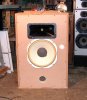
Well, here's what the cab looks like so far.

Kegger came over for about an hour last night and we gave it a bit of a listen and were pretty impressed, rock hard, split surrounds notwithstanding. Bass is better already that the Altecs and the sound is nice and balanced.

We played it in mono with the LE14 on one side and the Vals on the other and when we rolled over to the Vals, the sound was immediately louder, much more midrangey (all midrang??) and perhaps even a bit hollow or nasal. But in their defense, after a few minutes I became re-acclimated to the Altec and found that they were charming in their own right. Needless to say, I can hardly wait for the surrounds to arrive as they should really free up the LE14s to do their thing and really blossom the sound, and I'm already penciling time Tuesday to build box #2 :D

BTW, Kegger thinks I should go with 2 smaller ports and I was thinking of maybe moving the drivers up another inch or so? I've got a piece of MDF left over for a new motorboard, so that's no problem. Comments??

attachment.php
 

Attachments

  • le143.jpg
    le143.jpg
    61 KB · Views: 263
i got all my parts, both from JBL and PE, last night, brought 'em to work this morning, and just finished putting them together in a temporary paper tray. i can't wait until i hook 'em up to the horns! :D
I wanna see these paper-tray crossovers. I showed y'all my wire-nut wonders first. They're gonna be tough to beat! :p:

I thought that 15" woofers typically reacted a little bit slower than 1" compression drivers, so that would have the effect of shifting the acoustic center of the woofer back just a little, correct? is the rule of thumb to start with both drivers in the same plane or to give the woofer a little positive offset?
The only way to know where the actual acoustic centers are is to measure. I was surprised to discover they're not at the voice coils of either woofers or horns/waveguides.

It appears you've sussed out the matter of nulls out fairly well, but your initial hypothetical calcs seem wrong to me. :dunno:

When auditioning a speaker, if you want to try to judge its off-axis performance by ear, listen for the difference between the direct sound and the reflected sound. Walk around the room. Stand up and sit down. Listen in various places.
Footnote: It's all rendered much more audible via playing white or pink noise. :yes:

We played it in mono with the LE14 on one side and the Vals on the other and when we rolled over to the Vals, the sound was immediately louder, much more midrangey (all midrang??) and perhaps even a bit hollow or nasal. But in their defense, after a few minutes I became re-acclimated to the Altec and found that they were charming in their own right.
Lots of folks like "That Altec sound," or L100 "West Coast sound," or AR/Advent "Vintage East Coast sound," and the differences are immediately apparent in A/B evaluations. We acclimate to what we're listening to psychoacoustically, which is why what we hear is not definitive, and subject to change as soon as the next time we listen. The true challenge in critical listening is ascertaining what is "good," and what is "best...." :thmbsp:
 
Back
Top Bottom