6dB/octave augmentation
Can you elaborate on that, Wayne? A cap bypassed resistor is a textbook shelf filter. Where would a rising response with no flat shelf come from?
If you use a series resistor bypassed with a capacitor, the transfer characteristic is essentially a 6dB/octave diagonal line from maximum attenuation until you reach approximately 3dB attenuation. At that point, the filter is no longer a filter but instead approaches a short circuit. In this sense, you're right that there's a shelf, but it's not useful to us because we want the 6dB/octave slope for CD equalization. That's why passive equalization requires at least 10dB attenuation, any less and you don't have enough attenuation to remove before you reach 20kHz. At 10dB, if you start bringing in augmentation around 5kHz, you have just less than 2 octaves of useful augmentation you can provide at 6dB/octave, and that's just about right.
There's a bit more to it than that. For one thing the high-pass filter that is used as the "core" of the tweeter circuit is designed for a specific load resistance. Less than that and it will be overdamped, and greater than that and it will be underdamped. So a single series resistor large enough to provide audible attenuation will likely shift the filter heavily towards being underdamped, and that would cause a large peak near the crossover frequency. Also, the driver isn't a pure resistance but is a complex reactive load. Those things are discussed in more detail in the links below, handouts from the "Crossover Electronic 101" seminars that I do at the various audio shows. It's also a big part of my Crossover Document linked earlier in this thread.
What we want for CD compensation, is an
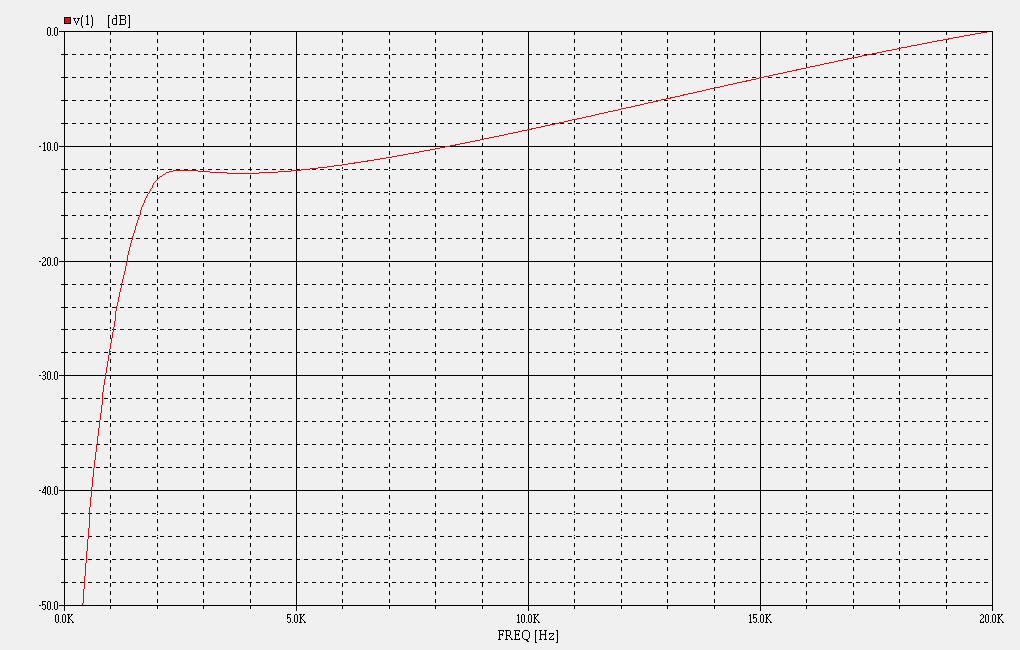
initial shelf that's flat, followed by rising response to compensate for the falling power response of the driver. The capacitor bypassed resistor provides the rising response part. What we need is something to bump up the lowest frequencies, from the crossover frequency up to about 5kHz. One way to do this is to slightly underdamp the frequency-splitter high-pass filter, the "core" filter of the crossover. By underdamping it slightly, you lift the bottom of the diagonal line, providing a curve that looks like this:




 .
.

