• Please note that Audiokarma will be offline briefly for updates early on Monday morning, September 28th.

A tale of two Fishies - X-101-C integrated amp restorations

I'm not trying to be flip. I try to balance the tech and the subjective aspects of this hobby.


Hi Don! :banana:
I know you're you're not being "flip"! :yes:
I understand fully, that's why I said "Assuming that you could hear the difference on any given system."

I'm just curious what or where it might have an impact is all and maybe a little of the thinking behind the practice. This is not the first time I've read of this.

Phyllis :)
 
It's the tweakers tweaky tweak. The last step. The thing you undo to redo.
It's a "the neighbor who hoses his driveway to keep the dirt off" kind of thing.
 
Phyllis; Or the neighbor who goes out and picks the dandelion blooms right AFTER dousing them with a defoliant.

IIRC Way back when, Before Don and I were Twinkles in our Daddy's eye's or mind, caps were made with shielding, as radios usually didn't use shielded wire, or other ways of shielding RF(radio frequency) interference in the unit except in a few very expensive and hard to get low production radios. So the caps had built in shielding.

Now today with the advent of shielded cables, and shielding in the chassis ( note the barrier up the middle? and around the MPX area? it's an RF shield of sorts, as it separates the Tuner section from the Audio.) there isn't much of a need if any for shielding the caps, except maybe in a tuner if it's really noisy. But some manufacturers still make them and tout the shield as a solution for induced noise. It's something that today, would only be seen on a scope. It's not something that would be readily audible. So Audiodons answer is correct. It's a tweak to a tweak to a tweak. As the caps are bipolar it really doesn't matter which way you install them, unless you have a scope and your OCD(not that you do I'm just making a point here.) requires that you absolutely have to have the lowest noise floor in the world. Most people wouldn't notice the difference if they wern't told about it, and it's so slight that it really takes a scope to see it.

Throw them up in the air with some chicken bones, dice, and frog tonsils while chanting in tongues in a grass skirt and a shaman headress, after winning the IRISH Sweepstakes , and before sacrificing a virgin lamb. However they land, put them in just like that. It won't make a difference except on the scope.

Larry
 
Phyllis; Or the neighbor who goes out and picks the dandelion blooms right AFTER dousing them with a defoliant.

IIRC Way back when, Before Don and I were Twinkles in our Daddy's eye's or mind, caps were made with shielding, as radios usually didn't use shielded wire, or other ways of shielding RF(radio frequency) interference in the unit except in a few very expensive and hard to get low production radios. So the caps had built in shielding.

Now today with the advent of shielded cables, and shielding in the chassis ( note the barrier up the middle? and around the MPX area? it's an RF shield of sorts, as it separates the Tuner section from the Audio.) there isn't much of a need if any for shielding the caps, except maybe in a tuner if it's really noisy. But some manufacturers still make them and tout the shield as a solution for induced noise. It's something that today, would only be seen on a scope. It's not something that would be readily audible. So Audiodons answer is correct. It's a tweak to a tweak to a tweak. As the caps are bipolar it really doesn't matter which way you install them, unless you have a scope and your OCD(not that you do I'm just making a point here.) requires that you absolutely have to have the lowest noise floor in the world. Most people wouldn't notice the difference if they wern't told about it, and it's so slight that it really takes a scope to see it.

Throw them up in the air with some chicken bones, dice, and frog tonsils while chanting in tongues in a grass skirt and a shaman headress, after winning the IRISH Sweepstakes , and before sacrificing a virgin lamb. However they land, put them in just like that. It won't make a difference except on the scope.

Larry

Hi Larry and Don :banana:,
Understood, I'm not going to get bent over it, just trying to understand the why and how.
Like why is it's most positive effect realized directionally? I know I've read here that on some shielded wire you only connect one end of the shield to the chassis, connect both and you might get hum. But I didn't know it necessarily mattered which end.
I'm trying to see this as a mental image.
Is the cap constructed like that with the shield only connected to one end?
And if so, how do you figure out which end with the cap out of circuit, or can you?
I know I have seen some brands that mark it, Green and Red on the leads.
Just curious! :yes:
Thanks guys! :)
Phyllis
 
Often the manufacturer's markings aren't consistent. Even on Auricaps and Kimbers, I've found the markings inconsistent. On the recent Vcaps I bought, all were marked correctly, and for the Psvanes three of the four were marked correctly.

Visualize it this way:
The foil is rolled up with an insulator sandwich throughout the cap. That's why it's considered a dielectric.
One lead on the cap taps the foil at the inner side of the roll. The other lead on the cap taps the foil at the outer end of the roll.

If I remember correctly, the outer foil tap is the one that, if you can figure out which one it is, you should put towards the input to the cap and the inner foil is what you want at the output of the cap. That outer foil is considered the shield. I'm not going to open a cap to check, though others have.

There is a thread on how to test it somewhere, but a quick cursory search didn't find it. I suspect it was a post or two buried in another thread. I think FalconEddy was the one who posted how to do it. You need a scope to test it. There was another post on it one time but I found that test ineffective.

All right lurkers, feel free to eviscerate me. You know you want to.
 
Last edited:
I couldn't leave it at that. I must have been out of sorts because I wrote that post while dialed into a business meeting that was, at that point, running over 2 1/2 hours.
So, it's amazing how refreshing a run and lunch can be.

I took apart a cap from the HK hot rod.
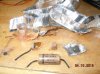
It appears to be a beeswax cap, but this one was marked with the shield. Here's what one of those caps looks like assembled and disassembled.

Try visualizing a paper in oil cap as like a fruit rollup. The fruit is the foil and the paper is the oil insulator.

This cap had tin foil, separated by a coating of oil, all rolled up and with the ends squished together. While squished together, the outside leaned to one side and the inside leaned toward the other side. Each end was attached to a conductive substance capped by beeswax. The one marked shield was attached to the outer foil side, and the other one was attached to the inner foil side.

I can see how these would dry out over time.

attachment.php
 

Attachments

  • capunrolled.jpg
    capunrolled.jpg
    46 KB · Views: 264
Last edited:
I couldn't leave it at that. I must have been out of sorts because I wrote that post while dialed into a business meeting that was, at that point, running over 2 1/2 hours.
So, it's amazing how refreshing a run and lunch can be.

I took apart a cap from the HK hot rod.
It appears to be a beeswax cap, but this one was marked with the shield. Here's what one of those caps looks like assembled and disassembled.

Try visualizing a paper in oil cap as like a fruit rollup. The fruit is the foil and the paper is the oil insulator.

This cap had tin foil, separated by a coating of oil, all rolled up and with the ends squished together. While squished together, the outside leaned to one side and the inside leaned toward the other side Each end was attached to a conductive substance capped by beeswax. The one marked shield was attached to the outer foil side, and the other one was attached to the inner foil side.

I can see how these would dry out over time.

attachment.php

WOW! :yes:
Didn't intend for you to go through all those changes, but THANK YOU!
Some old speakers here had that type of paper cap in them and the tweeter quit working.
A new cap fixed it.
Just like the ones in your picture but HUGE and took 3 of them just to add up to 8uF!
They weren't marked though, they did have wax on the ends that just crumbled away when handled.
Thank you Don! :yes:
Phyllis
 
So, a week ago Friday I cleaned up my electronics room and workbench because we were going away for a week the next day and were having house guests stay here. While cleaning, I put on the ratrig X-101-C, spun up a vinyl version of Jeff Buckley's Grace and went to town putting things away and straightening things out.

I'd recently purchased some new speakers from AK'er Ashok (Omega Super 3Ts) so I can test low powered SET amps because I don't like the horn sound.
Towards the end of my straightening things and putting things back time I took those speakers off the picture window shelf in that room because they were in the sun. I put them together in the center of the workbench for a nice appearance. Somewhere in this process, the side of the record ended and . . .

Fast forward 9 days. I walk into the electronics room (which is 5 1/2 feet by 11 feet with a 6'5" ceiling and noticed it was a little warm. Well, it was warm because it had a little ratrig heating it for nine days.
That amp is so darned quiet, I couldn't hear anything. While my ears may not be 100% over my airplane ear, snorkeling and scuba diving ear shenanigans, I couldn't hear a thing. It was idling along, quiet as a blade of grass growing.

I tried it and music sprang forth. It makes me glad that I do those 4+4 tests when finishing off an amp. The 4 days plus 4 hours continuous test is for these "went away for vacation and left the amp on" emergencies.
Now I've had a real-life experience with an amp that's passed that test. I guess those teflon caps are fully broken in now.
 
So bizzarre- don brought over the rat rig to my place- you'd never know it was once a Habitrail of sorts for Fieldmouse and Co. A really attractive unit, clean and tidy.

And how did it perform? Hooked up and with source on pause, it's dead quiet. Not a whisper from the unit or speakers. Activate the source and beautiful glorious sound pours like honey from this debonair old gent. Classy and even a bit dashing.

Don's work is exceptional.
 
I've always heard that the outside foil should go closest to ground so that in the case of something cutting or melting through the case, you still have most of the capacitor working for you. Is that right?
 
Thanks Deli.
At Deli's house I did take the liberty of turning the volume all the way up when nothing was playing for a demonstration.
I liked what that amp did with his Merlins.

Ths364,
That explanation you've provided is a new one on me.

What I probably read somewhere is that you put the shield is toward the source on these types of non-polarized caps for a variety of reasons, all of which sound plausible when read and don't stand up to reality whatsoever.
 
Last edited:
So, a week ago Friday I cleaned up my electronics room and workbench because we were going away for a week the next day and were having house guests stay here. While cleaning, I put on the ratrig X-101-C, spun up a vinyl version of Jeff Buckley's Grace and went to town putting things away and straightening things out.

I'd recently purchased some new speakers from AK'er Ashok (Omega Super 3Ts) so I can test low powered SET amps because I don't like the horn sound.
Towards the end of my straightening things and putting things back time I took those speakers off the picture window shelf in that room because they were in the sun. I put them together in the center of the workbench for a nice appearance. Somewhere in this process, the side of the record ended and . . .

Fast forward 9 days. I walk into the electronics room (which is 5 1/2 feet by 11 feet with a 6'5" ceiling and noticed it was a little warm. Well, it was warm because it had a little ratrig heating it for nine days.
That amp is so darned quiet, I couldn't hear anything. While my ears may not be 100% over my airplane ear, snorkeling and scuba diving ear shenanigans, I couldn't hear a thing. It was idling along, quiet as a blade of grass growing.

I tried it and music sprang forth. It makes me glad that I do those 4+4 tests when finishing off an amp. The 4 days plus 4 hours continuous test is for these "went away for vacation and left the amp on" emergencies.
Now I've had a real-life experience with an amp that's passed that test. I guess those teflon caps are fully broken in now.


Guy's

Tell you the truth, Fishers are dead quiet, even spot my new KX200.
I got to double check it to see if it's on or off, glad to hear she's working
great!

Tube
 
Last edited:
After spending some time at AK'er Steph_Gaynor's house, the ratrig has been packed up and has gone on a road trip. Guess where!
 
Last edited:
Keep it up Don, and the South will RISE AGAIN! Us Yankees gotta keep some secrets from them Rebels! :D
 
This thread is a great read! :thmbsp: I recently purchased a restored X-101-C from Sony6060 and have it paired with my modded Heresy speakers. It sure has changed the way I think about collecting gear, now I can collect space heaters and vintage audio together. :D The tubes sure do keep things toasty.:scratch2:
 
Hi don,

When I went back to redo my X101-C this week, when I received the new bottom
panel I took apart the Bias pot and phase inverter pots cleaned them, a little lube and
put them back together I just set them in the middle of there range and left them,
is that okay?

Tube
 
Last edited:
Back
Top Bottom