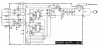
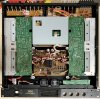
As expected R8 adjustment doesn't change the output voltage. In case anyone is interested, this is how these amplifiers age (sorry for the basic English

):
- C11 and C13 are degraded soon due to the heat generated by R8 and R9 (2W). (Note: Low ESR, high temp and long life caps must be used to replace them. I used Nichicon HE)
- The output voltage begins to increase without load as these capacitors degrade, due to anomalies in the waveform generated in the primary.
- The first symptom is that the fans begins to spin when the amp is cold. Excess voltage turns on Q717 in the fan control circuit at room temperature.
- If C11 and C13 are not replaced, the increased output voltage damages the filter capacitors
This unit is like new, little used, and C11-13 were out of specs. The remaining caps are ok.
About the fans, an ebmpapst 414 Is a quieter alternative than OEM, with enough airflow for home use (24VDC, 5.9CFM, 1W, 6000RPM, 18dBA, Sintec Bearing). They are turned on at low speed when the headsink temperature exceeds 60ºC
This is not a studio amp, but lets see how it sound

I'm going to test it in my active loudspeakers to power the mids and highs. Yamaha PC2002M for the lows.