Yes, the pre-amp has two sets of outputs.So would I run a set of cables to each amps main in from the pre-amp? I have been using the pre-amp + power amp(2150) only and picked up a Receiver(7150 -both items are 50w per ) and was trying to incorporate it into the system.Since I have a separate pre-amp do I still put the amps in bridged mode? Thank you for any suggestions.Some preamps have 2 sets of outputs (like my AVA preamps) and they are "Y'd" internally. I run 2 different amps from one preamp in this fashion with zero problem. However, it might be nice if one of the amps has a volume control level to balance the outputs, but I'm not sure I know what you are doing....If you are bi-amping then yes.


You are using an out of date browser. It may not display this or other websites correctly.
You should upgrade or use an alternative browser.
You should upgrade or use an alternative browser.
Best way to wire one preamp to two power amps?
- Thread starter z-adamson
- Start date

the skipper
Professional Curmudgeon
Having a separate preamp has nothing to do with bridging an amp. One has nothing to do with the other.Since I have a separate pre-amp do I still put the amps in bridged mode? Thank you for any suggestions.


Dave B.
Well-Known Member
Going back to a year-old thread here ...
My Mac C22 Frank McIntosh CE preamp has one set of balanced XLR outputs. I'd like to use a Y-adapter to connect both a Mac MC275 VI and an MC2000 (both tubes amps, as you know) to that one set of C22 outputs.
Restorer-john notes that both amps have to be on at the same time to avoid distortion. I would never be running both amps at the same time. Would his caution apply to my desired configuration? Would it be better to use an XLR switch to connect both amps?
Thanks for the help!
Dave
Just bear in mind however, both amps must be turned on. If one is turned off, you can get distortion from the unbiased front end asymmetrically distorting the waveform.
My Mac C22 Frank McIntosh CE preamp has one set of balanced XLR outputs. I'd like to use a Y-adapter to connect both a Mac MC275 VI and an MC2000 (both tubes amps, as you know) to that one set of C22 outputs.
Restorer-john notes that both amps have to be on at the same time to avoid distortion. I would never be running both amps at the same time. Would his caution apply to my desired configuration? Would it be better to use an XLR switch to connect both amps?
Thanks for the help!
Dave

twiiii
Lunatic Member
Depends on the output impedance of the pre-amp and the input impedances of the power amps. You want the total impedance of the two power together to be at least 10 times higher than the output impedance of the pre-amp. Preferably 20 times. So if you have a modern SS pre-amp with a 500 ohm or less output impedance and the total impedance of the amps is above 10,000 ohms you' d be OK. But if you have a classic tube pre-amp requiring 100,000 ohms or higher loads from the two amps you would be in deep doo-doo. The old pre-amps don't have the current capability of the newer pre-amps. If you have a modern ARC pre-amp you could be in for complications. The old 400 Fisher pre-amp with cathode followers would have no trouble at all. Just remember the 10 to 1 or preferably 20 to 1 rules.
wyn palmer
Addicted Member
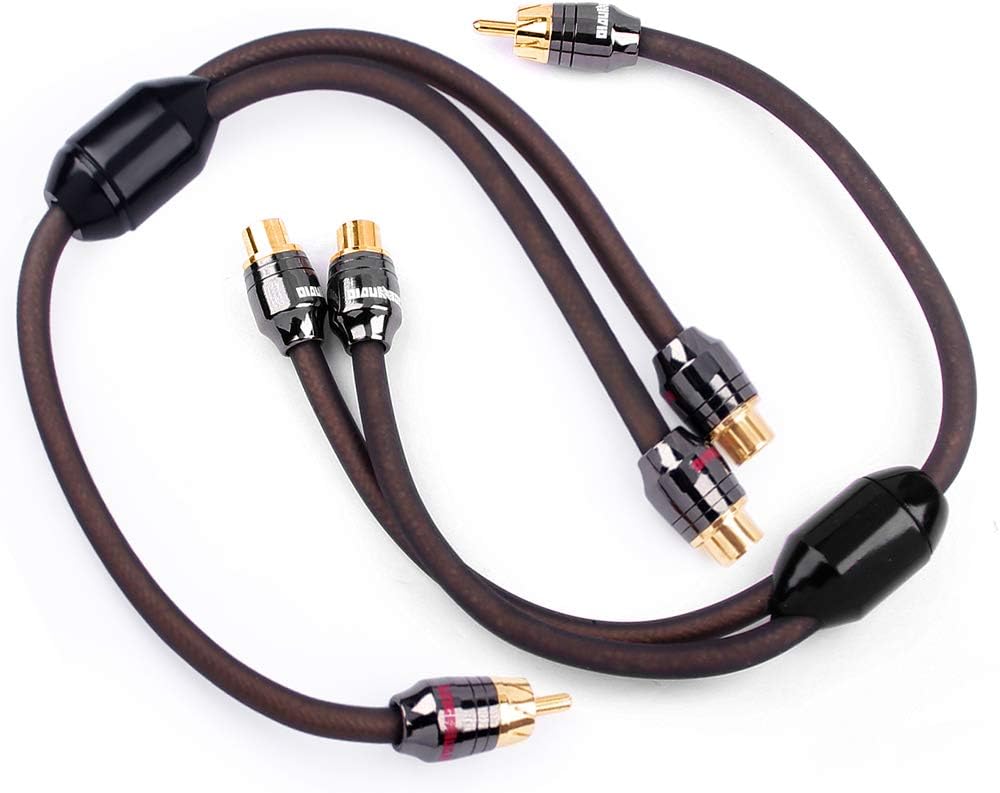
Just use a Y cable??
Or would it be better to get a second identical preamp and use the tape out from one preamp to get signal to the second preamp? One amp per preamp and no Y cable.
It depends on the input load presented by the power amps and the output impedance/distortion characteristic of the preamp.
For example, if you have a tube/FET preamp with a high output impedance (say 2k) and low standing current in the output stage, then loading with a single 10k input impedance power amp can generate significant harmonic distortion (approaching 1%) and adding a second amp as a load will make it much worse.
If the power amp loads are 100k, then it will be fine.
If the preamp has, say, 100 ohms output impedance and has local feedback or a high standing current, then a combined load of 5k would have negligible effect on the distortion.


WaynerN
Addicted Member
Instead of a splitter could you use the tape outs for one amp and the main for another assuming both amps have gain controls? I’m thinking McIntosh MC2250 and MC2105 into a McIntosh C22.
No. The tape out is not connected to the volume control. It would produce a "full blast" sound.

No. The tape out is not connected to the volume control. It would produce a "full blast" sound.
But what if that can be controlled by the gain controls on the amp?
WaynerN
Addicted Member
But what if that can be controlled by the gain controls on the amp?
Sure, as long as the output of the pre has some form of adjustable attenuation.

Champco
Super Member
The PreAmp 1 & 2 come off the same output lead. Left sideThose outs are all just wired in parallel internally, right??
If so, same thing as Y cables.
The right side 1-2 come off their own output lead.
HK Citation 11
Running a short Y cable is the same.

Built in Y-splitter..Just get a preamp with two sets of preouts...

bimasta
Addicted Member
So do I, Meggy... and I'd have to count the 2 powered subwoofers as yet another pair of amps, for a total of 8 amps — 3 amps to drive each of my 3-way speakers, for a total of 6, then add the 2 sub amps for a total of 8. The main speakers have no internal passive crossovers, so each driver is driven directly by its own amp.I use tri-splitters and go to six monoblocks.
I have to use 4 x 2-way way splitters for each channel, all plugged into one little RCA pre-out socket on my little passive preamp. I think using a simple passive pre, sending a direct signal to each of the drivers, yields a very clear and "present" sound with tons of detail, and subtle ambient sounds of the recording venue which get lost when they have to pass through an active preamp and then complex passive crossovers in the speakers. It's called "insertion loss", and it's not just a loss of volume, it's the loss of small details, overtones and harmonics, the slight reflections from the walls of the original venue, the whispers of the musicians, the clink of ice-cubes in the glasses of ringside patrons at the Jazz club — restoring all these sonic "cues" comes really close the original sound.
All but one of the power amps has a Volume control for each channel, and I use these to balance the outputs of the 3 main drivers. I need this feature because my Tweeter is the JBL 077, the Midrange is the JBL LE-85, and the woofer (temporarily) is just a generic polyprop 8-incher. It's sensitivity is only 93dB, whereas the two JBL's are 105dB — without the volume controls, the JBL drivers would be way too loud, and overpower the woofers.
I'll soon replace the woofers with JBL 2213 12-inch drivers, which I hope have better sensitivity, and I hope give deeper bass — and they have those very cool White Aquaplas cones.


Champco
Super Member
So do I, Meggy... and I'd have to count the 2 powered subwoofers as yet another pair of amps, for a total of 8 amps — 3 amps to drive each of my 3-way speakers, for a total of 6, then add the 2 sub amps for a total of 8. The main speakers have no internal passive crossovers, so each driver is driven directly by its own amp.
I have to use 4 x 2-way way splitters for each channel, all plugged into one little RCA pre-out socket on my little passive preamp. I think using a simple passive pre, sending a direct signal to each of the drivers, yields a very clear and "present" sound with tons of detail, and subtle ambient sounds of the recording venue which get lost when they have to pass through an active preamp and then complex passive crossovers in the speakers. It's called "insertion loss", and it's not just a loss of volume, it's the loss of small details, overtones and harmonics, the slight reflections from the walls of the original venue, the whispers of the musicians, the clink of ice-cubes in the glasses of ringside patrons at the Jazz club — restoring all these sonic "cues" comes really close the original sound.
All but one of the power amps has a Volume control for each channel, and I use these to balance the outputs of the 3 main drivers. I need this feature because my Tweeter is the JBL 077, the Midrange is the JBL LE-85, and the woofer (temporarily) is just a generic polyprop 8-incher. It's sensitivity is only 93dB, whereas the two JBL's are 105dB — without the volume controls, the JBL drivers would be way too loud, and overpower the woofers.
I'll soon replace the woofers with JBL 2213 12-inch drivers, which I hope have better sensitivity, and I hope give deeper bass — and they have those very cool White Aquaplas cones.
LPad

Bill Ferris
Lunatic Member
FWIW, In the past when I needed to drive 2 or more different amplifiers, whether SS or tube, from a preamp, also whether tube or SS, I usually installed what ever amount of L/R RCA jacks that was required for however many amplifiers to be driven and mounted them in a project box with common 47k (or higher) resistors connected in series between the input of the box`s RCAs to the output RCAs to provide buffering/build out isolation between the preamps output impedance & the paralleled input connected amplifiers combined input impedances..
Was especially helpful for me yrs ago when driving different amplifiers connected to different sensitivity speakers engaged at the same time and keep from any effect of adjusting one power amps input level adjustment controls from effecting another strap connected amplifier`s input levels, and of course buffered the preamps output impedance from being loaded down, as no matter the amount of amplifiers connections the preamps output was buffered by the 47k series resistors, which value is not carved in stone and could be empirically adjusted/selected for best results depending on the particular desired preamp/amps equipment connection configuration.
And since the preamps output signal levels and especially current levels is very small the resistors shouldn`t effect the overall signal throughput strength by much of a signal insertion loss..
Just a thought.
Ciao
Similar threads


- Replies
- 8
- Views
- 1K

- Replies
- 18
- Views
- 2K
