• The move to the new server is done. There are some software and database maintenance updates in process. This has us passing the hat around to help out. We appreciate any donations. Seriously, even a dollar helps. The payment page may be found here - https://www.audiokarma.org/support.html

cheapest speaker made in the last 10 years that can beat any speaker made before 1970?

Concert Grands are 94 db 4 ft 1 watt. Thats about 95.3 db 1 meter 1 watt. So rated at 100 watts that means 115. db 4 ft 1 watt or as a Grand doesn't come together until 15 or 16 feet. That means your level would be 103 db each . A Klipsch horn is 121 db at 4 ft or about 109 db at 16 feet. A Jubilee is rated at 109 db so with 100 watts - 12 db would be 117 db. So you can see a Concert Grand comes up way short. I use 250 watts for the bass and another 250 watts for the mid/tweeter bi-amped. But I seldom use of 60 watts. But then I am not the type thats into hard rock or really strong hard pounding Country western or pop music. I am more about quality than quantity. For me if a system puts out 104 db thats all I need most of the time. So the two Concert Grands with a center Symphony is all I really need from my HT system. Where some people want ten db more.

Now my line arrays are 88 db 2 watts so at 12 feet with 500 watts each. Thats 118 db with two speakers. But as line arrays only loose 3 db when you double the distance then at 12 feet thats 112 db. So I seldom use more 60 watts for both channels 300 watts for both channels with peaks.

If your a concert goer a full orchestra can put out 115 db in the front rows. As I like sitting further back to experience more room ambience and a better blend levels seldom reach 104 or 5 db and thats what both my systems reach without strain or become dynamically challenged. Most speakers such as Klipsch and JBL compress the signal 3 to 5 db at maximum power rating. The Jubilee and well designed line arrays being the exception. I haven't measured Wilson, Magico or modern B&W but I know B&W compressed the signal with the older 800 and 801 models. Big JBL's and Altecs and EV's not very much. Where new models seem to more often. But thats because the older speaker designed around professional drivers and horns, where a lot of todays are not. Being more consumer oriented. Even JBL's DD67000 based on commercial drivers compresses the signal 3.2 db at rated power. The Jubilee is supposed to remain linear at 100 watt levels.
 
Last edited:
@twiiii oh no ,, i dont listen loud , i listen only at 70 until 80 db ,, it seem you talk about maximal db before clip and no sensitivity of speaker , right? ,, i just want detail and resolution only ,, just wonder any modern speaker can beat any pre 1970 in detail and resolution ,,,, thanks for everyone who responded to this thread!
 
DSN_9947.jpg Well Grands would work well with the addition of super tweeters. You will also have to voice the system as they tend have a large hump in the bass centered around 160 HZ. If you pull them away from the wall to flatten the bass then you compromise the bass below 40 HZ. Plus they have an irritating narrow peak around 8 Khz. You can also force the 16 KHZ region to be flat but the highs sound unnatural with the older 200x tweeters, better with the 200y tweeters, and with very little voicing with 200Z tweeters.

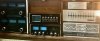
I use a Crown EQ2 parametric EQ to voice the Grands and two of the front speakers other two EQ- 2 to voice the Symphonys for the HT system. The bottom 207 powers the woofers of the Grands and front Symphony displayed by the meters. The top 207 powers the mids and tweeters on channels 123 displayed by the meters. Three more channels are for the super tweeters. The rest of the channels power the rear and side speakers for the HT system. The UREI cross over is for the Grands, The MPI-4 and the MC 2505 are for the separate Stereo system. The SAE is the program EQ for the Stereo system.
IMG_3674.jpeg
 
Last edited:
details could have been stated more clearly?
The OP has selected a birthday that makes him 92. for this reason I understand why he cannot articulate the details for one of two reasons
He is 92 and forgot all he learned about sound
He is closer to 22 and hasn't learned a bunch of terms needed to help further the details.

But with the massive sound of the Bozak Concert Grands and the bass response of the new Acoustic suspension design, finding a new speaker today that will beat both of those is not gonna be cheap.
 
Last edited:
The OP has selected a birthday that makes him 92. for this reason I understand why he cannot articulate the details for one of two reasons
He is 92 an forgot all the learned about sound
He is closer to 22 and hasn't learned a bunch of terms needed to help further the details.

I saw that and was curious. I don't think I was disrespectful about anything and just threw my 1 cents worth in. We all have a right to our opinion. :beerchug:
 
I'm kind of clueless also! A lot of speakers prior to 1970 were not cheap dollar wise back then, and also sounded very good. I'm not sure if the OP included the cost of the old gear and priced it comparative to the rough inflation value in the market today. Either way, not enough clarity on what the heck is really going on...
 
The OP is asking what is the cheapest recent speaker we think surpasses ANY speaker from before 1970. This calls on three opinions: what we think is the best pre 1970 speaker, if we think any recent speakers surpass that speaker and if so which is the cheapest. I made the assumptions that the Altec 604E is the best speaker pre 1970, that there are recent speakers that surpass it and the GPA 604 is the cheapest speaker to do so. All these assumptions are subjective, that is to say opinions.

Certainly people on this forum aren't leery of venturing opinions? There must be some jasper reading this thread who thinks the AR3 is the best speaker in the world? Or more reasonably that the Quad ESL of 1957 is?
 
I love "old vs new" discussions, but this one is too difficult to wrap your head around to be able to provide an answer. One big reason it's difficult to wrap your head around is that the question seems to presuppose that new speakers are definitively better than vintage, which I don't think is true. Certainly, new speakers should be able to trounce vintage speakers due to the advances in materials alone, but I haven't seen that be the case at all. I've said it in another thread and I'll say it here, it comes down to designers. Back in the day, they were crawling around rooms figuring out what worked in real-world environments. They also did extensive analytics, but the analytics were a supplement to real-world evaluation rather than today where analytics in a lab and computer modeling replace real-world evaluation. Back then, the designers also actually understood the math and the underlying principals of physics and acoustics. Today, designers are mostly punching numbers into an algorithm to create their "design". This is why the new designs often do not match vintage, even though they have a decided advantage in materials progress since the vintage days. Most of the modern speakers are cookie cutter designs/copycat designed in a lab -- hard to compete with designers living in real environments, understanding the math, and not settling until their products work well in a variety or real-world environments.

That's not to say there aren't some great modern speakers, but I don't think it's accurate to presuppose that modern speakers are better.
 
Last edited:
None of the speakers back in the 60's had the Hf capabilities of todays better speakers. They weren't using fancy magnets or diaphragm materials and horns designs were very inferior. Bass distortion wasn't that low either. But as the best speakers at the time were using professional driver and as big power hadn't arrived just yet speakers had to be efficient to reach concert levels. Most folks 40 to 50 watts was all they could afford. So there were a lot of speakers out there with over 100 db sensitivity for larger rooms. An though AR and KLH were very popular they were just for average folks. Bozaks were kind of in between in efficiency and out put level. Most spealkers back then HF started rolling off and was gone by 16 Khz and the bass seledom extended below 30 HZ. But who cared as source material was limited back then especially LP', Tape and FM. So thats all you needed. There were exceptions of course. There are a lot of speaker that will surpass most speakers from the 60's. But when you start talking about the best of the best That brings up questions. People listened differently back then than today. They loved clarity and dynamics and is why Sheffield, Mobile Fidelity, Command and others along with Mercury would set up their mics and walk away trying to keep every thing natural with the Best dynamics. Even tapes with only 55 db signal to noise if properly produced could extend the dynamic range 6 to 10 db beyond the machines rating if the electronic were well designed. Plus you can hear information even below the tape hiss which frequencies are centered above the most important fundamental frequencies. So tapes could easily have 70 dynamics even with tape hiss if produced propely. LP's could approach if not even being better. SHeffield for instance with no compression and using all tube electronics, which surprised many folks saying tubes were dead by the early 70's. So the distortion levels were higher and the dynamics were just as large if not larger than today do to every one trying to get the loudest levels on digital recordings and manipulating the sound instead letting us the natural dynamics of a recording. There for our speakers do not have to be as dynamically capable today. Average person seldom reaches 85 db with 6 db peaks. Where former professionals seldom reach much over 90 with 10 db peaks. There are always exceptions. But I can remember driving Altec, EV, Klipsch speakers with 40 watt amps running on the ragged edge with close to 104 db sensitivity. Along with a lot of customers and friends and thinking noting about tape hiss or other issues of the day. With most speakers, not all, to achieve those levels today would take 20 times the power. Yes my room is smaller now and my hearing wont take the levels any more, So i have backed off a bit over the years, 10 db or more most of the time, That saves a lot of power and if I wanted to a larger selection of speakers to choose from. But if you want to match the frequency range with the same dynamic range. The most affordable speaker is still the Jubilee. Now if your willing to give 7 or 8 db a pair of Cornwalls or quite a few speakers would fit the bill. But they won't reach the bottom octave. Are you willing to give that up too? I am not and thats why I gave up on older Klipsch many others years ago. Mcintosh was the first to produce a speakers system with 3% distortion at 20 HZ a 100 db at 12 feet. Yes it took power from a pair of MC 3500s or a 2300 later on.
 
Last edited:
None of the speakers back in the 60's had the Hf capabilities of todays better speakers. They weren't using fancy magnets or diaphragm materials and horns designs were very inferior. Bass distortion wasn't that low either. But as the best speakers at the time were using professional driver and as big power hadn't arrived just yet speakers had to be efficient to reach concert levels. Most folks 40 to 50 watts was all they could afford. So there were a lot of speakers out there with over 100 db sensitivity for larger rooms. An though AR and KLH were very popular they were just for average folks. Bozaks were kind of in between in efficiency and out put level. Most spealkers back then HF started rolling off and was gone by 16 Khz and the bass seledom extended below 30 HZ. But who cared as source material was limited back then especially LP', Tape and FM. So thats all you needed. There were exceptions of course. There are a lot of speaker that will surpass most speakers from the 60's. But when you start talking about the best of the best That brings up questions. People listened differently back then than today. They loved clarity and dynamics and is why Sheffield, Mobile Fidelity, Command and others along with Mercury would set up their mics and walk away trying to keep every thing natural with the Best dynamics. Even tapes with only 55 db signal to noise if properly produced could extend the dynamic range 6 to 10 db beyond the machines rating if the electronic were well designed. Plus you can hear information even below the tape hiss which frequencies are centered above the most important fundamental frequencies. So tapes could easily have 70 dynamics even with tape hiss if produced propely. LP's could approach if not even being better. SHeffield for instance with no compression and using all tube electronics, which surprised many folks saying tubes were dead by the early 70's. So the distortion levels were higher and the dynamics were just as large if not larger than today do to every one trying to get the loudest levels on digital recordings and manipulating the sound instead letting us the natural dynamics of a recording. There for our speakers do not have to be as dynamically capable today. Average person seldom reaches 85 db with 6 db peaks. Where former professionals seldom reach much over 90 with 10 db peaks. There are always exceptions. But I can remember driving Altec, EV, Klipsch speakers with 40 watt amps running on the ragged edge with close to 104 db sensitivity. Along with a lot of customers and friends and thinking noting about tape hiss or other issues of the day. With most speakers, not all, to achieve those levels today would take 20 times the power. Yes my room is smaller now and my hearing wont take the levels any more, So i have backed off a bit over the years, 10 db or more most of the time, That saves a lot of power and if I wanted to a larger selection of speakers to choose from. But if you want to match the frequency range with the same dynamic range. The most affordable speaker is still the Jubilee. Now if your willing to give 7 or 8 db a pair of Cornwalls or quite a few speakers would fit the bill. But they won't reach the bottom octave. Are you willing to give that up too? I am not and thats why I gave up on older Klipsch many others years ago. Mcintosh was the first to produce a speakers system with 3% distortion at 20 HZ a 100 db at 12 feet. Yes it took power from a pair of MC 3500s or a 2300 later on.
yes 50 hz to 9khz is enough for me that means cornwall? i hear that 20 hz can damaged ear without notice so maybe iam not too favoriting lower register speaker ,, but dynamic ofcourse have to be there and tramsparancy too ,,, anyway thanks to all who answer this thread!
 
yes 50 hz to 9khz is enough for me that means cornwall? i hear that 20 hz can damaged ear without notice so maybe iam not too favoriting lower register speaker ,, but dynamic ofcourse have to be there and tramsparancy too ,,, anyway thanks to all who answer this thread!
Any frequency can damage one's hearing if the level is high enough. Ideally you want a flat in room response from 20Hz to 20KHz. My system measures ~-2dB at ~18Hz

My usual listening level is ~85dB. However, at times I've been known to approach 100dB at my "chair".
 
Last edited:
There are definitely some low-end models of Elac, KEF, Bowers and Wilkins made in the past 10 years that could beat a variety of Lafayette, Jensen, Criterion, Norelco, Allied speakers just to name some brands of pre-1970 speakers I've enjoyed for the looks but sound absolutely terrible.
 
... that could beat a variety of Lafayette, Jensen, Criterion, Norelco, Allied speakers just to name some brands of pre-1970 speakers I've enjoyed for the looks but sound absolutely terrible.

I agree, pre-1970's is not really a fair representation of vintage speakers -- the 70's through early 80's is probably the "sweet spot" for speaker performance to give fair representation of what vintage can do.
 
Last edited:
Back
Top Bottom