Yeah... I know :thmbsp:
I was around during the making of SET12's Monster Thread

In fact it and he inspired me to to do my external XOs
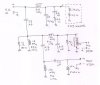
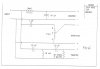
I'm just wondering what his XO schematic looks like NOW w/Cap values
Thanks Frank,
Well my system has been down for a while as I have had to integrate a 60in Panasonic Plasma ST Series into my listening room. I had two defective 60in Sharp Aqous in my home that drove my wife nearly insane tearing apart her living room that I share as my listening room. So I took down my system and have yet to put it back in place due to so much going on.
So I'm sorry to say I can't quite remember the last values I was working with as the networks sit with a pile of parts on them.
I had been working with this crossover calculator
http://www.apicsllc.com/apics/Misc/filter2.html
Woofers
And some of ALKs values from his analysis of the Forte like the woofer specs
So basically the woofers resistance from ALK is 5.5 ohms with an inductance of .74mH which works out to be 6.262 ohms for an AC impedance @ 700hz
Plugging in the #'s for a Linkwitz-Riley low pass 12db/octave
I come up with 2.85mH inductor with a 18.16uf
I did manage to listen to a close combination with my North Creek 3mH and an 18uf and liked what I heard.
Tweeters
Another investigation was my tweeters as posted from the second post up but as stated by ALK
The tweeter filter, by Paul Klipsch's own admission, was designed using long outmoded "constant K" methods. This method is for filters that are to be used between EQUAL impedances. It yields a symmetrical filter that can only operate smoothly between symmetrical load and source impedances. A tweeter is 8 Ohms and an amp is a voltage source. It's less that 1/10 of an ohm! It's WRONG! It results in a filter that has a very rough response and a lot of loss. The measured performance of the AA tweeter filter is shown. It has a 2 dB "sag" and 2.6 dB loss at 20 Khz! The loss is partly due to old dried out caps, but the "sag" is just bad design! As a matter of fact, component loss actually acts to mask this type of sag. If you replace the caps with new ones, the sag will get WORSE!
With Tube amplifiers especially SET Amps with higher output impedance's the losses are less here so one could tune somewhat up to the value for a SS amp that maybe used IMO, really depends on what you may prefer.
I did increase the second caps value to 6uf and heard a slight increase in information with my SET Amps but with SS you may here more
Mids
Now for the mids. I know I was greatly confused by the stock values, initially values that I plugged into the calculator were not making a lot of sense to me at first.
Then it dawned on me,
Linkwitz-Riley crossovers match attenuation slopes so that system response is flat at crossover point.
So in order to get this it seems what the designer did was to push the actual crossover point up an octave to 1400hz leaves the 700hz point at a perfect point for making the 700hz point flat through the summing of the second order woofer to the first order mid.
I measured about 12 ohm's DCR for the mid and adding a couple of ohm's for the mids inductance that brings the value to about 14 ohm's.
And as ALK so fondly pointed out the actual input impedance seen by an amplifier is the Auto-Transformers Turns ratio which is about 2.8 to 1 squared X the mids impedance which equals about 110 ohm's!
Using the crossover calculator fin a first order high pass mode I set the cross over point for 700hz and as you can see when its run it comes up with 2uf but when set for 1400hz it comes up with the 1uf value.
With the Forte II it appears the Forte's approach was not used!
I come up with about a 3.17 to 1 turns ratio for a 10db cut, 3.17 sqaured X 14 ohms and you have about 140 ohm's for the coupling cap to see and running that @ 650hz it suggests a 1.75uF cap.
Some people have reported a prominence in its mids and I can not help but to think that the summing is not as flat as the Forte's but perhaps some may prefer this as there is a definite camp of enthusiast for the Forte II but I suspect its more for the Forte II's Tractrix horn. Still one might consider IMO a .8uf or so coupling cap for a possible smoother response from a flatter crossover point which maybe some what elevated.
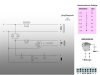
Lastly I have the ALKjr crossover which I'm very fond of, I like its simplicity, I like the fact of a near 10 ohm load for the mids instead of the 100 plus ohm's. I think I would stick with the second order for the woofer. I think I would stay with the 40 ohm resistor across the tweeter to quell the rising impedance to as in the original network. So actual values haven't been worked out yet but I hope to work with this model which I feel is far more electrically correct.
SET12