• The move to the new server is done. There are some software and database maintenance updates in process. This has us passing the hat around to help out. We appreciate any donations. Seriously, even a dollar helps. The payment page may be found here - https://www.audiokarma.org/support.html

Harman Kardon A500 No Sound

So with everything fully connected, I get the exact voltages on the voltage taps +\-10VDC.

Now for the channel imbalance, I’ve cleaned all switches with deoxit and the issue still persists. I’ve played with the 2 potentiometers and now much sound changes.

I’ve also switched the Channel Reverse switch and channel A stays loud and beautiful, channel B is quiet.

I’ve swapped output tubes, as well as speakers to confirm that’s not the issue. It’s definitely something in the amp.

This issue was originally here, I was hoping caps being replaced would help.

Channel A neutral sounding.

Channel B makes sound but only fills a room when you turn loudness all the way up.

All tubes test good, and all voltage taps measure their respective voltage. Any tips are greatly welcome for troubleshooting this step.

Thanks!
 
Okay…

Time to start diagnosing. Do both channels play equally loud at higher volumes? Or is channel B always quieter no matter what the volume setting? Same question for treble and bass controls. Might be easier to use a dummy speaker load and use a scope, if you have one.
 
Now for the channel imbalance, I’ve cleaned all switches with deoxit and the issue still persists. I’ve played with the 2 potentiometers and now much sound changes.
Have you worked all the switches/dials fully after the DeoxIT application, rotating/sliding each control at least 30x? Just spraying with DeoxIT alone won't necessarily eliminate the issue.
 
Have you worked all the switches/dials fully after the DeoxIT application, rotating/sliding each control at least 30x? Just spraying with DeoxIT alone won't necessarily eliminate the issue.
This works for remote controllers, too! Goomba gets into the devices, and simply working all the buttons a few dozen times can sometimes fix the stubborn ones.
 
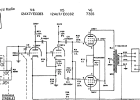
You should get near nominal voltages (especially the drop across the various tap points). They should not all be the same, tubes or no tubes. Those resistors (R78 - R82) in the lineup should be dropping the voltages, not the tubes.
The resistors won't drop voltage if there's no current draw across them. The tubes are the only thing that create that current draw, so without tubes, all the voltages will be the same. This is why the various decoupling caps must have a higher voltage rating for an amplifier with a solid stage supply than one with a vacuum tube rectifier. The solid state rectifier applies voltage before the tubes conduct, so the resistors don't drop any voltage. Note that the three sections of C30 in the A500 are only rated for 350V. This is exceeded when power is first applied, but HK relied on their surge rating not to fail.

Jack
 
The resistors won't drop voltage if there's no current draw across them. The tubes are the only thing that create that current draw, so without tubes, all the voltages will be the same. This is why the various decoupling caps must have a higher voltage rating for an amplifier with a solid stage supply than one with a vacuum tube rectifier. The solid state rectifier applies voltage before the tubes conduct, so the resistors don't drop any voltage. Note that the three sections of C30 in the A500 are only rated for 350V. This is exceeded when power is first applied, but HK relied on their surge rating not to fail.

Jack
Then, how do you get B+ if all the tubes were pulled? :idea:

I agree that the voltages on the rail may be higher due to no tube load, but they should not be all the same, as the resistors are a load. You can measure voltages on a circuit with the tubes out and compare them to the schematic. They will not be all the same.

He got the thing working, so that's all that matters here. :thumbsup:
 
Last edited:
So I found this thread:https://audiokarma.org/forums/index...xing-harman-kardon-a-500-weak-channel.968930/ and started doing their troubelshooting.

All tests were done with amp in MONO, and Ch B was still much much quieter.
Reversing RCA cables did not change things, nor did switching speakers.
I've cleaned all switches and knobs and this did not fix things.
I've swapped Ch A and Ch B's power tubes and this did not solve things.
I've swapped around V1,V2,V3, and V4 and this did not change things.
I've tried my phone, macbook, new Aux and new RCA cables and this didn't change things.
I've tried Aux, Tuner, and Tape inputs and the issue was consistent amongst all 3 inputs.
At this point it's safe to say the input devices and cables are not the issue.

One thing to note, is that with only Ch B input plugged in, and the volume cranked, I can hear music out of Ch A's speaker, quieter yes, but it's still obviously there.
If I reverse this and have Ch A plugged in only (volume knob has to be reduced to half because Ch A is loud) I hear nothing out of Ch B's speaker. I'm thinking maybe something is shorted out for Ch B and dragging it down.

Any ideas?
 

Attachments

  • 1737314827120.png
    1737314827120.png
    204.3 KB · Views: 3
Then, how do you get B+ if all the tubes were pulled?
Sorry, I don't understand the question. B+ is produced by the power supply, in this case solid state.
I agree that the voltages on the rail may be higher due to no tube load, but they should not be all the same, as the resistors are a load.
The resistors are not a load. They don't connect to ground. None of the takeoff points connect to ground either. They only draw current when the tubes conduct.

Jack
 
Did you measure it before replacing? Which resistor was it?

Jack

For V5, the 22k resistors looked a little crispy, though it could have been dirt. I measured them and they were fine. I replaced them and issue still persisted. This is jst the general area with smoke came from. I was never able to find out where.
1737315707822.png
 
Sorry, I don't understand the question. B+ is produced by the power supply, in this case solid state.

The resistors are not a load. They don't connect to ground. None of the takeoff points connect to ground either. They only draw current when the tubes conduct.

Jack
The caps are grounded.
 
This is jst the general area with smoke came from. I was never able to find out where.
It's not uncommon for a part to overheat but not show the damage. Did you ever sniff around the chassis to try to locate it? I wasn't kidding about that. This is one of the many methods for finding it, and in your case, the part that died could very well be the reason one channel has a problem.

Jack
 
I'm thinking of the electrolytic caps in the power supply. It's not the current we are discussing (I think); it's the potential (voltage).

:)
We're discussing the DC current that would be necessary for the resistors to drop DC voltage. If there's no current, there will be no voltage drop, and all the resistors in the chain will measure the same.
 
the only time you'd get any sort of appreciable drop from full voltage with no tubes is if there is a resistor to ground somewhere serving as a bleeder resistor, or if a cap had enough leakage to be a problem.
 
It's not uncommon for a part to overheat but not show the damage. Did you ever sniff around the chassis to try to locate it? I wasn't kidding about that. This is one of the many methods for finding it, and in your case, the part that died could very well be the reason one channel has a problem.

Jack
Okay I’ll give a sniff test tonight when I go through again.

It is odd no one has responded about my observation about Ch B being quieter, and also able to be heard through both speakers when at full volume even when only Ch B is plugged in.
 
the only time you'd get any sort of appreciable drop from full voltage with no tubes is if there is a resistor to ground somewhere
That's correct, but no such resistors exist in the A500. With no tubes, every power supply node should read the same if a high-impedance DVM is used for the measurements.
 
Back
Top Bottom