• The move to the new server is done. There are some software and database maintenance updates in process. This has us passing the hat around to help out. We appreciate any donations. Seriously, even a dollar helps. The payment page may be found here - https://www.audiokarma.org/support.html

[help] Trouble with Revox B215 cassette

Just wanted to say thanks for the great feeback. I'm sure it's gonna help many others to :-) I will tried the simplier method of turning the motors first!

I suggest you at least wick a drop of fine machine oil to the front bearing, though. It takes a lot of the grunt. Just remove the reel tables, oil and replace. Takes moments.
 
I'm also trying to find the smaller left pinch roller for the early B710 deck.

Ditto. The right one was easy. Found a generic on that auction site for $4.
The really great part is that I didn't have to pay some "ambitious" person $85 :yikes: For ONE!

The left roller is "ok" but not great.
 
And let us know as well. I have a B710 with a problem that is very likely the same, that I couldn't figure out what to do with the motors.

Sasi, I could tell you a very interesting story about the motors. Drove me to the brink of insanity, but 11 hours at the bench later I DID figure it out.
You'll NEVER believe it.

It's a long one.... probably email or PM if you are curious.

Marc
 
Well, I'll try to make it short.

I received my B710 with a blown fuse. Price was right, so I took a chance. It was, as I suspected, a shorted FRAKO cap in the power supply. Replaced all 3 and the deck basically worked. Then I had the problem with the motors. Sluggish performance AND it would pull the tape slightly in reverse when in stop mode.

So first I dismembered the motors to clean and oil them. Re-assembled them only to have the rewind problem again. I could play, fast forward and rewind, but everytime I hit stop, it would start pulling tape backwards. Sometimes it wouldn't.

Anyway.... the motors turned smoothly now, so the problem was more apparent than before. I began pulling schematics and the o-scope out. The left motor kept getting much higher pulses than the right, so instead of stopping and holding the tape in slight tension, it would wind (slowly) backwards since the mechanism now turned freely.

It turns out that the motors get a bucking current when turning in one direction, but not in the other. Again, this is part of the tension system. I tried a whole lot of stuff including a total re-cap of ALL the boards, (was going to anyway) to no avail. I began de-soldering a few key spots to trace out where the extra bucking pulses came from. I have most of the IC's in my parts bin, so even tried swapping chips to see if one was getting flakey. Nope. By this time I Ultrasound cleaned ALL the boards and made sure the IC sockets were clean as well.

I eventually concluded after a lot of head-scratching that there was basically nothing wrong with the electronics. Huh.....:headscrat

I finally (after now overhauling the whole deck in the process) had the brilliant idea to reverse the motor connections. It COULDN'T be the motor, it uses only 2 wires and the optical sensors DO NOT determine the braking current based on rotation.

Well, gee whiz..... the left motor STILL did exactly the same thing as before, except it was now being run by the right motor electronics. :scratch2:

OK, so what's different about the motor? Both ran nice and smooth after cleaning and oiling, and both drew the same current off the power supply when tested before re-installing in the deck....

So being at a total loss, (maybe I DID make a mistake re-assembling the motor?) I took the left motor back out. Oh, what FUN!!:grumpy:

Took the whole thing back apart and saw nothing amiss. Hmm...

Out came the stereo inspection microscope (everyone has one, right?) and the motor was carefully examined. Well, I found the culprit.

Stay tuned for part 2 next week.
 
Naaa... just kidding...:D

Anyway, it turns out there was a TINY piece of metal shaving between 2 poles of the already horrendously tiny commutator. It took a little effort to clean it without damaging anything, but a second inspection showed a nice clean commutator free of any metal. It was not visible because the commutator is packed with grease from the factory. It looks solid, but is in fact hollow.

Soooo.... I re-assembled the motor and the deck. The tension mounted as I tested the mechanism. Sure enough, it ran like a clock. It now winds effortlessly and stops on a dime. I cleaned the other motor as well just to be safe.

The decks control logic is very clever... it can detect when the motor runs clockwise or counter clockwise. There is an op-amp feedback circuit that bucks the motor to create back-tension while in play mode, and a slight holding tension in stop mode to keep slack out of the tape. All this from a basic dc motor. Slick! But hard to figure out.

So my theory goes as follows: The motor uses grease on the brushes since they are metal fingers instead of carbon brushes. Over time, the tiny metal wear particles from the brush and comm get trapped in the gaps by the grease. If the resistance between to windings gets low enough, the logic mis-behaves, even though the motor will check fine out of circuit. This causes odd behavior, bad tension, too much tension, etc. It ALSO caused it to wind quickly for a few seconds (as it should) and then drop to a slow speed. If the tape was even a little tight, it then just stopped. Pressing FF or REW would repeat and stop.

At 11:30 at night I walked into the house stating "I won, now I can sleep". :thmbsp:

So I learned something really interesting that night. Basically, the motor IS strong enough to overcome the worn bearings, but if the commutator has metal particles in the gaps (again, invisible in the grease) it just won't run right.

Well, that's the story and I'm sticking to it. Hope it helps the next poor slob with a haunted B710.

On the bright side, I did all the things in one day that I would have put off for weeks. :D

I have one FINE running deck now. :thmbsp:

 
Interesting story Tinman. Thanks for the tip for the oil, I will put a drop. The machine will also be re-capped.:banana:
 
Re-capping is VITAL. At this age, the gold Frako caps may still test ok, but they have a tendancy to suddendly short. This of course can take out something you can't readily replace. I re-capped a Studer mixer console recently with a "power supply" problem but otherwise in perfect operating condition.

Power supply was fine..... 8 caps were shorted in various modules in the console.
ALL were gold Frako's 470uf or higher. I think the real problem is that they run them too high on their tolerance range. All were 16volt caps on a 15volt rail. It's the power-on surge that ends up finally shorting them out.
 
W.M Berg parts:
B1-50-S Shielded grease ball race, id=3mm od=7mm t=3mm
B1-51-S Shielded grease ball race, id=3mm od=8mm t=4mm
B3M-2 Oil-less sintered bronze, id=3mm od=8mm t=3mm

Ummm.... without me having to pull out a motor again, which of those would be the correct replacement? :headscrat
 
We tried to turn the motors upside down, but it didn't help :no:
Lazy man's approach. Leave the motors upside down and FF/REW a cassette starting with the shortest one you have (C30, C45 or C60). Repeated rotations might help loosen the "grit".

I must say this is seldom a solution, but for the rare cases it is, it is much simpler and failproof. You can always revisit the motors and clean them.

By the way, would spraying the motors internally with WD40 clean them or would it finish them?
 
Patlamm, from your original description, maybe it is not a motor fault, especially since you get exactly the same behaviour in FF or REW.

As far as I know, the B215's had ball-race motors, so the motor turning trick is more appropriate to the B710

Incidentally, have you checked the power supply? The big capacitors in these machines die, which can lead to odd behaviour.
(what series B215 is it?, oldest=silver with grey+red buttons, middle-age=silver with black buttons or youngest=all black+gold lettering)
 
Lazy man's approach. Leave the motors upside down and FF/REW a cassette starting with the shortest one you have (C30, C45 or C60). Repeated rotations might help loosen the "grit".

I must say this is seldom a solution, but for the rare cases it is, it is much simpler and failproof. You can always revisit the motors and clean them.

By the way, would spraying the motors internally with WD40 clean them or would it finish them?

The way these motors are constructed, spraying them with anything will not get to the rear bearing. It's a bad idea. Also, the rotor is basically a wire basket that's glued together. Get the wrong stuff in there and it could cause it to come apart.

I did find some potential replacement motors for $6 a pop. Stay tuned. I don't know if these will work yet, but they SHOULD. The core part number is the same. I have 2 in the mail to me. You can find them with google, but only buy if you are willing to experiment until I can verify that this IS the same motor.
 
Well, the motors for $6 each were a bust. The shaft is too small, even though the other parameters match. Another set I found on the internet for $10 a pop is the wrong voltage, and it has a worm gear attached to it. The good thing is that for $20 and some work I now have 4 ball bearings for my revox motors instead of $35 or so a piece for the bearings from that bearing place.

So, no drop-in motor replacement, but a good rebuild none the less.
 
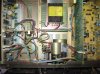
Hi Steerpike, so I beleive that there are the youngest one, black and gold. You can see the picture taken before we changed them. Now the machine has new capacitor in there, but the problem still remain. Other capacitor were changed to, there was humming at the output, now it's gone :-D.

Another thing i've notice now that I used it for a couple of days, it got the same problem at the beginning of the cassette on play, the machine stops 1, 2 or 3 times before playing normaly. When it's on the clear tape at the beginning I guess?


Patlamm, from your original description, maybe it is not a motor fault, especially since you get exactly the same behaviour in FF or REW.

As far as I know, the B215's had ball-race motors, so the motor turning trick is more appropriate to the B710

Incidentally, have you checked the power supply? The big capacitors in these machines die, which can lead to odd behaviour.
(what series B215 is it?, oldest=silver with grey+red buttons, middle-age=silver with black buttons or youngest=all black+gold lettering)
 

Attachments

  • IMG_0080.jpg
    IMG_0080.jpg
    94.7 KB · Views: 90
That is one empty cassette deck Patlamm. At least, when compared with the B710. Several daugterboards to the right side and a few to the left, in addition with a full complement of smaller boards in the front section, to the left and right of the transport.
 
Back
Top Bottom