Your ears probably don’t like the titanium diaphragm in those k68. If I remember right it was about a 50/50 split with the k53 ti vs phenolic when that swap was all the rage on the other forum years ago.I ran the K-68 driver and the curve was exactly the same, however the PRV 270 sounds much sweeter and less forward. I tried turning up the L-PAD to get the curve flatter, but in all honesty, it sounded terrible. a 2dB attenuation via the L-Pad seems to be the sweet spot.


You are using an out of date browser. It may not display this or other websites correctly.
You should upgrade or use an alternative browser.
You should upgrade or use an alternative browser.
Measurements for dummies…
- Thread starter Gigantic
- Start date
-
- Tags
- frequency response rew thd umik

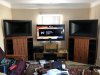
I first noticed the "Titanium Ringing" when I had EV DH1a/940horns in my small office on top of Peavey FH1 bins with K33's. I was using PEQ Boosts/Time Delay in the Digital Crossover to make things flatter. This was 16 years ago and sounded really good, even with the extra "sizzle wiggle" from the Titanium OEM Diaphragm as seen in the curves. Since then, because of low dispersion issues from 2" compression drivers, and the inherent "sizzles" (I had better hearing then) I experienced the superior output of TAD Berylium drivers, which I sold with my Jubliee Clones. It's the main reason I let the natural rolloff of compression drivers with Ti Diaphragms remain under 6 Kz. and use a Super Tweeter for better dispersion characteristics and clarity. Unlike the latest Jubilees from Klipsch, which uses a 3D printed, passive, dispersion device between the driver and K-402 horn. TADs didn't need a super tweeter, but had narrower dispersion above 7 Khz. Either way, its has to be dealt with for maximum imaging qualities now that the sizzle is gone.Your ears probably don’t like the titanium diaphragm in those k68. If I remember right it was about a 50/50 split with the k53 ti vs phenolic when that swap was all the rage on the other forum years ago.
Since this is a measurement thread, please note the curving laptop and microphone pre amp/signal generator on the coffee table. All this before the Umik came into the market.
Last edited:

Assuming you are talking about TWiiii here. I got him on ignore. Total waste of time as he contributes nothing of substance. But the crown still goes to Randy in the BS department. I agree with your post as others probably do.
Yes it is about tweedle TWiiii. I remember posting some things about older Klipsch info I had found. Roy jumped all over me about the need to use verified info only and how did I know what I had posted was legitimate. Others with much more time in the Klipsch world popped up to vouch for the info and explain where it came from. Same day Randy was posting bad info, once again, and the warning I got from Roy to leave him alone even though he was posting bad info came to mind. I never posted anything informative like that again there and was sorry I had even tried to do so.
OK I am trying to figure if you meant like bananas or is bananas like.Hey if the guy likes banana's, let him like banana's.
.
I ran the K-68 driver and the curve was exactly the same, however the PRV 270 sounds much sweeter and less forward. I tried turning up the L-PAD to get the curve flatter, but in all honesty, it sounded terrible. a 2dB attenuation via the L-Pad seems to be the sweet spot.
Curious to know if you have checked for drift on those L-Pads. I would fiddle with getting mine just right and balanced side to side and to the other drivers. It worked fine for speakers as insensitive as Fortes. When I was working on my two way however which is much more capable I found that the next day when turned back on I had output drift and would often have to rebalance things again. I ended up using a fixed resistor L-Pad, which when the right combination was found has given me great no variance results for months now.
The term "flying bananas" is something I "stole" from a Tom Danley post on another forum.OK I am trying to figure if you meant like bananas or is bananas like.
.
Since I have owned his USA horns (20 down to 4), 5 Flagship Synergy Horns SH-50s (down to 3) and countless Tapped Horn subs, and one BT-7 serveo sub AND meeting Tom 6 years ago, also with Email correspondence, I'm a fan of all his Synergy Horns and label him the most prolific speaker designer in the world, currently. His JERICHO Horns simply STOMP the crappy performance of Line Arrays, in shootouts, yet, the world of people addicted is stubbornly clinging to those "flying bananas." This includes a "name dropper only" individual here and his BS without any skin in the game, so to speak.
Call me a well invested proponent instead of a fan boy (a term I hate) if you will, but a listening test will quickly make any person into a believer, without exception (as compared to makers of said Bananas with a much bigger AD budget in the Trade Magazines).
Your ears probably don’t like the titanium diaphragm in those k68. If I remember right it was about a 50/50 split with the k53 ti vs phenolic when that swap was all the rage on the other forum years ago.
I think that can be driver dependent in some ways. I REALLY like my 1132 drivers on my 402's. I have yet to find a 1" Ti diaphragm driver that does not sound tinny and shrill, to me of course. I have had various Ti 2" Ti diaphragm drivers to play with and outside of the 1132 nothing capable of large output has come close to the sound quality of a Faital HF146R with a poly-mylar diaphragm in my personal use. The mylar diaphragm on the DE-10's and DE-120's are superior sound in every way to ALL the Ti 1" diaphragms I have tried.
Only one purported drawback to the mylar diaphragms I know of. If they get hot they can lose their shape and lose that great sound quality. However with the well over 700 pcs of B&C drivers I have handled so far not one person has reported this as a problem. Pro gear pushed to the max and past by SLV idiots will destroy anything though and I have seen some remarkable damage and can't imagine what they were doing.

Gigantic
A big, big love
Curious to know if you have checked for drift on those L-Pads. I would fiddle with getting mine just right and balanced side to side and to the other drivers. It worked fine for speakers as insensitive as Fortes. When I was working on my two way however which is much more capable I found that the next day when turned back on I had output drift and would often have to rebalance things again. I ended up using a fixed resistor L-Pad, which when the right combination was found has given me great no variance results for months now.
I haven't noticed much drift, but I've been adjusting them pretty regularly, just to be certain that the attenuation is just right, flipping between 12:00-9:00 (0dB to -3dB.) -2dB seems to be the sweet spot. Ultimately, I'll either do a fixed resistor L-Pad or a 3619 autoformer from @Deang
Easy, too much cheap class D power in the hands of ignorant people who push 113 db levels at Concerts (I had a Sound Meter with me). I am refurbishing 12 JBL boxes with 12" and 15" woofers (24 total). Only 10 are putting out sound, the other 14 woofers are dead from too many WATTS. Reminds me of the 16 year old going on a Joy Ride with his Rich Dad's $1.4 Million Ferrari. The kid lived thought the 200 MPH crash but the car was in 3 pieces, 2 blocks apart!Only one purported drawback to the mylar diaphragms I know of. If they get hot they can lose their shape and lose that great sound quality. However with the well over 700 pcs of B&C drivers I have handled so far not one person has reported this as a problem. Pro gear pushed to the max and past by SLV idiots will destroy anything though and I have seen some remarkable damage and can't imagine what they were doing.
BTW, the Titanium Drivers (1.5" throat) all survived because of protection and running with 10 db of attenuation to match the double woofers in a BR box tuned to 40hz.

mboxler
Well-Known Member
I'm curious how others determine the delay between, say, the mid and tweeter drivers. ChrisA on the Kforum suggested something like this...
I ran a sweep using the PRV D2200ph/18x10 and the Crites CT-125. Both flush with a makeshift baffle. The drivers are wired in parallel after a 15uf capacitor. I started the sweep at 3500hz, then applied 1/6 smoothing.
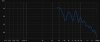
I then executed the Spectrogram function. The appearance settings are ones ChrisA suggested.
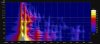
Notice the "twin towers" that represent the energy from the two drivers. I think the red dotted line represents where the most energy is at that frequency. I assume the "left tower" is the tweeter, and it's around -500 microseconds. So...the sound from the tweeter is arriving 500 microseconds before the mid?
If ChatGPT is correct, that equates to 17.15 centimeters. It's hard to measure the real distance, but the answer seems reasonable. I'm at 6000 feet, so the distance will be a little shorter.
If I were to enter a tweeter delay of 500 microseconds in MiniDSP the "twin towers" would line up?
Mike
I ran a sweep using the PRV D2200ph/18x10 and the Crites CT-125. Both flush with a makeshift baffle. The drivers are wired in parallel after a 15uf capacitor. I started the sweep at 3500hz, then applied 1/6 smoothing.
I then executed the Spectrogram function. The appearance settings are ones ChrisA suggested.
Notice the "twin towers" that represent the energy from the two drivers. I think the red dotted line represents where the most energy is at that frequency. I assume the "left tower" is the tweeter, and it's around -500 microseconds. So...the sound from the tweeter is arriving 500 microseconds before the mid?
If ChatGPT is correct, that equates to 17.15 centimeters. It's hard to measure the real distance, but the answer seems reasonable. I'm at 6000 feet, so the distance will be a little shorter.
If I were to enter a tweeter delay of 500 microseconds in MiniDSP the "twin towers" would line up?
Mike

mboxler
Well-Known Member
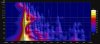
I held the tweeter with it's voice coil above the mid voice coil. Not really an accurate way to do this but it was quick. The red dash line is much straighter. Is there a better way to determine time alignment? A low pass on the mid and a high pass on the tweeter will increase the delay even more.
It's within 1/4 wave, so nothing to worry about. The group delay/phase shift from porting the Doghouse is nothing to worry about either, since the wavelengths involved are so small.I recall coming across the LaScala woofer distance relative to the midrange at one time, but can't remember now. I believe @ClaudeJ1 would know.
Those with factory LaScalas are hearing a "Closed Box" response of the doghouse below the 104 hz. HORN cutoff part. Those who ported it, depending on port length, will have additional time delay as a trade off for more bass. No free lunches, but the extra bass is worth it. Besides y'all who have done this still shouldn't worry because the longer wavelenght involved are not audible unless the low bass notes are A/B compared to those from a Full Horn Loaded Sub, and even then..................not very audible. Just enjoy the music imperfect.
Last edited:
It's about 0.7 feet difference in path length. Which about 1/4 wave at 403.5714 Hz. Just don't let the 4 decimal places fool you. It's inaudible but only measurable and calculatable. Pun intended.How does one determine the delay between the woofer and mid on a La Scala? I did chuckle when I realized that the title of thread might pertain to rulers yard sticks and tape measures as well
This is why I prefer LaScalas with THTLP Horns Subs over a Khorn any day of the week. With a distance aligned DaveTN tweeter on top of course.It's about 0.7 feet difference in path length. Which about 1/4 wave at 403.5714 Hz. Just don't let the 4 decimal places fool you. It's inaudible but only measurable and calculatable. Pun intended.
I’m picking up a mic later this week, but in the meantime, I downloaded the House Curve app and did some measurements using the app and the microphone on my iPhone.
here are the curves at 1m from the speaker:
View attachment 2816761
I know you're onto to REW now, but curious if the iPhone HouseCurve results were useful (e.g. consistent with REW)? This is the first I've heard of this app.
Gigantic
A big, big love
It was not all that different from measurements at the main listening position. It’s useful as an overview, but not so much for details.I know you're onto to REW now, but curious if the iPhone HouseCurve results were useful (e.g. consistent with REW)? This is the first I've heard of this app.

0.7 feet would equate to 621uS or 0.621mS.It's about 0.7 feet difference in path length. Which about 1/4 wave at 403.5714 Hz. Just don't let the 4 decimal places fool you. It's inaudible but only measurable and calculatable. Pun intended.