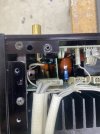
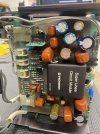
Thank you Mark and Alex! It worked in my 780.
Thanks for reminding me I still haven't ordered the parts yet to build the boards I was so graciously sent.
Thanks for the "kick-in-the-brain", and I'll get an order out tonight!


Thank you Mark and Alex! It worked in my 780.

After discovering a failed PA3004 chip on my SA-7700 rebuild, and paying $35 for a single replacement, I asked @merlynski to help me design a PCB substitute, so we can all keep rehabbing these old units without paying exorbitant prices for new "old stock" chips.
Our design goal was to replicate all functions of the original chip, allowing the board to be used as a drop-in replacement in all use cases, in as small a package as possible.
The PA3004 is a speaker/output stage protection circuit in certain Pioneer amps and receivers which includes; DC deviation, B-/+ detection, AC detect, discharge/switching and power muting.
I think we have succeeded admirably, and we're happy to offer the full gerber, design and BOM files here so that any one can use them. I created a small website with info and files for download here:
https://guerillavending.com/alex/PA3004/
I think we succeeded in designing a circuit that would replicate all functions of the original chip, and the price is a significant improvement as well - when building 10 at a time, the cost is about $7 a board! I laid out both SMD and thru hole versions, so people that want to build their own can do so, and anyone who needs the tighter size of the SMD version has access to it. The nominal voltages for the PCB in operation are almost exaclt the same as the original chip, so no trouble shooting operations need to be changed.
The boards themselves are about as small as they can be, and can hopefully fit in all units. I'm interested to see if that is indeed the case - I'm including a picture of a working pcb in my SA-7700.
I have tested this board thoroughly on my own SA-7700 Amplifier, and have detailed my testing results here. I would love to have some other people verify operation with different models, if they are willing to test out the boards. I have a handful I can mail out to anyone willing to test, and I will update this post and the website when more successful substitutions are confirmed.
I'm attaching a pic of the boards, the schematic and layouts here. We tried to design the boards to use cheap and common components, and to be easily buildable!
I'm happy to answer any questions any one may have. AK has helped me to restore a couple of amplifiers, and I'm more than happy to contribute to pay it forward!
UPDATE MARCH 2024
@EastPoint has made both the thru hole and SMD boards available via his ebay store! If you need one of these boards, this is the place to get one!
PA3004 Replacement Thru Hole
PA3004 Replacement SMD
Masters!After discovering a failed PA3004 chip on my SA-7700 rebuild, and paying $35 for a single replacement, I asked @merlynski to help me design a PCB substitute, so we can all keep rehabbing these old units without paying exorbitant prices for new "old stock" chips.
Our design goal was to replicate all functions of the original chip, allowing the board to be used as a drop-in replacement in all use cases, in as small a package as possible.
The PA3004 is a speaker/output stage protection circuit in certain Pioneer amps and receivers which includes; DC deviation, B-/+ detection, AC detect, discharge/switching and power muting.
I think we have succeeded admirably, and we're happy to offer the full gerber, design and BOM files here so that any one can use them. I created a small website with info and files for download here:
https://guerillavending.com/alex/PA3004/
I think we succeeded in designing a circuit that would replicate all functions of the original chip, and the price is a significant improvement as well - when building 10 at a time, the cost is about $7 a board! I laid out both SMD and thru hole versions, so people that want to build their own can do so, and anyone who needs the tighter size of the SMD version has access to it. The nominal voltages for the PCB in operation are almost exaclt the same as the original chip, so no trouble shooting operations need to be changed.
The boards themselves are about as small as they can be, and can hopefully fit in all units. I'm interested to see if that is indeed the case - I'm including a picture of a working pcb in my SA-7700.
I have tested this board thoroughly on my own SA-7700 Amplifier, and have detailed my testing results here. I would love to have some other people verify operation with different models, if they are willing to test out the boards. I have a handful I can mail out to anyone willing to test, and I will update this post and the website when more successful substitutions are confirmed.
I'm attaching a pic of the boards, the schematic and layouts here. We tried to design the boards to use cheap and common components, and to be easily buildable!
I'm happy to answer any questions any one may have. AK has helped me to restore a couple of amplifiers, and I'm more than happy to contribute to pay it forward!
UPDATE MARCH 2024
@EastPoint has made both the thru hole and SMD boards available via his ebay store! If you need one of these boards, this is the place to get one!
PA3004 Replacement Thru Hole
PA3004 Replacement SMD

Awesome, this is a new unit to me regarding the PA3004 chip - glad it's working!Wanted to send a big Thank You to the OP for designing this PA3004 substitute! My MZ-1 mono-block had a PA3004 IC go bad and the SMD version of this design was a perfect drop in replacement, both in size and functionality!
Thanks again!
Kevin
Hi @bbtv - the pins should correspond exactly to the original chip. If you're using the ebay kit you'll have to cut off a pin from the header to make it match exactly and fit in the footprint on the protection board. Go ahead and ask any questions you might have and I'll do my best to answer!I know I am late to the party, but I'm trying one of these in a mighty Pioneer SX-1980. So far I'm a little confused about the pins to use and not use, but I've only just begun. This is the last step in a very long rescue of a water-damaged unit. Stay tuned.
Thanks so much for your willingness to help. After stepping away from it for a day, all is well. The replacement board seems to be working perfectly. I may simulate some fault conditions later to make sure, but it appears that it works fine in an SX-1980 as well as the others. It was too close of a mechanical fit, so I bent the pins to install the board at a slight angle to clear the bottom plate. Note to future users: get the smd version for the 1980.Hi @bbtv - the pins should correspond exactly to the original chip. If you're using the ebay kit you'll have to cut off a pin from the header to make it match exactly and fit in the footprint on the protection board. Go ahead and ask any questions you might have and I'll do my best to answer!
 At the moment, it's working fine and I'm going to bench test it for a few days before getting it back to its home.