• The move to the new server is done. There are some software and database maintenance updates in process. This has us passing the hat around to help out. We appreciate any donations. Seriously, even a dollar helps. The payment page may be found here - https://www.audiokarma.org/support.html

Recapping a Tandberg TR-2080

For future reference, what's the best material for the cord?
Dial cord/string sold at a few shops wjoe has it, there are many kinds floating in the bay, usually different diameters and of course if you want a millenium's supply there is the Dacron fishing line some mention available at your local tackle shop in obscene lengths for dial stringers.
 
Dial cord/string sold at a few shops wjoe has it, there are many kinds floating in the bay, usually different diameters and of course if you want a millenium's supply there is the Dacron fishing line some mention available at your local tackle shop in obscene lengths for dial stringers.

I was wondering if there was something specific. I was thinking something like strong kite string or spiderwire type fishing line but I wasn't sure what diameter of string was needed.
 
IMG_8763.JPG

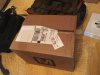
Big ol' box o' parts from Mouser came in today and I hope to have the power amp board back and tested this weekend.

IMG_8768.JPG

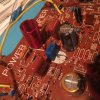
The CMF55 resistors are nice and small, very low noise, and 1/2 watt. This board seems like it's been pushed to limits, so all the 1/4 watts got bumped up to 1/2 watt.

Gotta love lead benders and lead formers...

IMG_8767.JPG
 
View attachment 1184117

Big ol' box o' parts from Mouser came in today and I hope to have the power amp board back and tested this weekend.

View attachment 1184115

The CMF55 resistors are nice and small, very low noise, and 1/2 watt. This board seems like it's been pushed to limits, so all the 1/4 watts got bumped up to 1/2 watt.

Gotta love lead benders and lead formers...

View attachment 1184118

My favorite resistors as well. The 50 ppm versions are extra nice. :)
 
What is the 50 ppm version? Like 0.01% ?

Not tolerance, temp coefficient. They are more consistent over temperature changes than most other reasonably priced resistors. Good for things like turntable circuits where circuit RC constants or voltage dividers may set servo feedback performance. :)
 
Since you're upping the resistor values (wattage) aren't you worried about a cascade failure if one of your components shorts down the road? I was told never to change the value of the resistor (ohm rating and power rating) since some resistor are meant to blow.
 
Since you're upping the resistor values (wattage) aren't you worried about a cascade failure if one of your components shorts down the road? I was told never to change the value of the resistor (ohm rating and power rating) since some resistor are meant to blow.

I hear ya. Good thing to point out.

I've watched out for schematic indications of fusible resistors and physically looked for 1/8 watt resistors, but seen none in this Tandberg.

There is no parts list or schematic indication of wattage other than the high wattage resistors, so the ones coming off the board are a hard-to-tell mix of 1/4 watt and 1/2 watt. When I had to start building my all-in BOM, I weighed the overheating signs and my lack of precise data and went with "bump all unknowns up to 1/2 watt". Not a perfect approach, but the one I chose.

I'll learn if I'm wrong during testing. And if anyone has good, clear data like "R973 on the power amp board is supposed to be fusible", please say so.

 
I prefer higher wattage resistors since the wattage rating is done at 25 deg C and
we must derate above that temp which is not even ambient on a hot day. Many
engineers do not bother so any that are close to their rated 25 deg C power should
be upgraded. Even better is to use them at half of their rated power.
 
I prefer higher wattage resistors since the wattage rating is done at 25 deg C and
we must derate above that temp which is not even ambient on a hot day. Many
engineers do not bother so any that are close to their rated 25 deg C power should
be upgraded. Even better is to use them at half of their rated power.
But some of those resistors are made to act as a fuse and blow up, protecting the circuit, in case of a failure. If you place a higher wattage resistor, like doubling from 250mw to 500mw, then that fuse wont blow and other things, some of them impossible to find in 2018, will. You can actually start a fire inside your electronics. "Engineers do not bother", those are bad engineers and most of the gear we buy here did not have bad engineers. These things are so well built that they are still working after forty plus years. I don't question original designs, I know my limitations.
 
I hear ya. Good thing to point out.

I've watched out for schematic indications of fusible resistors and physically looked for 1/8 watt resistors, but seen none in this Tandberg.

There is no parts list or schematic indication of wattage other than the high wattage resistors, so the ones coming off the board are a hard-to-tell mix of 1/4 watt and 1/2 watt. When I had to start building my all-in BOM, I weighed the overheating signs and my lack of precise data and went with "bump all unknowns up to 1/2 watt". Not a perfect approach, but the one I chose.

I'll learn if I'm wrong during testing. And if anyone has good, clear data like "R973 on the power amp board is supposed to be fusible", please say so.

I think it's a good idea to replace resistors in the signal path with metal films since they are low noise but with the same value (since these are not stressed as much). Probably the ones that you found toasty are the ones that would blow, indicating that this receiver has been driven hard in the past (also since it's already been worked on and it's also 40 years old). I say this that due to my own stupidity, I caused a short in a Yamaha 2020. One resistor blew up in the left channel but everything else was saved and after correcting the short and replacing the fuse it worked just fine (I still have it).

You're doing a great job, keep it up.
 
Even modern metal film 1/4w resistors will take way more abuse than old 1/4w carbon films. If we're going to worry about unlabelled fusible resistors we might as well not replace any for fear of roasting something.

As an aside, if you buy the 1/4 W Mil spec version of the Vishay Dales (RN I think?) They're derated 1/2 vs the commercially specced CMF series. So an RN rated at 1/4w would be the same as a CMF rated at 1/2w. So depending on what specific line of resistors you choose you could accidentally build a lot more current tolerance into the design, even keeping the specs the same.

Personally, I think if a design is using resistors as fuses and not calling them out as such, that's kind of a lame design practice. I think there comes a point where you just accept the risk in exchange for better performance/sound quality/ease of parts ordering.
 
Personally, I think if a design is using resistors as fuses and not calling them out as such, that's kind of a lame design practice. I think there comes a point where you just accept the risk in exchange for better performance/sound quality/ease of parts ordering.

Yes, exactly! Upgrading from 1/4 or 1/8 to 1/2 is not going to matter with regard to saving a circuit.
@fernarias
I've worked on a lot of equipment and never saw a resistor save any other parts by burning up.
I'm also an EE with over 20 years in Miltary design. Your claim is internet myth.
 
It is absolutely valuable to recognize some designs were made using resistors to act as fuses. For the designs that call them out, I follow that intent and get fusible resistors as appropriate. If there are secret fusibles, that's shame on the designer. This is a Tandberg, so I doubt the engineers didn't note such a part.
 
I also think that at the end of the day, these are our toys and they're for making music and making us happy. While it'd be regrettable for a rare piece of vintage gear to forever let the magic smoke out because of something one of us did in a repair, it's not as if we're endangering the life of an astronaut, pilot, airline passenger, or soldier by changing a resistor wattage rating. The world will continue to turn if we burn up a rare piece of equipment. I have the weight of the former concerns on my shoulders every day at work, so while I'm as careful as possible with my rebuilds I try to keep some perspective.

I made an oops working on a turntable a while back and lost a good bit of sleep over it, and once it was repaired and working again I realized that all that angst just wasn't worth it, no matter how rare the piece of equipment.
 
It is absolutely valuable to recognize some designs were made using resistors to act as fuses. For the designs that call them out, I follow that intent and get fusible resistors as appropriate. If there are secret fusibles, that's shame on the designer. This is a Tandberg, so I doubt the engineers didn't note such a part.
Obviously, yes _if_ they are called out that way then keep that type.
 
IMG_8778.JPG IMG_8779.JPG IMG_8780.JPG

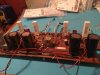
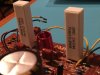
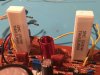
The gianornous "towers of doom" 10W resistors installed... only thing left now are the transistors....
 
Back
Top Bottom