

You are using an out of date browser. It may not display this or other websites correctly.
You should upgrade or use an alternative browser.
You should upgrade or use an alternative browser.
Rek-O-Kut Rondine Jr. L-37 Restoration Begins.
- Thread starter Brett a
- Start date

Brett a
~◦●○o0o○●◦~
Well, it lives once again! This time in the new plinth with the Pioneer PL-51 arm. I'll get pictures of it up later today, but for now, here's the difference in motor noise with the massive plinth (It's an even 50 pounds inclusive)
I amplified the same section of "silence" on the Beatles record. I was careful to apply the same level of amplification to both so as not to disturb the relative difference between them.
Here's what it looks like:

But listening reveals a greater perceived difference. here's the sound clip of the above screen shot. (It's a 6 second 320mp3)
http://dl.dropbox.com/u/16387095/ROK Project/FrankenSilence.mp3
:yes:
I amplified the same section of "silence" on the Beatles record. I was careful to apply the same level of amplification to both so as not to disturb the relative difference between them.
Here's what it looks like:
But listening reveals a greater perceived difference. here's the sound clip of the above screen shot. (It's a 6 second 320mp3)
http://dl.dropbox.com/u/16387095/ROK Project/FrankenSilence.mp3
:yes:
Attachments

Brett a
~◦●○o0o○●◦~
Very cool. I had lost motivation to work on it, but now I'm becoming motivated to work on the L34.
I can't tell you how much fun I'm having. You definately found a good home for it!
I was just saying to my wife as I was preparing those samples that I haven't enjoyed working on the system this much in a very long time.

Very cool. I had lost motivation to work on it, but now I'm becoming motivated to work on the L34.
That's cause winter is here. I don't even listen in the summer time. I was just out in the garage taking inventory to see what I needed to get my system in place. If the temp is above 50, I dont think much about it.
Brett a
~◦●○o0o○●◦~
Brett,
Is the first part of the audio clip before,and the second part after the re-build?
Dave
Yes the first part is before and second part after. The only difference in the base. There were no other tweaks or fixes.
Brett a
~◦●○o0o○●◦~
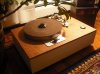
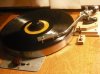
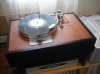
Well, this is what it looks like this evening. I can't wait to trim out its side walls. I painted them white last night. I think I'll take it apart and briong it back to the shop, square the sides and finish them off either with satin black MDF or some nice hardwood.
It's mounted with a Shure M91ED for now. (Also, this Pioneer arm is temporary)


It's mounted with a Shure M91ED for now. (Also, this Pioneer arm is temporary)
Attachments

Brett a
~◦●○o0o○●◦~
It's too early to tell. The jury is still out as to how quiet this thing will get. Right now it's still pretty loud.
The new motor and drive systens grommets (set of 7) should arrive in the mail this week. Then there's getting the idlers rebuilt too.
Also,as for comparing it to the Well Tempered, the ROK's got a long way to go. It's not really a fair comparison considering there's a four-figure value difference between arms, cartridges and phono amps. (FWIW---which is something)
The new motor and drive systens grommets (set of 7) should arrive in the mail this week. Then there's getting the idlers rebuilt too.
Also,as for comparing it to the Well Tempered, the ROK's got a long way to go. It's not really a fair comparison considering there's a four-figure value difference between arms, cartridges and phono amps. (FWIW---which is something)

dnewma04
The Healer
I wasn't expecting it to unseat the well tempered by any stretch, but it'll be interesting to see if the rim drive "sound" will be something that will provide something the well tempered can't, while understanding the well tempered is simply a better table with better components.

drillher
Super Member
The noise is coming from either the motor itself coupled to the plate that has the bearing and then to the spindle and platter,or via the rubber idler wheels.Having the rubber idler wheels refurbished may make a big difference along with the new motor mounts.I wonder what differences the more expensive rim drive tables have that have them with a lower noise floor.

Brett a
~◦●○o0o○●◦~
I wasn't expecting it to unseat the well tempered by any stretch, but it'll be interesting to see if the rim drive "sound" will be something that will provide something the well tempered can't,
Ahhh. I get it.
And I think part of my answer (now that i think about it) was that it's really difficult to tell where this ROK is heading-or even quite what it offers today- as the tonearm/cartridge/phono amp are pretty uninvolving. They don't resolve the level of detail or present on open enough soundstage to really understand what's spinning on that platter.
That said, I do believe that every once-in-a-while, I get a hit of more solid, sharp leading edges especially with percussion and piano. I also suspect the drive mechanism somehow allows for better/clearer resolution of timbres. And i can really trust that sustained notes are stable.
So I guess, yes, the ROK has a sharper attack then the Well Tempered. And what I'm excited by is the prospect of what the ROK might reveal once I have a better arm/cartridge on it, (and maybe eventually a better phono amp).
It's honestly just matter of time before i make an armboard to mount the WT arm on the ROK. It'll be interesting to see how much the suspended silicone bath arm isolates the arm wand from motor/plinth vibration. Think about it; no mechanical connections, just a pool of thick liquid.
:scratch2:
The noise is coming from either the motor itself coupled to the plate that has the bearing and then to the spindle and platter,or via the rubber idler wheels.
The motor is rubber-mounted as is the carriage for the idler wheels. So, as Redboy said, changing these out will make it quieter. (along with getting the idlers themselves restored).
The motor, when spinning alone, is silent. The platter, when spinning free is also silent. It's when you press the idler wheel against the platter that the motor vibration really comes on.
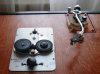
And I noticed this weekend that a lot of vibration also transfers from the motor to the top plate via the start/stop knob. You start it by loosening this knob a quarter turn and sliding it to the left (for 33 rpm). This actually moves the motor over to press the left idler against the inside of the platter and simultaneously switches on the motor.
Then when you screw the knob back down to lock it into place, it couples the motor to the top plate and transfers a lot of vibration with it. i bought a couple of rubber washers at Home Depot to help cushion this. We'll see if it does anything.
Here's a picture from earlier in the thread:
http://www.audiokarma.org/forums/attachment.php?attachmentid=313142&stc=1&d=1322232760
Last edited:
Brett a
~◦●○o0o○●◦~
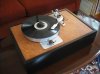
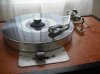
I just finished installing a black MDF frame around the plinth. It ain't the prettiest, but it helps. Of course, all this is practice for when I build one out of Baltic ply. I'm getting many mistakes out of the way with materials I have on hand. That Baltic ply is expensive stuff. It'll be over $100 for the wood when the time comes.


The Shure M91ED with Ed Saunders stylus:

The Shure M91ED with Ed Saunders stylus:
Attachments


Brett a
~◦●○o0o○●◦~
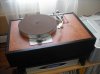
Thanks! Of course, i can see all the imperfections (which I will resist the urge to point out).Looks good to me!
I'm really loving this 'table. It definitely gives music a presence that even the Well Tempered does not deliver.
I think I'll have time on Sunday to install the new drive system grommets.
I'll post more audio clips after that point.
Attachments
Last edited:
Brett a
~◦●○o0o○●◦~
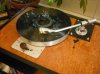
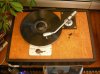
I got home tonight and found this Rek-O-Kut model 120 arm waiting for me. I couldn't wait it mount it!. I had cut a few extra blank armboards when I built the plinth so setting it up was fairly easy.

So far, I'm just running it with a Shure M91ED with a low compliance stylus off an M97.

I'm going to order a Denon DL-103 and see how it sounds all period-correct.

:thmbsp:
So far, I'm just running it with a Shure M91ED with a low compliance stylus off an M97.
I'm going to order a Denon DL-103 and see how it sounds all period-correct.
:thmbsp:
Attachments

Last edited:
