• The move to the new server is done. There are some software and database maintenance updates in process. This has us passing the hat around to help out. We appreciate any donations. Seriously, even a dollar helps. The payment page may be found here - https://www.audiokarma.org/support.html

SA-8800 Oscillation?

Great work. Once it is warmed up, can you set the idle back to spec 56mV using VR7, assuming VR9 still set to min?
If so, let it settle to warm up to normal op temp. monitor the ops bias I for an hour or so and see where it is drifting around at and if it will settle down or keeps running away. Could keep the scope on the o/p as well.
Do the finger check on the drivers and o/p devices to get an idea of op temp after warm up.
You could do some static voltage measurements to determine the op currents. Like
1) measure DCV across R77, to determine the CCS value. V(acrossR77)/R83=?
Do this for other R's to determine these values as I have noted in the ltspice schematic, that way we can see how they differ in real life vs a sim.

Do you do a lot of this stereo work or this your own unit?
 
Hey - it's nice you guys are looking to and spending time, taming this NSA design for available components.
There maybe a whole new world of broken SX-3xxx's and the SA-(NSA amp)'s to repair.
They are wonderful sounding receivers and integrated amps when working up to specs.
 
I'll get onto that now. Just on channel 1? Should I leave it connected through a DBT?

This is my SA-8800 and part of a collection of Pioneer equipment I'm building up... probably too much!

But I do work on other less complicated things like Pianos and guitar amplifiers. Sadly with those, most of the time its just replacing a board for a simple fault rather than actually repairing it. I enjoy repairing or restoring older equipment where you actually diagnose and repair the problem rather than just changing out circuits until it works again...

Hey - it's nice you guys are looking to and spending time, taming this NSA design for available components.
There maybe a whole new world of broken SX-3xxx's and the SA-(NSA amp)'s to repair.
They are wonderful sounding receivers and integrated amps when working up to specs.

I have the SA-7800 too that I usually use in my workshop. I recently went through that when I discovered the phono pre-amp was dead and had desoldered its transistors from the EQ board! Happily, it didn't go the way of the SA-8800....

I also have a SX-D5000 which I think is similar inside to the SX-3xxx. I agree, they sound very good and I think so far, I like the SX-D5000 the best, even though the idle current is insanely high...

It might be next as I've had to stop using it. I think it's time the power supply got reworked. When I turn it on now, it pops periodically until it warms up which I think could be a cracked solder joint...
 
So, I let it run for around 30 minutes. I tried to set the idle current but it kept running away. Around 1mV every 10 seconds and the drivers were running at around 62°C.

If I touched them to check the temperature, the idle current would drop back. So my guess here is that the drivers are on the verge of thermal runaway. I gave the drivers a blast of dry compressed air and the idle current dropped to 35mV from 56mV. I decided it was best to give them some extra cooling at this point, so I powered down and bled the capacitors. Removed the two drivers, fitted them with heat sinks and reinstalled them.

I tried to set idle current again and this seemed better. I set the pot at around the midway mark and let it come up to temperature. The drivers are now running at 50-52°C and after about an hour it began to settle at 55 to 56mV idle current and would drift up and back down. At this point, the drivers were still 50-52°C and the outputs ranged from 30-36°C. Important note, the unit is currently on its side with the left channel nearest to the bench, right channel above. This will probably be effecting the idle current adjustments but it looks to be holding itself steady at the moment.

I had it running on a 200W DBT.

I measured R77 and R83. On both, I measured a voltage drop of 1.68V
 
Good work again.
That makes it about 7mA, which is what we want.
Using heat sinks for the drivers is good. Some amps mount the drivers on the heatsinks with the ops. Sim's says that they are dissipating around 900mW.
Sounds like it is stable under this bias setting. Would not hurt to try it in right position to see how it behaves.
So what is next?
take it off DBT or try to adjust VR9 or both. Just keep an eye on bias to see how it behaves? if that goes okay, do the other channel, play the tunes I hope.
No shortage of NSA amp technology. I'll have to look at the SX-D5000 and see how much that differs, bias for all these should be about the same, Sa-8800 and SA-9900 are the same.
I like the SX-D5000 the best, even though the idle current is insanely high...
You can not set it to spec? change any comps from original?
 
Great! :) So far so good in terms of readings then. Thinking about the drivers, they seem to greatly effect the idle current and they're at 50°C now so I think I'll try VR9 next and keep an eye on their temperature. I'd like to stay around 50°C if possible. I'd put them on the heatsink if there was room...

With VR9 we're aiming for 70mV? roughly how far around the trimmer should I find it? The 56mV on VR7 came out just shy of dead centre.

If VR9 looks good, i'll take it off the DBT and repeat the idle adjustments. I suppose after that it might be wise to check its performance with Square wave testing?

You can not set it to spec? change any comps from original?

No, nothing like that. Currently its all original except for me migrating two voltage regulators from the power supply to a larger heatsink I fitted inside. The transistors are the same ones used in the SX-1980 if I'm correct. The idle current is around 120-150mV IIRC and that's what the service manual specifies. I checked it and nearly hit the roof. Reached for the service manual and was surprised when it actually said that that was fine. Explains why it can get like an oven...

did you ever change c52 ?

I think C52 is still the original capacitor.
 
made me think as have followed this from the start . i may have missed some things . originally oscillation was before q14 ..saying that c52 comes after .

is the oscillation still at q14 ?
 
VR7 is 100 ohm and the sim shows 40ohm which is about half.
The 56mV on VR7 came out just shy of dead centre.
That is usually encouraging
70mV(75mA) is what they call for on VR9
the sim says 25K and it is a 68K pot, so around 1/3-1/2 is my prediction.
C49-C52 at 10n is fine.
It is the comp cap, C45 that sets the dominate pole in the response. Stock it is 39p, the sim shows 82p for the best square wave response. I guess you could use a trim cap(5-50pF) across C45 to fine tune/play with the response.
Thinking about the drivers, they seem to greatly effect the idle current
Maybe that is why they have the bias so low (3mA) on the drivers. It is possible to reduce it to somewhere between what I suggest (17mA) and what they used. You can play with that.
Measure to confirm the bias current in the drivers. DCV across R121(75 ohm)?
 
Off DBT today and set idle to 56mV. It is just a little over halfway on the trimmer actually. Once it was warmed up, I adjusted VR9 and I got it to 70mV ar around 2/3s of the way round. The Drivers are running at around 57-60°C and the outputs run between 38-42°C. Still seems stable and maintains its idle current. I measured the voltage across R121 which is still 75 Ohm (two 150 Ohm resistors in parallel). It measures at 1.22V and R77/R83 continue to come out at 1.68V

I'll look to adding the heatsinks to the Channel 2 drivers and check to see how that one responds next.
 
I think so far, I like the SX-D5000 the best, even though the idle current is insanely high...
First glance, I do not see much/if any difference between the SX-D5000 and the SA-8800 PA designs. The bias in the SX-D5000 S/M I believe is wrong, the SX-D7000 shows the same bias as SA-8800/9800. I should check SX-3900 as well. Wonder how many had the same reaction that you did with those numbers. Maybe that is why you think it sounds so good as the class A region is larger with more bias.

1.22V/75=16.3mA = just as expected based on the sim.
Great, do the other channel to see if it can be a matched in op, then the big test = music and enjoy your new amp design.
 
First glance, I do not see much/if any difference between the SX-D5000 and the SA-8800 PA designs. The bias in the SX-D5000 S/M I believe is wrong, the SX-D7000 shows the same bias as SA-8800/9800. I should check SX-3900 as well. Wonder how many had the same reaction that you did with those numbers. Maybe that is why you think it sounds so good as the class A region is larger with more bias.

That's very interesting. I might adjust that when I next look into it. That could be why it sounds that bit nicer....

I've tried biasing the other channel and it appears to check out too. My only slight issue so far is setting the 70mV. Do I stabalise it at 56 and then turn VR9 up to 70 and then readjust VR9 when it overshoots 70mV?

I think the temperature is interfering because if I turn back to check the 56mV, it only drops a few mV lower instead of going back to 56mV.

I'll try to bias it with the bottom cover on and on its feet and see if that improves things...

I have to nearly have VR9 turned 2/3 or more the way round to establish the 70mV. Am I going about it the right way?

I read up on "Dominant pole" feedback a little and if the ideal is 82pF then we can go ahead and test this? I could try n get some replacement capacitors at 82pF?
 
You have a very sensitive ear if you can hear these small differences in performance.
I think you are dong the bias procedure correctly. It is a very sensitive ckt affected by heat. I think the SX-Dxxx designs are later, so looking at them we see changes and have to wonder why they made these changes.
I think the designers were fine tuning this design over a number of designs/revisions.
I have asked some experts (Bob Cordell) on diyaudio to see if they can lend any insight as to our work so far.
I'd look at the square wave response with the 39pF cap first to see what it looks like. Look for ringing/overshoot and if it rings a fair bit then you can try to add more capacitance to see how it affect the response. More cap will usually make the amp more stable.
 
Last edited:
I have asked some experts (Bob Cordell) on diyaudio to see if they can lend any insight as to our work so far.

I have his book and refer to it all the time.
Why did Pioneer develop the fragile NSA design for a mass production application? Or is it not so fragile? This experiment is showing that it is stable when dialed in. :dunno:
Anyway: Nice work. :lurk:
 
Thanks Bob,

Glad to hear you have the book too. I have learnt a lot from his book, way more than Doug Self's book. Also learnt to run ltspice from Bob's book.
Maybe Bob C. can take some time and comment on this design, also some of the work we are doing to tame this design. I do wonder why he did not touch on this topology in his book?
I posted the design in his book thread in diyaudio. Hopefully we will get some feedback.
 
Maybe Bob C. can take some time and comment on this design, also some of the work we are doing to tame this design. I do wonder why he did not touch on this topology in his book?

Because it's crazy to mass produce it? You can fry an egg on the bonnet when listening at moderate levels. I wonder if George Foreman designed it?
Note:
I'm trying to get a response from MTF but it's not working ;)
 
Last edited:
Still trying to get the idle current up to 70mV with channel 2 and its not managing it.

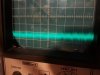
I can set it to 56mV but then VR9 will only take it to around 66mV. On the scope, there is a very high speed waveform at a very low level. It keeps growing and shrinking so I'm guessing something isn't quite right on this channel yet?

I've tried it out on headphones and it seems to be okay I'd like to get this last little issue sorted before continuing to speakers.

Heatsink is running at about 34°C, Drivers are between 50-60°C
 

Attachments

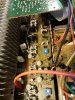
  • 20180419_182548.jpg
    20180419_182548.jpg
    74.6 KB · Views: 25
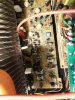
  • 20180419_182554.jpg
    20180419_182554.jpg
    74.6 KB · Views: 25
  • 20180419_191636.jpg
    20180419_191636.jpg
    55.6 KB · Views: 23
I think mtf abandon us in this thread long a go. Analysis of this design, at least for me, requires you to simulate the design. Imagine the original designer was doing this all on paper and his calculator/slide rule :)
I can set it to 56mV but then VR9 will only take it to around 66mV
I guess that you could increase R109 a bit.
On the scope, there is a very high speed waveform at a very low level. It keeps growing and shrinking so I'm guessing something isn't quite right on this channel yet?
you can try to over compensate it with up to the 82p that I called out for the best square wave response. See what that does
 
I guess that you could increase R109 a bit.

What would be causing the need to increase it? I'll measure across it to check current flow.

you can try to over compensate it with up to the 82p that I called out for the best square wave response. See what that does

I'll add a little more to the feedback loop, but what would cause these two channels to behave differently like this?
 
Back
Top Bottom