• The move to the new server is done. There are some software and database maintenance updates in process. This has us passing the hat around to help out. We appreciate any donations. Seriously, even a dollar helps. The payment page may be found here - https://www.audiokarma.org/support.html

Sanyo Turntables

Setting the TF was a bit of a chore, seems that I had to have the table running to do that (with very little space between the arm rest and the platter).

Next time unplug the turntable or slip the belt off the capstan. :)

The anti-skate has me puzzled. It's the type that's made up of two small shafts that pivot. There are no rings or gradations on the shaft with which to measure

The weight disk is secured with a small set screw as I recall. I think setting it in the middle is appropriate for 2g of VTF. Toward the ens of the shaft for more, toward the pivot for less.

(not to mention that the small weight on the end of the shaft doesn't seem to move at all anyway).

There's often a set screw for that as well but I don't see it. Maybe it's preset at the factory. It's not all that important, really.

I'm curious as to how I should set the cartridge overhang. I know that a lot of Japanese s-arms seem to want 49mm.

The 49mm shortcut is Pioneer. That's a C.E.C. table and I think they use 50mm. I also believe that you can set the overhang on that table the old fashioned way by lining the stylus tip up with the inner edge of the trim ring on the mat with the arm over the spindle.

The OM & SM for the TP 625 at VinylEngine will help you with setup. It's very similar.

John
 
I have Sanyo Plus Q40. Nice unit, all in all; not great, but nice. That said I have to agree with mythless re: points 1 and 2.

I also have a Q40. After putting a kilo of modelling clay under the plinth, I'm going to call it great instead of nice.

If you have some experience with the platter ball bearing, please PM me. I'm convinced that there should be a better surface for the bearing to run on than the bare sheet metal of the motor access plate. A tough little plastic bit showed up on my workbench that looks like it might belong there but I need to check with someone who's already gone down this road. While the speed is rock steady, the platter doesn't deliver enough energy to the return and shutoff mechanism to completely cycle it. Every time I start up, the mechanism hasn't completely cleared. It might be bearing friction or it might be something else.
 
Next time unplug the turntable or slip the belt off the capstan. :)

The issue seems to be with the arm lift. If I let the arm return automatically to the rest, the lift stays in an upright position (preventing my being able to balance the tonearm). If I return the arm manually to the arm rest, the lift stays in the down position, even after unplugging the table. I can work with that.

The weight disk is secured with a small set screw as I recall. I think setting it in the middle is appropriate for 2g of VTF. Toward the ens of the shaft for more, toward the pivot for less.

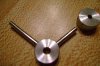
Found the screw! (see attached photos). The screw was facing backwards, and I couldn't even see it. I disattached the entire anti-skate mechanism and reattached weight with the screw on top this time.

With the antiskate disattached, I was able to confirm that the shaft has absolutely no gradations on it. Seems an oversight on Sanyo's part, although maybe the owner's manual addresses this. I checked out the TP625 manual that you provided the link for (thanks!). Looks like that TT has the same antiskate as mine, but I didn't find any mention on actually setting it. I think that I'll use your advice - middle of the shaft is approx. 2g of force.

The 49mm shortcut is Pioneer. That's a C.E.C. table and I think they use 50mm. I also believe that you can set the overhang on that table the old fashioned way by lining the stylus tip up with the inner edge of the trim ring on the mat with the arm over the spindle.

I think that I remember some posts mentioning 50mm as a general number for C.E.C. tables. I'll try that, and probably see how it turns out using a Stevenson protractor.


Thanks, John for your input - much appreciated! :yes:
 

Attachments

  • DSC00201.jpg
    DSC00201.jpg
    55.9 KB · Views: 79
  • DSC00202.jpg
    DSC00202.jpg
    65.1 KB · Views: 66
The issue seems to be with the arm lift. If I let the arm return automatically to the rest, the lift stays in an upright position (preventing my being able to balance the tonearm). If I return the arm manually to the arm rest, the lift stays in the down position, even after unplugging the table. I can work with that.

Some Pioneer turntables are like that. They say to start the turntable and unplug it after the lift bar has descended.

Found the screw! (see attached photos). The screw was facing backwards, and I couldn't even see it. I disattached the entire anti-skate mechanism and reattached weight with the screw on top this time.

The same may be true for the lateral weight. They may have secured the weight before fitting the plinth into the base.

With the antiskate disattached, I was able to confirm that the shaft has absolutely no gradations on it.

Nope! Nary a one! I've seen other tables with that sort of anti-skate where there are grooves in the shaft and a spring-loaded detente ball in the weight. Pretty cool.

Seems an oversight on Sanyo's part, although maybe the owner's manual addresses this. I checked out the TP625 manual that you provided the link for (thanks!). Looks like that TT has the same antiskate as mine, but I didn't find any mention on actually setting it. I think that I'll use your advice - middle of the shaft is approx. 2g of force.

The OM tells you to set the VTF to 2 grams "when using the supplied cartridge". I might have been thinking that the AS weight had been factory pre-set for 2 grams since they don't mention anti-skate at all in the OM. In that light having it pre-set for 2 grams VTF would be a safe assumption - but we know what they say about assumptions.

Thanks, John for your input - much appreciated! :yes:

De nada, amigo.

John
 
Sanyo TP-1800 vintage turntable

There were 2 months ago, I purchased a 1976 Sanyo TP-1800 turntable. It's very similar to a Sanyo TP-626 and it's very built. I replaced recently the belt and I would lik to replace the cartridge. Presently, I have a Shure M91ED (black copy needle) and I'm hesitating between a Ortofon OM5E, Ortonfon 2M Red and a Shure M97xe.
 

Attachments

  • IMG_0510.jpg
    IMG_0510.jpg
    72.3 KB · Views: 144
  • IMG_0191.jpg
    IMG_0191.jpg
    45.1 KB · Views: 79
  • IMG_0508.jpg
    IMG_0508.jpg
    46 KB · Views: 79
  • IMG_0286.jpg
    IMG_0286.jpg
    100.5 KB · Views: 75
There were 2 months ago, I purchased a 1976 Sanyo TP-1800 turntable. It's very similar to a Sanyo TP-626 and it's very built. I replaced recently the belt and I would lik to replace the cartridge. Presently, I have a Shure M91ED (black copy needle) and I'm hesitating between a Ortofon OM5E, Ortonfon 2M Red and a Shure M97xe.

You could do far worse than getting a good stylus for that cartridge. The M91ED is a good cartridge and a good match for that arm. Garage 'a Records has NOS N91ED (US made thin cantilever) for $55.00 or so.

John

PS: Replacing the M97xE on my TP 626 with an M91ED was what made me send the M97 to a new home.
 
Is the TP 727 a decent tt?

Is the TP 727 direct drive? I'm not familiar with that particular turntable but it looks similar to the unit that was in a Fisher (owned by Sanyo) all-in-one I had. It was a pretty decent turntable, by far the best one I've encountered in an all-in-one and better than many stand-alone tables.

John
 
You could do far worse than getting a good stylus for that cartridge. The M91ED is a good cartridge and a good match for that arm. Garage 'a Records has NOS N91ED (US made thin cantilever) for $55.00 or so.

John

PS: Replacing the M97xE on my TP 626 with an M91ED was what made me send the M97 to a new home.


I found also a JICO copy S.A.S. (Super Analog Stylus) at turntableneedles.com. Is it good or much better than a M97xe and a original or copy N91ED?

http://www.turntableneedles.com/JICO-SAS-stylus-761-DSAS-for-Shure-N91ED_p_3979.html
 
I also have a Q40. After putting a kilo of modelling clay under the plinth, I'm going to call it great instead of nice.

If you have some experience with the platter ball bearing, please PM me. I'm convinced that there should be a better surface for the bearing to run on than the bare sheet metal of the motor access plate. A tough little plastic bit showed up on my workbench that looks like it might belong there but I need to check with someone who's already gone down this road. While the speed is rock steady, the platter doesn't deliver enough energy to the return and shutoff mechanism to completely cycle it. Every time I start up, the mechanism hasn't completely cleared. It might be bearing friction or it might be something else.

Apologies for the horribly tardy reply; been an off and on AKer for the past month. I'm afraid I've not that far into it with respect to the bearing. My unit seems to operate smoothly with one minor exception: when the tonearm approaches the end of the final track there is the faintest of a thumping noise that is absent once the tonearm begins to return. Unit is totally silent at all other times.
 
I found also a JICO copy S.A.S. (Super Analog Stylus) at turntableneedles.com. Is it good or much better than a M97xe and a original or copy N91ED?

http://www.turntableneedles.com/JICO-SAS-stylus-761-DSAS-for-Shure-N91ED_p_3979.html

I've not had direct experience with the JICO SAS but, based on the reports here, it's at least the equal of the US made N91ED and probably better. There's absolutely no contest, however, when comparing it to the Mexican made N91ED.

Both the US N91ED and SAS styli are worthwhile choices and there are still some NOS N91ED around, both Mexican and US. The US Shures are a lot less money than the SAS so that might be a factor.

As to the M97xE, the M91ED with SAS would probably eat it for lunch but there would probably be no clear favorite between a stock M91ED and an M97xE. Of course, there's the money again. You can buy a whole M97xE cartridge for the same money as an NOS N91ED stylus.

John
 
Apologies for the horribly tardy reply; been an off and on AKer for the past month. I'm afraid I've not that far into it with respect to the bearing. My unit seems to operate smoothly with one minor exception: when the tonearm approaches the end of the final track there is the faintest of a thumping noise that is absent once the tonearm begins to return. Unit is totally silent at all other times.

I don't seem to have that problem with my Sanyo but I do with my H/K T-25 IF the LP doesn't have a normal amount of deadwax.
 
I've not had direct experience with the JICO SAS but, based on the reports here, it's at least the equal of the US made N91ED and probably better. There's absolutely no contest, however, when comparing it to the Mexican made N91ED.

Both the US N91ED and SAS styli are worthwhile choices and there are still some NOS N91ED around, both Mexican and US. The US Shures are a lot less money than the SAS so that might be a factor.

As to the M97xE, the M91ED with SAS would probably eat it for lunch but there would probably be no clear favorite between a stock M91ED and an M97xE. Of course, there's the money again. You can buy a whole M97xE cartridge for the same money as an NOS N91ED stylus.

John

Hello, I found in E-Bay a vintage Shure N91ED NOS Stylus. It's in the original box. It is mark as used but it can also be new. Coming from an estate, the actual owner doesn't know of its previous use. According to him, It was probably manufactured in the 70's.

This is a part of several Vintage electronics and photo items we are in the process of listing on eBay (all items coming from a local estate). So, i'm presently bidding in this article.

http://www.ebay.com/itm/Replacement...584?pt=LH_DefaultDomain_2&hash=item19c924dc98
 
Hello, I found in E-Bay a vintage Shure N91ED NOS Stylus. It's in the original box. It is mark as used but it can also be new. Coming from an estate, the actual owner doesn't know of its previous use. According to him, It was probably manufactured in the 70's.

I'd steer clear of that one. It's not an original equipment stylus. Rather, it's an aftermarket generic of unknown quality and in unknown condition. If you're on a budget you'd be far better off getting one of the Pfanstiehl #4761-DE generics that sell on eBay new in the box for around 15 bucks.

John

Are you sure that's not a OEM stylus? Because, as an example, the friend of my father has exactly the same stylus on his old Micro Seiki Solid1 turntable since 1973 and he bought a spare needle that marked "Shure Hi-Track". On his actual needle, it's only yellow, the same color of needle.
 
I hate to digup an old thread but would like to hear from some AKers that have a Q50.

Ive had my Q50 since I bought it new in 1979 and totally love it. My only issue with it is mounting my Denon cart on the headshell. Its the ADC type headshell and they're small. Makes it hard to mount a larger body Denon 103R. Now I have my beloved Dynavector Karat 23RS and man, it sounds remarkabl.

Anyone with a Q50 or Q60 have any issues wit monting certain cartridges? I also had the cue issue. I did the same as another poster and put some 300K silicone lube on the piston shaft from the inside and that fixed it perfectly.
 
I have had a Q50 and presently use a Denon 103R with a Luxman PD-441 and Michell Tecnoarm, a good but not perfect pairing. The Q's TA is very low mass and I would think not a suitable match for the low compliance 103R. I would consider high compliance cartridges like a Shure or Grace F9 which I think is much more compatible.
 
That looks VERY famliar....LOL

Thanks! I really like the looks of it. Couldn't pass it up for the price :thmbsp:

I had a spare belt that I threw on it until I purchase the the exact one, just to temporarily test things out. Mechanically, seems to check out so far (although I don't have it connected to my amp yet - the sound check will be next).

Setting the TF was a bit of a chore, seems that I had to have the table running to do that (with very little space between the arm rest and the platter). The anti-skate has me puzzled. It's the type that's made up of two small shafts that pivot. There are no rings or gradations on the shaft with which to measure (not to mention that the small weight on the end of the shaft doesn't seem to move at all anyway).

I'm curious as to how I should set the cartridge overhang. I know that a lot of Japanese s-arms seem to want 49mm.

Very Familiar....Sanyo Otto

599387_496131467068987_961560658_n.jpg
 
I agree, the Sanyo's were not built with MC cartridges in mind. Not saying it can't be done, but they were prolly engineered fro high compliance MM carts ...
 
I have had a Q50 and presently use a Denon 103R with a Luxman PD-441 and Michell Tecnoarm, a good but not perfect pairing. The Q's TA is very low mass and I would think not a suitable match for the low compliance 103R. I would consider high compliance cartridges like a Shure or Grace F9 which I think is much more compatible.

I dont know, it sounds stunning with my Dynavector Karat 23RS. I used to use Shures, the V15 type II, III and IV. Since switching to the LOMC 23RS, there's just now way I can listen to a Shure cart/stylus anymore.
 
Back
Top Bottom