• The move to the new server is done. There are some software and database maintenance updates in process. This has us passing the hat around to help out. We appreciate any donations. Seriously, even a dollar helps. The payment page may be found here - https://www.audiokarma.org/support.html

So That's A Decent Direct Drive Table? OK I Will Take It

I haven't quite decided. this whole thing came together in a quick time frame, and I wasn't really searching for a SP 10. i liked the idea of the possibility, but I was realizing that finding them isn't as easy as I once thought.

I like the idea of one of the Technics arms as I have friends who think highly of them. But I hear finding one in proper condition is not easy, and the costs are rising on them too. But I think this could be a bang up table, so I don't want to skimp either.

So perhaps my second choice would be one of these. I would opt for the 12" version.

494551-project_xtentionevolution_12cc_tonearm_fiber_carbonlike_new_condition.jpg


I also need a plinth, and am thinking of getting a 4" thick piece of acrylic water jetted for this. there are stacked plywood plinths for them also, with sand loaded in chambers. That might be an option.

But the first step is to get the table here safe and sound. My recent amp purchase proved that is not always the case.

Regards
Mister Pig


Wow what table is that? I love the platter looks impressive.:thmbsp:
 
Do you happen to have any pictures of your table after your modifications?

Take care, and its cool to hear that your table is working so well for you.

Regards
Mister Pig
Hi Mr. Pig,
It's not top-notch-absolute-perfect. It's just adequate/OK now.
I believe that there are more potential to be achieved in the future.
It's not that hard to achieve that "perfect" sound on Technics.
It's just easier to get close to "perfect" with other tables such as LINN SONDEK LP 12 for example.

Turntable bearing was purchased from Dave Cawley of AES.

I'm looking forward to your updates (pics and vids?) on your Panasonic Turntable.

This is how the turntable operates after Torque Modification:
https://youtu.be/RlU8Vyd0HGc

LINN Ittok LVII tonearm on Technics 1210 M5G Body:
16916975662_fef890f212.jpg


Power transformer Removed:
16918216225_9e5483a955.jpg


20 VDC SMPS Power Supply from TOPPING amplifier:
16730628768_23e2f9c8a7.jpg


The culprit to that "dead" sound:
16730963380_08658c0b88.jpg


ISONOE turntable feet - Silver version:
16298208863_629d428a66.jpg


Ortofon Moving Magnet:
16298140133_bf693d6e85.jpg


:banana::banana::banana:
 
Last edited:
Completely damping things seems to end up given a result that comes out sounding unappealing. I recall someone a couple of years ago or so using a huge load of putty to deaden a plinth and they hated the end result and removed most of it. I guess the point is to remove harmful levels and frequencies or resonance rather than simply remove all of them. Many roads lead to Rome, but not through quicksand it seems.
 
Why, Why Why!!??

Just kidding. When I saw that come up on BT I almost pulled the trigger. That should be an interesting project.
 
Completely damping things seems to end up given a result that comes out sounding unappealing. I recall someone a couple of years ago or so using a huge load of putty to deaden a plinth and they hated the end result and removed most of it. I guess the point is to remove harmful levels and frequencies or resonance rather than simply remove all of them. Many roads lead to Rome, but not through quicksand it seems.


I understand that 'live' TTs can sound different than 'dead' ones... But what I dont understand is what sort of feedback (frequencies or resonance) from the TT going back to the stylus makes the music better.
 
Completely damping things seems to end up given a result that comes out sounding unappealing. I recall someone a couple of years ago or so using a huge load of putty to deaden a plinth and they hated the end result and removed most of it. I guess the point is to remove harmful levels and frequencies or resonance rather than simply remove all of them. Many roads lead to Rome, but not through quicksand it seems.

As I see it this whole 'damping' matter is only a matter of preference. It´s not so that what we listen to is free from resonances or vibrations, they are present, but at different frequencies and at different amplitudes, and different damping, different mtrls, different designs, will effect how much added distortion there will be present. Of course the frequency response can also be effected.

We listen subjectively, some will like a sound free from added resonances, some will not.
 
Am I wrong here?

I thought that a lower rumble number was better?

"Rumble
The measure of the low frequency (many tens of Hz) noise contributed by the turntable of an analogue playback system. It is caused by imperfect bearings, uneven motor windings, vibrations in driving bands in some turntables, room vibrations (e.g., from traffic) that is transmitted by the turntable mounting and so to the phono cartridge. A lower number is better."

From here, but still, i thought this was indeed how it works.
http://en.wikipedia.org/wiki/Audio_system_measurements#Analog_electrical

You are not wrong. Lower rumble is always better. So -78 dB is better (quieter) then -73 dB, by 5 dB. Now the number I posted I found from the Database at the Vinyl Engine. JP posted the comments below in response. I don't know the accuracy of either number. I can tell you that when I saw the relitive rumble levels of the SP10 quoted as louder then the 15 or 25. I had thought that the 10 was Technics top performing table. That is why I am willing to accept that JP seems to know what he is talking about in his post.

But yes, lower rumble is better.

Shelly_D


The summary pages on VE are inaccurate. From reading the manuals:

SP10 MKII: -70dB DIN 45539B (VE says -73dB)
SP10 MK2A: -86dB IEC98A
SP15: -78dB IEC98A
SP25: -78dB IEC98A

The MK2A is what Mr. Pig is buying, which has the same motor as the MKII. Compared apples to apples, the SP-10 MK2A measures a fair bit better. And, the W&F on the 2A is .02%, not that .005% difference is meaningful.
 
You are not wrong. Lower rumble is always better. So -78 dB is better (quieter) then -73 dB, by 5 dB. Now the number I posted I found from the Database at the Vinyl Engine. JP posted the comments below in response. I don't know the accuracy of either number. I can tell you that when I saw the relitive rumble levels of the SP10 quoted as louder then the 15 or 25. I had thought that the 10 was Technics top performing table. That is why I am willing to accept that JP seems to know what he is talking about in his post.

But yes, lower rumble is better.

Shelly_D

And, as I've already pointed out, that -70 (or -73) measurement was obtained using a different standard than the -86 for the Mk.2A (which uses the same motor as the Mk.II, I think), and the 15 and 25. It's comparing apples to hand grenades.
 
The problem is that, around -68 db or so from memory, you hit the inherent rumble of the media. This means that, as far as we're concerned, anything below this figure is effectively silent.
 
That you can't hear above certain frequency has not stopped people from claiming that they hear or benefit from the frequencies above such though.
 
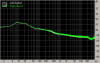
Spectrum of a silent groove from my 1200II.
 

Attachments

  • Spectrum.silent_groove.png
    Spectrum.silent_groove.png
    4.4 KB · Views: 173
Spectrum of a silent groove from my 1200II.

attachment.php


It seems to me that your tonearm-needle-turntable is resonating at 10Hz.
What arm?
What/any mods on the 1200?
Did you turn the speakers on while measuring or did you mute the speakers?

:banana::banana::banana:
 
attachment.php


It seems to me that your tonearm-needle-turntable is resonating at 10Hz.
What arm?
What/any mods on the 1200?
Did you turn the speakers on while measuring or did you mute the speakers?

:banana::banana::banana:

Yes, the res is around 8-10Hz. It has the original arm, but there are some modifications both to the TT and the arm. I like it very damped.
 
The problem is that, around -68 db or so from memory, you hit the inherent rumble of the media. This means that, as far as we're concerned, anything below this figure is effectively silent.

Not quite. It defines how low the noise can possible get but noise from the media and noise from the table are additive, but not in a simple A+B way. We dealt with this a lot in the phone company when I worked there. If you have 3 different turntables with rumble specs of -68dB, -78dB and -83dB what you will get when you combine the results is:

-68dB & -68dB ==>> -65 dB
-68dB & -78dB ==>> -67.6 dB
-68dB & -83dB ==>> -67.9 sB​

As you can see the results is well into the law of dimishing returns but that is the physics of the situation. If somehow, a pressing achieves better then the -68 dB spec of the medium then the better turntable spec helps in decreasing the overall rumble as well.

Just wanted to point out the real situation with respect to rumble.

Shelly_D
 
The problem is that, around -68 db or so from memory, you hit the inherent rumble of the media. This means that, as far as we're concerned, anything below this figure is effectively silent.

That sounds about right - in my personal experience I've found about -65dB to be silent to the point where I can't really hear it no matter how hard I try (that figure is according to a spec and in truth the table might perform better than spec, but with a 40 years old unit I kind of doubt it) and around -60dB seems to be the point where it becomes irrelevant as far as I'm concerned. I'm sort of shooting from the hip here, so no hard science in my numbers.
 
Anyway, to get back to Piggies table :D Really look forward to hearing your experiences with all your tables once you've got them all together.
 
As I see it this whole 'damping' matter is only a matter of preference. It´s not so that what we listen to is free from resonances or vibrations, they are present, but at different frequencies and at different amplitudes, and different damping, different mtrls, different designs, will effect how much added distortion there will be present. Of course the frequency response can also be effected.

We listen subjectively, some will like a sound free from added resonances, some will not.
Frequencies, the resultant harmonics and the interaction between is clearly a complex subject. Then add in that for the most part we listen to music and are ourselves part of the equation We will never be free from resonances, nor would we want to be. Finding a combination that keeps them all under control and reduces the unpleasant ones as much as possible is all we can do in the end.
 
Back
Top Bottom