• The move to the new server is done. There are some software and database maintenance updates in process. This has us passing the hat around to help out. We appreciate any donations. Seriously, even a dollar helps. The payment page may be found here - https://www.audiokarma.org/support.html

Sony 2251 and/or 2250 owners thread

Hi, did you ever fix the issue? I have the same same issue on my 2250 and expect the cx032b is bad and can't find a replacement or even a datasheet for the ic.
I have tried everything except replace the cx032b, and by everything I mean everything.
I bought one, but haven't gotten around to installing it.
 
Hello dear community!
I am writing through an auto-translator, so don't judge strictly ...

Please help in repairing a critical malfunction of Sony - PS2500.

When you turn on any of the speeds (33 or 45), the disc begins to accelerate very quickly uncontrollably. I did not wait longer than 2 - 3 seconds - turned it off; very high speed !!!

I checked the electrolytic capacitors - everything is normal: capacity, leakage currents, ESR is normal. Or does it make sense to replace them?
Q6 is tested as good.
Motor windings: 50, 160 and 800 ohms.

I ask for advice on what to check first.

I posted the same message asking for help in troubleshooting in another forum thread.

Thanks in advance,
Lelik.

Hi,

Though i'm not a PS-2251 owner anymore, maybe I can help.

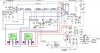
The first thing that modulates the power to the turntable motor is the power transistor that is mounted on the heatsink. This is Q6 in the diagram attached. All the power components around should be checked too, for example R24, a 5W resistor. All things that get hot might fail or even they could have bad soldering joints (re solder them). The diodes D10 and D11 should be checked too. C18 too.

Now, Q6 is what controls the motor (!). If Q6 is faulty all kind of things can happen, like the motor running to full speed like crazy. Assuming R24 and D10/D11 and C18 is ok, this would mean either a faulty Q6, or that Q6 is receiving no voltage from Q5. Q5 could be faulty too.

Really you would need to check that everything that goes after the out of pin 11 of the IC is completely OK.

Then of course i am assuming you have checked the obvious things such as the speed selectors and switches actually making good electrical contact...

sonyttsch.jpg
 
I have tried everything except replace the cx032b, and by everything I mean everything.
I bought one, but haven't gotten around to installing it.
I've replaced caps and bad diode and a burned resistor (still in spec though) and it runs very fast and pulls about 300ma and blows the fuse if not run through multimeter. I haven't hooked it up to oscilloscope yet, but figure it must be the ic. Where were you able to buy it? I cannot find any source. Haven't touched it for about 6 months, but will have another go with info from this and other threads again.
 
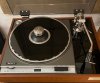
Here's mine. Has not been used in many moons however. I don't think I'll ever part with it though. She's a keeper.

JMsYwwVdQrCHqnWEPp5D1iI-wdE-FI07I9Tk8XJNND6aT9Q3HXz2OA5IGhl2Ns_W8xy2Bkk0lixxZTYOwYAK9kAUNpkkYKHm3UcT4v4oEZH_770cYpFXghflIm5mTWAIEtv2RvM6NVo_pCdQ4q7AeQqv75JJzL4C7s1Tbp4AwEeaLJLiuKop8rhsSxg_3W8xtT2vxpFX2IOCE2M6quAxp0LHMQrEwE_dWKU7b5jl1uXw0jjLy_HFMEY3GU5y06qN_3WAXN1FnLQs1wa-eSwr6n8IvoUlEbkHW64xMdrYfqXBorTXj3_nsTNB93DpDo-gRzhiJfCdruaCDGe3kUgqKKSvs_S2_OGYy1e41dXkVJQvFlaJwPQVPJrjN17b-7Ucu-ZVHod2UtwDlI3v3PkdPC7e8jjsI0_L-fvrgOaUkiYmHKhKk5VIpvMKoBrxVhg2j6gj0vP9SRxqyvVe8_-S7A4qM_UzWqJT4OcCP6mlUBe4OQoTYs267fv6vyA-1fQ5Pca406-Gf29QrZNX2T0JJpuSIqXWh6pFPk-ZIkluliLoFKdtAYCs1OASM62zl_CtAONV1ZP3O7EgKZFmBvDjaXo_EL9qjDQVUy5u9iBtwda4-VUEAYuReN1vY4xYnxERFQAaXhSsT6eYwwLt5sdr4p3JKkEqEuJr3YnYLqoeZz-3-xAQldce4Nc6E86w7w8_V5j3L9lQPufoR-80PO7iXdhW8Wtg74qw-jgUkjwcMLPmjO7KJkglL5-TU53BL-T599Sd1hojY5PlYb25GjgT4uRWSKjAFVGT9kayGwF70fEqwFWJG2fSCUAK5jf7jRiv1zxGynF76jyhGiUxec37OpgaHkwAsKgx19yy7wwDsEXuGRiGUfoYpCz-O5h9oydOzwX57ha_zpr0B9Dqx8GsOYR6L4LC2ZIJxCuhyHk=w1920-h1080-no
 
Here's mine. Has not been used in many moons however. I don't think I'll ever part with it though. She's a keeper.

JMsYwwVdQrCHqnWEPp5D1iI-wdE-FI07I9Tk8XJNND6aT9Q3HXz2OA5IGhl2Ns_W8xy2Bkk0lixxZTYOwYAK9kAUNpkkYKHm3UcT4v4oEZH_770cYpFXghflIm5mTWAIEtv2RvM6NVo_pCdQ4q7AeQqv75JJzL4C7s1Tbp4AwEeaLJLiuKop8rhsSxg_3W8xtT2vxpFX2IOCE2M6quAxp0LHMQrEwE_dWKU7b5jl1uXw0jjLy_HFMEY3GU5y06qN_3WAXN1FnLQs1wa-eSwr6n8IvoUlEbkHW64xMdrYfqXBorTXj3_nsTNB93DpDo-gRzhiJfCdruaCDGe3kUgqKKSvs_S2_OGYy1e41dXkVJQvFlaJwPQVPJrjN17b-7Ucu-ZVHod2UtwDlI3v3PkdPC7e8jjsI0_L-fvrgOaUkiYmHKhKk5VIpvMKoBrxVhg2j6gj0vP9SRxqyvVe8_-S7A4qM_UzWqJT4OcCP6mlUBe4OQoTYs267fv6vyA-1fQ5Pca406-Gf29QrZNX2T0JJpuSIqXWh6pFPk-ZIkluliLoFKdtAYCs1OASM62zl_CtAONV1ZP3O7EgKZFmBvDjaXo_EL9qjDQVUy5u9iBtwda4-VUEAYuReN1vY4xYnxERFQAaXhSsT6eYwwLt5sdr4p3JKkEqEuJr3YnYLqoeZz-3-xAQldce4Nc6E86w7w8_V5j3L9lQPufoR-80PO7iXdhW8Wtg74qw-jgUkjwcMLPmjO7KJkglL5-TU53BL-T599Sd1hojY5PlYb25GjgT4uRWSKjAFVGT9kayGwF70fEqwFWJG2fSCUAK5jf7jRiv1zxGynF76jyhGiUxec37OpgaHkwAsKgx19yy7wwDsEXuGRiGUfoYpCz-O5h9oydOzwX57ha_zpr0B9Dqx8GsOYR6L4LC2ZIJxCuhyHk=w1920-h1080-no
Nice granite slab. I have one but in the shop used as base for sharpening chisel/plane blades and occasionally a veneer press. Never thought of using one for a TT base. It's like 80 lbs or something.
 
Well, good news - issue is not the cx032b IC.
When I last worked on it apparently I put 4 transistors in wrong - the damn ECB/EBC confusion. I am able to get the table spinning and holding 33/45 perfectly. The only issue is that it will blow the 200ma fuse on startup of either 33/45. With the multimeter running through Amps, the startup will pull about 320-340ma for half a second and then drop way down.
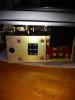
All electrolytics and transistors have been replaced, all resistors checked ok. The only thing I'm not sure of is the encapsulated component
120 Ohm + 0.033uf - could it be this, like in inrush cap? How would it be replaced with a separate resistor/cap? In series/parallel?

//Edit - looks like in series should do it, but might not be the issue.
 
Last edited:
So, I don't think it is mentioned anywhere in the SM, but on the chassis there is a label 200 mAT, so it looks like I just need a slow blow fuse and this table is running like a champ again. Makes sense to me given the startup behaviour.
I'm now stripping the plinth to redo a new wood veneer and polish the lid and brass badge. After that, I'll pop an SME 3009 into it.
Looking forward to putting this into service after dinking with it for almost 3 years.
 

Attachments

  • IMG_20230218_132811371.jpg
    IMG_20230218_132811371.jpg
    141.8 KB · Views: 18
  • IMG_20230218_132628275.jpg
    IMG_20230218_132628275.jpg
    146.4 KB · Views: 17
  • IMG_20230218_132420392.jpg
    IMG_20230218_132420392.jpg
    111.8 KB · Views: 22
Well, good news - issue is not the cx032b IC.
When I last worked on it apparently I put 4 transistors in wrong - the damn ECB/EBC confusion. I am able to get the table spinning and holding 33/45 perfectly. The only issue is that it will blow the 200ma fuse on startup of either 33/45. With the multimeter running through. Amps, the startup will pull about 320-340ma for half a second and then drop way down.
All electrolytics and transistors have been replaced, all resistors checked ok. The only thing I'm not sure of is the encapsulated component
120 Ohm + 0.033uf - could it be this, like in inrush cap? How would it be replaced with a separate resistor/cap? In series/parallel?

//Edit - looks like in series should do it, but might not be the issue.

So glad that you sorted out the problem. I was going to point out that perhaps the motor is drawing more current than necessary.

Never forget that this motor uses an eddy current brake. There's a magnet under the platter and this brakes the motor at all times. If the magnet is too close there's a chance the motor will require more power than usual.
 
So glad that you sorted out the problem. I was going to point out that perhaps the motor is drawing more current than necessary.

Never forget that this motor uses an eddy current brake. There's a magnet under the platter and this brakes the motor at all times. If the magnet is too close there's a chance the motor will require more power than usual.
Yes, and the SM mentions how to adjust. That would have been the next step as I was running out of ideas.
 
Hello,

I am new to the thread and a happy owner of a Sony 2251. I bought it about a year ago and it works flawlessly. However, I have not updated or replaced any caps or motor drive components. I replaced the arm board with a custom ½" acrylic piece and mounted a Fidelity Research FR-14 arm. It sounds terrific.

My question is: what would be the recommended minimum cap replacements I should perform given that it works great? I just don't want any nasty surprises since it's such a great friend. I have the service manual and quite a bit of experience restoring vintage gear.

Thank you for any advice.

John
 
Hello,

I am new to the thread and a happy owner of a Sony 2251. I bought it about a year ago and it works flawlessly. However, I have not updated or replaced any caps or motor drive components. I replaced the arm board with a custom ½" acrylic piece and mounted a Fidelity Research FR-14 arm. It sounds terrific.

My question is: what would be the recommended minimum cap replacements I should perform given that it works great? I just don't want any nasty surprises since it's such a great friend. I have the service manual and quite a bit of experience restoring vintage gear.

Thank you for any advice.

John
Personally, if it is working, I wouldn't touch anything. But I think the general consensus would be to replace electrolytic caps if you were intent on doing so.
 
Personally, if it is working, I wouldn't touch anything. But I think the general consensus would be to replace electrolytic caps if you were intent on doing so.

I'm with the leave it be. As an owner of a 2251 that I bought from the original owner, I know it's never gone any updating, and the only non original piece on it is it's arm. Has been working like a charm since acquired a couple years back, keeps perfect speed, and sounds amazing. Needless to say, Sony knew what they were doing when they built these tanks.
 
Hello,

I am new to the thread and a happy owner of a Sony 2251. I bought it about a year ago and it works flawlessly. However, I have not updated or replaced any caps or motor drive components. I replaced the arm board with a custom ½" acrylic piece and mounted a Fidelity Research FR-14 arm. It sounds terrific.

My question is: what would be the recommended minimum cap replacements I should perform given that it works great? I just don't want any nasty surprises since it's such a great friend. I have the service manual and quite a bit of experience restoring vintage gear.

Thank you for any advice.

John

I've owned a used 2251 for about 5 years now. I only did lubrication maintenance. No electronic. It's working perfectly. [fingerscrossed]. ;)
 
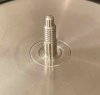
There are two mods that I made to the turntable platter that have been beneficial. The first was replacing the rubber mat with a custom cut 3mm acrylic mat. The mat is attached to the platter with mini Zots (soft adhesive mounting dots) spaced carefully to provide a minimalist contact between the aluminum platter and the acrylic mat. This combination isolates the LP very effectively and provides crisper bass. The second change was replacing the center spindle with a custom threaded spindle about ¾" tall. The threads were machined to match a VPI Delrin record clamp. I adjust the clamp tension for maximum LP contact with the acrylic matt. A friend showed me how to do this by gently tapping the LP to test for minimum vibration. Normally, this requires very slight tensioning force and so none of the vintage parts are being strained.

John

Sony 2251 Acrylic Mat.jpeg VPI Spindle Close-up.jpeg
 

Attachments

Yes, lubrication is probably the first thing that should be done on these now. Especially if it seems slow to hand turn. I'm going to do that to my Yamaha GT2000 probably next week.

Think of it this way. Why strain the power supply and irreplaceable motor by making it work harder than necessary? If it is harder to turn, it draws more current, which can push related components to their limit.
 
Yes, lubrication is probably the first thing that should be done on these now. Especially if it seems slow to hand turn. I'm going to do that to my Yamaha GT2000 probably next week.

Think of it this way. Why strain the power supply and irreplaceable motor by making it work harder than necessary? If it is harder to turn, it draws more current, which can push related components to their limit.

This is the lubricant that I use. [not affiliated with the seller].

https://www.ebay.com/itm/1639454335...efaultOrganicWeb&_trksid=p2047675.c101224.m-1
 
Back
Top Bottom