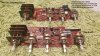
I'm currently upgrading my Marantz 2285 receiver, one of several Marantz units in my collection. Sofar I've completed upgrading the power caps to 18,000uF and the P800 power supply board (with guidance from Mburas excellent thread) and my last step has been the PE01 tone board. This step did not only include upgrading components but also replacing the BA312 IC's with Sparkos Labs modules. I have been comparing Sparkos vs. Burson modules but in the end realized that only Sparkos could fit into the confined space. The reason I left the Sparkos modules for last was that I wanted to evaluate them without having them masked by inferior components in the circuit. This project has been quite time consuming but also very rewarding. The major issue has been to select new components not only for quality but also for size since the space for the board is very confined in all three dimensions. Each step of all all nine steps included listening to alternatives before final selection of the new components. The final solution included a smaller PCB board (on standoffs) holding the six large Wima caps for the output stage and the location was the only way to squeeze them into the confined space with less than 1mm to spare. If space allowed I would have choosen Wima MKP10 for all signal line caps. A major part of the upgrade was replacing all film and elyt caps < 10uF with polypropylene caps and bypassed with polystyrene caps.
For the testing of each of the nine steps I had to isolate the tone board by using an external high quality signal source and for output a Mark Levinson 23.5 power amp. I used two references for A-B testing, the preamp part of my Marantz 2285B (not upgraded) and my favorite Audio Research preamp.
The nine steps in following order followed by A-B listening tests after each step:
1. Replacing all four transistors with Fairchild KSC1845 for HE03/HE05 and KSA992 for HE04/HE06
2. Replacing all ceramic caps with Kemet MLCC caps
3. Replace input caps CE05 and CE06 with 1uF/250V Wima MKP10 caps, bypassed with 0.1uF polystyrene caps
4. Replacing all other polyester film caps with Wima MKP4 polypropylene caps bypassed with 0.1uF polystyrene caps
5. Replacing all Elyte and Tantalum caps in the output stage with Wima MKP4 polypropylene caps bypassed with 0.1uF polystyrene caps. Wima caps are fastened with hot glue on a smaller pcb board on standoffs.
6. Bypassing all new signal path polypropylene caps with 0.1uF polystyrene caps
7. Install Sparkos Labs discrete modules
8. Trying out Nichicon FG,KZ and Elna Silmic II for the CE09/10 47uF and CE 13/14 10uF caps, eventually selecting the Silmics.
9. Bypassed the four Elyt caps with 0.1 uF polystyrene caps.
Not surprisingly all steps yielded an audible improvement. By each step sound became increasingly more spacious, detailed and refined. Details and instruments I haven't heard before became clear. Also the sound stage became more laid back. The steps that yielded most noticable improvement were 4, 5 and 7. All polypropylene caps in the signal path and 7. Sparkos Labs modules replacing BA312 IC's. Quite noticable improvement were made by bypassing polypropylene caps in stage 4 and the Silmic caps in step 8 with polypropylene caps.
In the end the difference between the preamps of my 2285 and 2285B were night and day (they were pretty close before). The 2285 preamp came close depending on the music material. Sometimes it was hard to tell the difference. Nevertheless I think my 2285 PE01 board would classify as a high end preamp in today's market.
Finally, I don't know what my evaluation of the Sparkos modules would be had I started installing them in step 1. Old and inferior components might have masked their performance and instead made step 4 and 5 even more significant. My advise, if you install the Sparkos modules then you should also replace all film caps with polypropylene caps for best effect. They are worth it.
After step 4
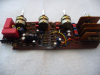
After step 5.
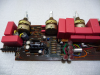
Final board with Sparkos modules.
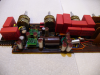



 ). This article will give me some good info to experiment with. I have a newly recapped 2275. If I get ambitious, I might try a before and after THD test with whatever is the latest version of the new component. My bias is that I am skeptical of measurable improvement in actual operation.