

You are using an out of date browser. It may not display this or other websites correctly.
You should upgrade or use an alternative browser.
You should upgrade or use an alternative browser.
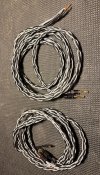
Speaker wires that came with my Magnepan 7s , need ID.
- Thread starter GD70
- Start date

Register to hide this ad


Blue Shadow
Waiting for Vintage Gear from this century
Kimber 4PR if the name was the same a couple decades ago when the colors were black and gray.
I’ve a couple sets of these, same black/gray.
I have not sliced through them to see if they are made of different size strands like the current offerings. Mine have Kimber Krimps on each end and came with WBT locking banana plugs.
I’ve a couple sets of these, same black/gray.
I have not sliced through them to see if they are made of different size strands like the current offerings. Mine have Kimber Krimps on each end and came with WBT locking banana plugs.

Banana Plugs look like Fospower brand which is sold in Walmarts among other places online like Amazon. They do carry a higher review response then many others of that design.
Garry
Garry

Definitely Kimber. Given that the wires are gray and black, it's likely 4VS.
One word of caution- those are the only speaker wires that have actively caused an amp to go unstable, in my system. It was a Marantz 140 power amp. It sounded absolutely WEAK and DISTORTED on those cables, at any volume level.
Swapped the cables out for a set of Audioquest F14s (flatwire), or any other cable I had, and the problem went away.
Braided cables can have weird values of capacitance and inductance... it's inherent in the geometry. And some amps just don't deal with that as well as others.
No other amp has exhibited that issue, in my experience- but just wanted to say, it's not impossible for it to happen, with a few unfortunate combinations...
Regards,
Gordon.
One word of caution- those are the only speaker wires that have actively caused an amp to go unstable, in my system. It was a Marantz 140 power amp. It sounded absolutely WEAK and DISTORTED on those cables, at any volume level.
Swapped the cables out for a set of Audioquest F14s (flatwire), or any other cable I had, and the problem went away.
Braided cables can have weird values of capacitance and inductance... it's inherent in the geometry. And some amps just don't deal with that as well as others.
No other amp has exhibited that issue, in my experience- but just wanted to say, it's not impossible for it to happen, with a few unfortunate combinations...
Regards,
Gordon.
Blue Shadow
Waiting for Vintage Gear from this century
Yes, that is it, the model I remember when I looked mine up a decade+ ago.it's likely 4VS

GD70
Lunatic Member
The banana plugs I had and put them on the wires in anticipation of trying them out. I’m hesitant now though.Banana Plugs look like Fospower brand which is sold in Walmarts among other places online like Amazon. They do carry a higher review response then many others of that design.
Garry
GD70
Lunatic Member
Hi Gordon,Definitely Kimber. Given that the wires are gray and black, it's likely 4VS.
One word of caution- those are the only speaker wires that have actively caused an amp to go unstable, in my system. It was a Marantz 140 power amp. It sounded absolutely WEAK and DISTORTED on those cables, at any volume level.
Swapped the cables out for a set of Audioquest F14s (flatwire), or any other cable I had, and the problem went away.
Braided cables can have weird values of capacitance and inductance... it's inherent in the geometry. And some amps just don't deal with that as well as others.
No other amp has exhibited that issue, in my experience- but just wanted to say, it's not impossible for it to happen, with a few unfortunate combinations...
Regards,
Gordon.
Thanks for this. I think I’ll not chance using them.
Cheers, Glenn
Blue Shadow
Waiting for Vintage Gear from this century
I used a 15 ft set with a McCormack amp, no problems.
Personally, I'd not let a corner case be the sole determining factor. I have a set and used with no problems as well.
One thing that could also happen, is that even if the amp isn't rendered unstable- there is a potential change in the speaker and overall system response, due to unusual electrical characteristics of the cables.
I haven't ever measured it myself, in one of my systems, with these cables- but anything that changes the balance of capacitance, inductance and resistance in a wire, could upset the response of a speaker, designed to work with more conventional cables, with a different balance of electrical characteristics. You're adding and/or changing effectively, poles and zeros in the total electroacoustic transfer function, in a way that the speaker designer likely did not design for.
Many people have gotten good results with Kimber- I just decided to move on to other cables that don't have these issues. Just a potential variable I don't want to have to deal with. Acoustics is complicated enough without adding more complexity.
Regards,
Gordon.

whoaru99
Epic Member
One thing that could also happen, is that even if the amp isn't rendered unstable- there is a potential change in the speaker and overall system response, due to unusual electrical characteristics of the cables.
I haven't ever measured it myself, in one of my systems, with these cables- but anything that changes the balance of capacitance, inductance and resistance in a wire, could upset the response of a speaker, designed to work with more conventional cables,
Regards,
Gordon.
I understand, but it is quite common, apparently, for people to suggest they choose cables for that specific reason.
Anyway, it's just one more thread I probably should have kept my nose out of. It's just disappointing to me that so often it seems 99 out of 100 people could report no problems but 100% of the focus and latch on is the odd man out, so to speak (that is not personally directed at you or this specific case, but it is an example of that).
Well, the stability issue is likely a statistical "one off"- but the change in electrical parameters is going to happen every time.
The question is- is, or is it not, audible? And is it beneficial if it is?
I am of the school, that says a speaker cable SHOULD NOT be acting as an "equalizer" or other frequency response modifying device. It just complicates upgrades and other changes to the system. In such a system, change one frequency-modifying accessory, and you have to RE-COMPENSATE the system for that effect not being there anymore.
Non-linear cables and such can tend to "mask" the need for implementing real beneficial changes, in many cases. Just ran into that, at a setup at an audio show a while back. I'm not naming names- but, in a room setup- the people running the room measured, and set up the speaker placement by one of the "textbook" tuning-formula computations (I don't know which one they used, but there's things such as the "Cardas formula" and such, for one example).
It initially sounded OK- but there were some frequency and transient response anomalies. Minor, but clearly there.
But, instead of trying to perfect the existing setup (speaker placement experimentation)- they immediately brought out the "tuning toys"- acoustic resonators and other accessories that change the response, by frequency-dependent absorption/diffusion, and cables with ostensibly non-flat response.
Well, they made it SOMEWHAT better- but- I've heard the same speakers, amps and sources in a very similar room- with nothing but complete optimization of the speaker placement- no "bells and whistles" needed- and it sounded MARKEDLY BETTER. It's almost impossible to get optimal TRANSIENT response, with these "band-aids" and response-modifiers, as opposed to a simple system optimized for best performance without all the added bells-and-whistles...
Regards,
Gordon.
The question is- is, or is it not, audible? And is it beneficial if it is?
I am of the school, that says a speaker cable SHOULD NOT be acting as an "equalizer" or other frequency response modifying device. It just complicates upgrades and other changes to the system. In such a system, change one frequency-modifying accessory, and you have to RE-COMPENSATE the system for that effect not being there anymore.
Non-linear cables and such can tend to "mask" the need for implementing real beneficial changes, in many cases. Just ran into that, at a setup at an audio show a while back. I'm not naming names- but, in a room setup- the people running the room measured, and set up the speaker placement by one of the "textbook" tuning-formula computations (I don't know which one they used, but there's things such as the "Cardas formula" and such, for one example).
It initially sounded OK- but there were some frequency and transient response anomalies. Minor, but clearly there.
But, instead of trying to perfect the existing setup (speaker placement experimentation)- they immediately brought out the "tuning toys"- acoustic resonators and other accessories that change the response, by frequency-dependent absorption/diffusion, and cables with ostensibly non-flat response.
Well, they made it SOMEWHAT better- but- I've heard the same speakers, amps and sources in a very similar room- with nothing but complete optimization of the speaker placement- no "bells and whistles" needed- and it sounded MARKEDLY BETTER. It's almost impossible to get optimal TRANSIENT response, with these "band-aids" and response-modifiers, as opposed to a simple system optimized for best performance without all the added bells-and-whistles...
Regards,
Gordon.

62vauxhall
Addicted Member
I used thirty-five foot runs of Kimber 4VS between a Kenwood Model 600 and Infinity Kappa 7.1's and sound was great. I was in the business for over three decades and new the rep who handled Kimber. Kimber braided wire was the only speaker cable with engineering that made sense to me then.

The instability of some amplifiers with braided speaker cables has been documented before, I had read that Cobra Cables discontinued this design several years back because some amplifiers would have HF oscillation and burn out tweeters. The increased capacitance I understand, can also lead to overshoot and make a speaker system sound brighter, or it can create somewhat of a HF filter, … either way I see no advantage to using speaker wires that are by their design, higher in capacitance than standard side-by-side cables.
If I want to modify the sound of my system from flat, I can do that with a DSP, I don’t need high-capacitance cables to do it for me.
Sorry, I know that speaker wire discussions are a trigger for many of us ;-)
If I want to modify the sound of my system from flat, I can do that with a DSP, I don’t need high-capacitance cables to do it for me.
Sorry, I know that speaker wire discussions are a trigger for many of us ;-)
whoaru99
Epic Member
The instability of some amplifiers with braided speaker cables has been documented before, I had read that Cobra Cables discontinued this design several years back because some amplifiers would have HF oscillation
The Cobra Cable is quite a bit different than these Kimber.
I've read accounts the Cobra Cable is ~500pf/ft capacitance. Kimber 4VS is ~40pf/ft from what I've seen. For reference point, plain old Belden 12ga "speaker wire" is ~23pf/ft. The Kimber is a bit higher but not an extreme departure and more than an order of magnitude less than Cobra Cable.
Last edited:
Yeah, 40pf/foot is not that significant, I made an apples to oranges reference it appears.

Similar threads


- Replies
- 61
- Views
- 4K


