• The move to the new server is done. There are some software and database maintenance updates in process. This has us passing the hat around to help out. We appreciate any donations. Seriously, even a dollar helps. The payment page may be found here - https://www.audiokarma.org/support.html

Speaker Wood

The inside of the enclosure, if it is a sealed one, behaves like a small room. It has it's own "room modes" with modal frequencies causing standing waves to the enclosed air.

This is handled by stuffing it with loose absorbing material. Some manufacturers place 1" thick acoustic foam to the inside of the enclosure panels.

Internal bracing increases the stiffness of the panels and is a good thing to have especially if you build a large enclosure and mount heavyweight woofers (>10~12").

You need to take the volume that the bracing occupies into account as it decreases the actual enclosure volume. On the other hand, stuffing causes a virtual enclosure volume increase effect, especially if the stuffing is denser than 30%

MDF and other dense materials are good for damping vibrations, but mass damping isn't the only way to go. I prefer the "clever" approach by using high quality plywood with bracing if needed.

I've made a pair of small satelite bookshelf speakers and they are about 12lt volume. I used two sheets of 0,75" (20mm) thick plywood pressed and glued together for a 40mm total thickness. No bracing here.

For larger enclosures (say 150lt) that I am considering building, I would also use plywood but this time 20mm thick with heavy bracing.
 
On the topic of bracing, what is the best method so as not to create a sonic mess inside, unless I want a sonic mess?
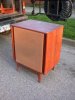
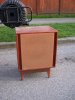
I have 2 approx. 23" square, bass-reflex cabs made from veneered press-board, or as my friend called it, "beaver-barf", and will have rear-loaded 15's . I like the cabinets so I will definitely need to beef up the stability of these. Eventually they will be the stands for the A-25's, with a pair of heppner horns, or the heils perched on top :)
Do i want to brace across in the middle, or at the wall joints and corners? Or would it serve me better to make a ply sleeve?

Plitron, that gif fully illustrates why bracing is an important issue, thus my question.
 

Attachments

  • altec cabs 001.jpg
    altec cabs 001.jpg
    108.6 KB · Views: 44
  • altec cabs 002.jpg
    altec cabs 002.jpg
    123.9 KB · Views: 36
Last edited:
I've used NidaCore in my marine business and while I don't think it has a low "Q" factor, with the right bracing it could be a light weight alternative.
"Verrrrry Intaresting..."

Yes, interesting. I was actually designing a speaker to be made out of fiberglass or carbon fibre with a balsa core. Balsa is very acoustically dead and dimensionally stable.
 
Common.
Sure real wood is much better because it makes the speaker much more valuable. For me I never even look and the pressboard speaker (unless it covers with a real wool veneer).

All this pseudo-technical opinions are full of ... (I like "multidementional" wood argument) simply because the difference in sound would be about 0.0001% (after thick insulation).

It's like you ask what screw to use and they advice you don't use the metal ones because of "resonance". True, but how nedligible it would be!

Or it's like a real estate agent calls fake granit countertop better then the real one because it "multidementional" and "uniform" due to epoxy, no matter how ugly it looks.

Use common sence, this is not a space ship you build.
Use the best looking real wood (or veneer), don't listen to "scientists".

Wrong...wrong...wrong! Why do you think the better factory made speakers weigh so much? Just because they want to rip you on shipping???

HOWEVER, you can build your speaker out of any damn material you want to as long as you line the cabinets with MDF or sheetrock. Yes, a true acoustic foam lining would also work but if you've priced this stuff lately you'll end up using the MDF or sheetrock. A large pair of speakers could cost $100 or more to line with the proper foam. (and should be at least partially lined with foam even with the MDF or sheetrock, IMO)

My most recent build was cabinets made from 16 ply cabinet grade plywood lined with sheetrock and again lined with acoustic foam. They are very large and weigh in at 300lbs each. (and cost more than a little to build)

You need to take the subject of cabinet resonance seriously if you want good results. :yes:
 
Last edited:
As mentioned earlier, if available in your area, MDX solves the toxicity problem of MDF.

Jon, the honeycomb material sounds like it would make a great subwoofer enclosure. Without knowing more about it, I'd hesitate to assume it would make a great mid/high enclosure.
 
You need to take the subject of cabinet resonance seriously if you want good results.
I think anyone who is absolutely convinced that they know better than "scientists," or whatever they want to call those who have brought speaker design to its current level of technological knowledge should just plow ahead and build what they think will work. The worst that can happen if they're wrong is that they will waste some time and materials on a project that they'll end up throwing onto a bonfire when it sounds as bad as everyone tells them it will and will eat some crow in the forum, and if by some miracle it turns out they do know something the experts don't, maybe they'll kick the science up a notch. Every innovation in speaker design known today was invented by someone who did something that other people said wouldn't work, and maybe in 400 years people will be studying some lucky AK'er's solid wood speaker cabinet to try to find out what's responsible for its magical sound the way a Stradivarius violin is analyzed today.
 
The worst that can happen if they're wrong is that they will waste some time and materials on a project that they'll end up throwing onto a bonfire when it sounds as bad as everyone tells them it will and will eat some crow in the forum

No, the worst that can happen is that they're wrong but they'll still convince people new to the area of speaker design that their hunch is more valid than proven science and whole groups of people will start making bad sounding speakers. But when it happens in a group, nobody wants to admit is sounds bad so they'll convince themselves that it's more "musical" or whatever. Then we have a wave of "reasoning" that counteracts all the research and advances that brought us to that point.
 
Pliotron, they have books on this subject, request one from your library - instead of learning about speaker design in short and not always accurate snippets, drink from the firehose. Do a search on this subforum to see what others have referred to.
 
No, the worst that can happen is that they're wrong but they'll still convince people new to the area of speaker design that their hunch is more valid than proven science and whole groups of people will start making bad sounding speakers. But when it happens in a group, nobody wants to admit is sounds bad so they'll convince themselves that it's more "musical" or whatever. Then we have a wave of "reasoning" that counteracts all the research and advances that brought us to that point.
Too late for that, IMO; the upside is, the value of our vintage gear just goes up that much more.

I think at the rate things are going, in a few years it'll be time for someone to "invent" the acoustic suspension woofer again. :)
 
Being a wood guy myself I'd like to bust or at least deflate a few myth's repeated in this thread:

Most engineered sheet goods, including plywood and MDF are made with Urea Formaldehyde or Phenol Formaldehyde resins. Both are carcinogenic in strong concentrations.

For years these products have been made with lower and lower formaldehyde formulations. Ratings do exist, the lowest is E0.

There have been no conclusive studies regarding the effects of MDF exposure. If there had you can bet that no children's furniture would be made out of it, there wouldn't be stacks of it at home depot out in the open, and everybody working it commercially would be wearing a moon suit.

The people condemning MDF the loudest are selling MDX just as those condemning Latex paint are selling their zero emission paint at a nice premium.

BREATHING ALL SAWDUST IS BAD, some is worse. The particle size range to avoid is 1-5 microns, <1 can be easily expelled by the lungs and >5 won't get there anyway.

Tropical hardwoods contain toxins to ward-off critters, molds and fungi that would eat them. Always use extra care with these. Most in the Rosewood family are considered the worst. Zebra wood is extra nasty as the toxins are released in the air by the heat of machining.

Man emulates nature by treating Marine plywood with chemicals for the same reason tropical hardwoods contain toxins and it's more expensive. Appleply is basically pre-finished baltic birch plywood and meant for making drawer boxes and it's more expensive. Baltic birch plywood is the best choice for speaker boxes, if you want to go with plywood.

MDF is more rigid than plywood, takes the right kind of screws well if pre-drilled and is an excellent substrate for veneering.

Ignoring the resonant properties of solid wood. Small speaker enclosures can easily be made as long as the wood movement can be accommodated. The front and rear panels would need to be veneered MDF or Plywood just the same though. Solid front and rear panels would not allow wood movement if glued in and would vibrate if left floating like in furniture. Bracing and baffling attachments in larger enclosures would pose even more movement problems.

Production furniture is about 3 things - cost of manufacturing, uniformity of materials as it relates to the 1st and consistency in the final product. Even if one considers speakers furniture, there's very little in the way of materials and methods that applies to DIY speaker building.

I'm very much a solid wood fan, but I would not make speakers out of solid wood. I would most likely use MDF and veneer them with shop-cut veneer.

Stuff I've made http://picasaweb.google.com/teamo65/Wood?feat=directlink
http://picasaweb.google.com/teamo65/RCM?feat=directlink
 
Being a wood guy myself I'd like to bust or at least deflate a few myth's repeated in this thread:


Super good info, thanks for sharing. Don't need to tell you how good your WW skills are....absolutely friggin' awsome. Gotta luv garage shops! :thmbsp:
 
Regarding the "Real Wood" vs "Plywood or MDF" choice, IMHO even furniture are built avoiding real wood as much as possible. Veneered plywood is the material of choice for anything flat and large like tabletops, cabinets, etc. Real wood is used only for chair and table legs.

Plywood, MDF, and particle board will warp/deform too. The decision by furniture makers is primarily cost......good hardwood is expensive.
 
There have been no conclusive studies regarding the effects of MDF exposure. If there had you can bet that no children's furniture would be made out of it, there wouldn't be stacks of it at home depot out in the open, and everybody working it commercially would be wearing a moon suit.

A conclusive study doesn't need to exist for a problem to be present. Especially when money is invloved......MDF is big business.

MDF is more rigid than plywood, takes the right kind of screws well if pre-drilled and is an excellent substrate for veneering.

MDF is more dense..... it is not more rigid.

Oh.....very nice projects. I like that headboard, and the turn table in the drawer.
 
Super good info, thanks for sharing. Don't need to tell you how good your WW skills are....absolutely friggin' awsome. Gotta luv garage shops! :thmbsp:

Thank you very much.

And one with a lot more dedication to the craft than I, based on the amount of time you were willing to spend on that post. :)

Good stuff. Thanks.

You're welcome, just something to do over the morning coffee.

A conclusive study doesn't need to exist for a problem to be present. Especially when money is invloved......MDF is big business.

I agree completely. The other side of that coin is that fear is a bigger business and it's even more profitable as it has almost zero overhead and no industry or government regulation. Claims are just claims. I think anecdotally a lot can be determined about relative hazards by looking at OSHA requirements.

MDF is more dense..... it is not more rigid.

You're correct.

Oh.....very nice projects. I like that headboard, and the turn table in the drawer.

Thanks.
 
I am wondering about speaker cabinets that I have seen over the years now that were hidden in console stereos. One type looked like one of those mountain bars candybars. It was a blob of some paper mache or something and when I opened it there was brown fiberous stuffing inside. Another set of speaker cabinets that I took out of an old console for inspection were made of white styrofoam like an ice chest. It was thick, hard and had fiberglass insulation in it. Why did both of those manufacturers do that when no one was going to see in the back of the console anyway?:sigh::sigh::sigh:
 
I am wondering about speaker cabinets that I have seen over the years now that were hidden in console stereos.
Think of those inserts as preformed cabinet stuffing with the speakers mounted in them. Modular construction for easier assembly and service.
 
Back
Top Bottom