• Please note that Audiokarma will be offline briefly for updates early on Monday morning, September 28th.

Speaker Wood

Constrained layer damping means putting a semi-viscous layer between them, not rigidly gluing. I've done it with RTV silicone and had it work out ok. The squishy middle layer will work as 2 interfaces to absorb/reflect sound coming out of the box and will exchange vibrational energy to heat for low frequencies where the whole panel is moving. The tough part is you have to join the outer layer so that it can move without leaving obvious gaps in the box.

Ray

Aha! Viscous glue. Does RTV come in a tube like caulk? I haven't used it as far as I know.

Yes, the joinery could get interesting. OTOH it can be done with other wood furniture, so why not speakers.
 
You cannot simply put any driver in any box and hope that it sounds good. Speaker design is a very technical science that must take all of the driver parameters into account and then a suitable enclosure will be built and a crossover designed.
 
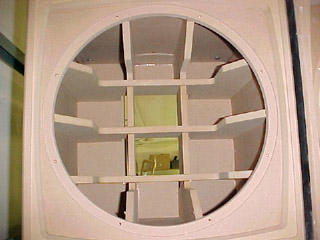
MDF and lots of internal bracing looks like what most high quality subwoofer builders use. Thank you all for your input. I think I've got it now.

http://www.hometheaterhifi.com/volume_12_3/triad-gold-subwoofer-8-2005-part-1.html


triad-gold-subwoofer-internal-bracing.jpg
 
Last edited:
Aha! Viscous glue. Does RTV come in a tube like caulk? I haven't used it as far as I know.

Yes, the joinery could get interesting. OTOH it can be done with other wood furniture, so why not speakers.
Now you're cookin'.

Silicone comes in tubes like caulk, yes. It IS caulk in some products.

A fellow over on DIY audio is using a polyurethane caulk, PL Door, Window, and Siding Sealer, and Geddes recommends two-part polyurethane. There's plenty of options for resiliant adhesives, and lots of info on the properties of different forumulations in the manufacturers' web pages. Look also under construction adhesives; subfloors move after we glue them down.

I was hunting down something appropriate to slather on kerfed-wood curved panels to fill the voids and found a bunch of alternatives.... :yes:
 
I love peanut sauce with chicken. I've never tried any tomatoes in the mix though.

FWIW, and in defense of my palette, the only similarity between between this recipe and thai peanut sauce is the ingredient list. If you don't think that the amounts and technique used in preparing the dish have as much influence on the finished product as the initial ingredients, I'm begging you, put down the spoon and step away from the stove. I mean, for God's sake, think of the children!
 
FWIW, and in defense of my palette, the only similarity between between this recipe and thai peanut sauce is the ingredient list. If you don't think that the amounts and technique used in preparing the dish have as much influence on the finished product as the initial ingredients, I'm begging you, put down the spoon and step away from the stove. I mean, for God's sake, think of the children!

:lmao:

I actually did think of the ratios, wondering how on earth they got them so that none of the individual flavors overpowered each other.
 
Use good veneered plywood and not the Chinese crap sold at HD and Lowes. Baltic birch plywood is the best as it has very few voids in it. I would use rabbet joints for the corners and plenty of glue. Internal bracing should be considered if the cabinets are large.

As someone who used MDF in a project once I highly recommend that you don't use it as it is very nasty to cut because of all the dust or do it outside.
 
I had read somewhere that *some* speakers were designed for the cabinets to resonate like a violin or guitar....

Instruments themselves make the music, so using types of wood that promote resonance from that instrument could easily be desired in order to color the sound of the instrument.

With speakers, they are not the instrument. They are the medium by which you want to hear the instrument being played, so adding or using a wood that would color the sound would be detrimental in any situation because you'd be changing the sound of the original instrument.

Speakers should be as "dead" as possible in order to portray the music played through them as neutral as possible.

I am highly skeptical that any (high end) speaker would be made using a wood that would intentionally promote resonance of any kind.
That's also why speakers are usually stuffed with all sorts of sound deadening filler fluff.

But speakers made out of sheet metal... now you've got some "colored sound" going on with all the resonance you could stand... and more. :D :scratch2:
 
Instruments themselves make the music, so using types of wood that promote resonance from that instrument could easily be desired in order to color the sound of the instrument.

With speakers, they are not the instrument. They are the medium by which you want to hear the instrument being played, so adding or using a wood that would color the sound would be detrimental in any situation because you'd be changing the sound of the original instrument.

Speakers should be as "dead" as possible in order to portray the music played through them as neutral as possible.

I am highly skeptical that any (high end) speaker would be made using a wood that would intentionally promote resonance of any kind.
That's also why speakers are usually stuffed with all sorts of sound deadening filler fluff.

But speakers made out of sheet metal... now you've got some "colored sound" going on with all the resonance you could stand... and more. :D :scratch2:


Disagree whole heartedly, you sound like you are reading from a sales brochure without thinking about it.

Speakers are the 'instrument'. Not by a classical textbook definition of an instrument, but by proper description of their function. They are the point of delivery where an electrical signal becomes sound.

No enclosure is dead. Maybe you are confusing undesirable and unconstrained resonance for what is staring you in the face as obvious. For example, pick by your definition a 'dead' sounding enclosure. Now remove the speakers and suspend them in air (but be sure to factor in sound contribution from the rear of the speakers as an element). Now are you telling me it's going to sound the same as it did before :scratch2: Of course not.

Example two. You have an 8inch woofer mounted in a 6inch thick concrete wall. Happens to sound great. Obviously there's no resonance, the concrete is all but sonically inert. Remove the woofer and play it suspended in air again (and be sure to remove the sound from the rear of the speaker as an element to factor as before). Now where did all that missing sound go? :D

All cabinets / enclosures quite obviously contribute to the sound. The ultimate design has a cabinet / enclosure of such design, construction, method and dimension to match and compliment the drivers and cross-overs used for a perfect reproduction of source material.

If what you are saying is true then I could make a bookshelf speaker sound the same as a tower.

BTW not sure if you are reading the same thread as the rest of us, but no one has mentioned sheet metal.
 
Last edited:
No one is claiming that cabinets do not at all affect the sound of the drivers mounted in them; what is disputed is the claim that resonant woods "improve" the sound of the speaker. IMHO, cabinet material should be as acoustically dead as possible. The only exception I would make would be if the drivers selected were so deficient that they needed reinforcement at the resonant frequencies of the cabinet, and there you're just masking a driver problem.

FWIW, aluminium was mentioned as a cabinet material on page 7 of this thread.
 
No one is claiming that cabinets do not at all affect the sound of the drivers mounted in them; what is disputed is the claim that resonant woods "improve" the sound of the speaker. IMHO, cabinet material should be as acoustically dead as possible. The only exception I would make would be if the drivers selected were so deficient that they needed reinforcement at the resonant frequencies of the cabinet, and there you're just masking a driver problem.

FWIW, aluminium was mentioned as a cabinet material on page 7 of this thread.

Yes I know it was me that mentioned it. :thmbsp:

3inch aluminium, as I wrote about, is not "sheet metal".

Krell make their speakers from it. In time more will use it.

And like I said, nothing, except a vacuum, is acoustically dead. As in the examples I provided - a really solid, resonant free cabinet is still the majority contibutor to the sound reproduced. That is why I used a free air suspended in space speaker as an example to highlight what is happening.

Even using the most inert accoustic material like a concrete wall, shows you the contribution the medium a speaker sits in to the overall sound reproduction.

I am just having difficulty wondering how anyone can see it any other way.
 
Last edited:
There's a major conceptual difference between a speaker cabinet's function in preventing backwave cancellation, changing the speaker's free-air resonance, providing proper porting if the design calls for it, etc. on the one hand, and radiating sound as a result of cabinet panel vibrations on the other. It is the last of these that has been the main focus of this thread.
 
Thanks for the field tests on cabinet bracing . Great to see the effects of brace placement visually. I still don't know the best place for my bracing!!!
I am sure there are varying positions on chicken mole as well......:D
 
Back
Top Bottom