• The move to the new server is done. There are some software and database maintenance updates in process. This has us passing the hat around to help out. We appreciate any donations. Seriously, even a dollar helps. The payment page may be found here - https://www.audiokarma.org/support.html

The Great Vinyl Experiment

Fantastic read (particularly since I was avoiding a project I need to start).

Thought about recommending this thread to some other AKers but instead I'll tell them to wait for the movie version (and multiple sequels). BTW is there any truth to the rumor that Danny Bonaduce is going to star as Justen?
 
Well, I just bit the bullet and ordered some Tergazyme. I'll send a film can to Justen so he can rank it with the carb cleaners and pet products too, but the description looks good.

"Concentrated, anionic detergent with protease enzyme for manual and ultrasonic cleaning. Excellent for removal of proteinaceous soils, tissue, blood, and body fluids from glassware, metals, plastic, ceramic, porcelain, rubber and fiberglass with no interfering residues. Ideal as a cleaning agent in Reverse Osmosis and Ultra-Filtration Systems. USDA authorized. Dilute 1:100. pH 9.5"

The only issue is that I read somewhere that the enzymatic activity is only good for 8 hours, so we'll have to mix it up in small batches if we want to enjoy the benefits of the protease activity. At 100:1 dilution, you only need about 3.5 grams for a 12 oz bottle, which is probably about a level teaspoon or so. We do have a O'Haus balance, so I'll know for sure.

OK, so 7 months later, I get around to using this stuff. I had cleaned a record last week with my 2 year old bottle of standard homebrew, but was disappointed to see that there still were visible fingerprints and smudges present, so I decided to tray the Tergazyme. I ballparked about a CC worth into about 200 ml of water, shook it up and started to use it. Initially it seemed no different, but the rinse cycle was quite telling. Instead of some beading and streaking I had been seeing with the water/alcohol/Dawn homebrew, the rinse sheeted out and covered the vinyl perfectly, which indicates a clean surface to me.After two rinses, I examined the LP in a floodlight and the gunk was all gone. Once on the turntable, it was markedly quieter and much freer of pops and clicks.
I went through the stacks and found another LP that was bespotted with fine white fungal spider webs; perfect. A quick application, scrub, 3 minute soak and a final scrub followed by 2 rinses yielded an LP that looked stunning. And it plays well too.

I'm very pleased by these results and plan on using this as my default cleaner. While the initial cost of the detergent was moderate ($35.00 or so shipped), it actually is dirt cheap when one considers it can make 52 gallons of cleaner.

I'll be cleaning a few more this weekend and report how it goes. :banana::banana:
 
Not only am I interested in your results on multiple tests, but I want to know about the stability and shelf life of this. You mentioned that the enzymatic activity only lasts for 8 hours or so, is that the case here?
 
That's my understanding.

It seems to work pretty well after the 8 hours though too. I cleaned a few LPs yesterday and it worked fine. I'll have to find a real nasty and test the "old" solution on it, but that dusty Foghat LP I picked up yesterday cleaned up very, very nice outside of the 8 hour window.

This appears to be more than a one trick pony. Although the enzymatic activity only lasts 8 hours, there still are detergents present to do the job. In fact, the enzymes seem to be mainly for biological protein based nastys as they are proteases: they would not be effective on oils and the like; that's where the detergents would come in.

With the 100:1 dilution, 3.73 grams would make 12 oz. of cleaner which would probably last darn near the whole 8 hours. I'd probably make up about 100 ml (about 4 oz) at a time and batch them out. lord knows I have enough....
 
I post this merely for amusement...

http://www.stereophile.com/artdudleylistening/listening_77/

I found this interesting. From the article...

"So I performed one more "test": I clipped a single bristle from one of the new Keith Monks brushes and, with the help of my friend Neal Newman, subjected it to microphotography at the same time as we were taking pictures of some styli. (Oh, the things middle-aged men do for laughs in wintertime!) The result, reproduced elsewhere on this page, offers irrefutable proof that even the finest bristles of this sort are still several times larger than any stylus tip—and thus too large to actually get into a record groove. The only bristles I've seen that could actually fit between the walls of a microgroove are the ones on carbon-fiber brushes—which are, of course, useless for wet-washing—and the fibers on very-good-quality pads such as the ones supplied by the Disc Doctor and, believe it or not, with the good old DiscWasher. Long-bristled wet brushes are great, necessary things—but you're better off thinking of them more as fluid spreaders than as record cleaners. "


I love this line- "Oh, the things middle-aged men do for laughs in wintertime!"

 
I was just thinking last night how the original discwasher brushes must have extremely fine "bristles." I concluded this because if I hold my discwasher just right on a spinning record, I can hear music coming from the grooves. It's not usually intelligible because more than one groove is responding simultaneously and it's pretty quiet, but it is "proof" nonetheless that the discwasher gets at least partway down the groove.
 
I saw something a little while back in this sprawling thread about pressuring washing an album?? Well, did anyone actually try this? Perhaps while doing the driveway or patio you could throw a few out there on the concrete. This should give some "grip" to keep them from flying away!
 
I post this merely for amusement...

http://www.stereophile.com/artdudleylistening/listening_77/

I found this interesting. From the article...

"So I performed one more "test": I clipped a single bristle from one of the new Keith Monks brushes and, with the help of my friend Neal Newman, subjected it to microphotography at the same time as we were taking pictures of some styli. (Oh, the things middle-aged men do for laughs in wintertime!) The result, reproduced elsewhere on this page, offers irrefutable proof that even the finest bristles of this sort are still several times larger than any stylus tip—and thus too large to actually get into a record groove. The only bristles I've seen that could actually fit between the walls of a microgroove are the ones on carbon-fiber brushes—which are, of course, useless for wet-washing—and the fibers on very-good-quality pads such as the ones supplied by the Disc Doctor and, believe it or not, with the good old DiscWasher. Long-bristled wet brushes are great, necessary things—but you're better off thinking of them more as fluid spreaders than as record cleaners. "


I love this line- "Oh, the things middle-aged men do for laughs in wintertime!"

I read this, but could not remember where. I liked it immensely.

And because of this thread I bought some cleaning fluids from Jim Pendleton of Osage Audio.

He included a copy of The Hi-Fi Reader and I subscribed. (It's refreshing!) See these things are like a butterfly's wings.

Hopefully with the right sauce, ... er, inspiration you will continue this, my second favorite, thread. The Celtic music thread is my favorite.
 
Last edited:
I may live to regret this thread, but after some mind numbing threads about cleaning vinyl and the pros and cons of Armor All & Windex I decided to put test the theories. YMMV.

First of all, the fuel behind the great idea....

'Tis a fine inspirational dram, to be sure.
 
Justen, are you still out there. This is one of my favorite threads. I've converted to wood glue for bad dirt and use a RCM for my LPs but wanted to keep track of your antics!
 
Bump.

I've considered restarting my pseudo-scientific research (hey Mark D, where ever you are!). Any suggestions?

I've tried the wood glue thing. Meh. Results aren't worth the effort.
 
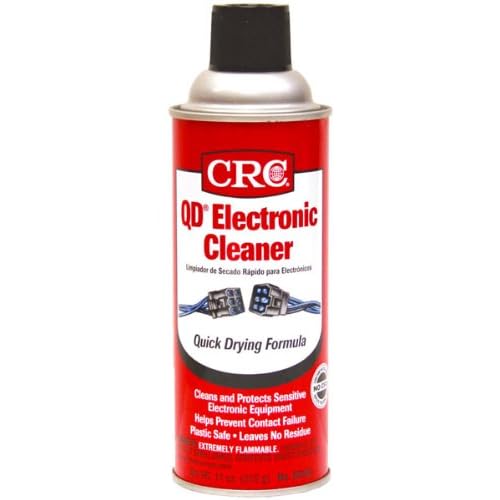
Yes! Try This Next!

41Y5lTaQJfL._SS500_.jpg


Product Description

Cleans and protects sensitive electronic equipment
Helps prevent contact failure
Safe on plastic
Leaves no residue
Fast drying formula

CRC's QD Contact Cleaner is a must for any shop or garage. This cleaner is designed for use on sensitive electronic equipment and is plastic safe. Use on your Mass Air Flow sensor, electrical connectors, fuse blocks and so much more. 11 oz aerosol.
 
Since this thread has come back to life, I'll post the results of my little experiment. I tried Windex with my DIY RCM. Here's my technique:
I spray the record with Windex while it spins on the RCM, protecting the label from overspray. I then take a cotton makeup square and distribute the liquid. This also removes any excess liquid. I then spread it with a paint pad, followed be another makeup square. If the square comes back clean, I go to the rinse stage, otherwise I repeat the cleaning process. I spray the record with distilled water while vacuuming. I continue spraying until the water in the tube is clean. I then place in a drying rack.

Records end up remarkably clean, at least as clean if not more so than my homebrew cleaner based on LabTone. The are very shiny and sound great.
 
DougMac,

Gather-Your-Ingredients.jpg


Sounds promising. Perhaps a non-amonia based window cleaner would be better than windex?

Or make your own window cleaner:

1 part rubbing alcohol
1 part white vinegar
4 parts distilled water
1/4 part lemon juice

I don't see any reason these ingredients would harm vinyl as long as you rinse in distilled water then vacuum dry.
 
Nix the lemon juice for sure.

Actually, way back when this thread was in full swing I tried both straight lemon juice (concentrate & fresh squeezed), and straight vinegar. Both worked surprisingly well. Lemon juice was sticky and needed lots of rinsing. The vinegar worked about the same and was a PITA because of the smell.

Both so not worth it, but mildly interesting.
 
Hell, I still on the first post with the bottle. yimmy yimmy, yimmy.

Scrub in the sink and let'r rip.


I yie capim.
 
Back
Top Bottom