
Poultrygeist
Lunatic Member
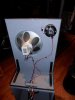
Close up of the amazing Bohlender Graebener planars.




You didn't need an L-Pad to turn the volume down and balance them with the mains?I love the shimmer of cymbals and these give me that and more. They're B&G Neo 3 planars with open backs which allow front and rear radiation. Incredibly smooth and detailed when so many I find are too hot and edgy. Used a 1.5uF cap on it's + terminal and they're parasitically driven from the speaker terminals.
View attachment 1316709
That's the way I've always used my Realistic super tweeters, otherwise they would overpower the mains and sound too bright.I use the Realistic supers facing to the rear to balance the front firing compression horn tweeters in these OB's.
View attachment 1316712

You didn't need an L-Pad to turn the volume down and balance them with the mains?


You didn't need an L-Pad to turn the volume down and balance them with the mains?
No, an L-pad is not required. With some trial and error selecting the right value cap ( 1.5uF in this case ) makes them blend. The tweets run off the same main amp and it's a simple matter of wiring the cap to it's positive terminal.

Very few mass market speakers run up to 40khz. Now as to whether they can be audible... My opinion is; I'd rather have a supertweeter and not need it, than need a supertweeter and not have it.I think it's a useless thing.
I mean, there was the Cambridge R50 (for example) with a T27 and a coles super tweeter. The T27 has a frequency range up to 40kHz. I know it does. I once used it in my apartment veranda to scare pigeons away using a 30kHz frequency I could not hear. What would be the reason for a super tweeter on a system with a half decent tweeter? We already complain that the midrange - tweeter spacing generates audible artifacts to the point that coaxial drivers are considered superior. Why then implement a tweeter - super tweeter spacing and half the ill effects? Or is it there are none because nothing audible comes out of them? A placebo effect perhaps?
You didn't need an L-Pad to turn the volume down and balance them with the mains?
Certainly, with regard to fundamental tones.Most good tweeters already extend beyond the range of human hearing ....



Certainly, with regard to fundamental tones.
But, many of the harmonics of those fundamentals are within the range of hearing, and your brain will psychoacoustically use those harmonics to fill in some missing fundamental information.
Properly applied and balanced, the absence of a supertweeter should be much more immediately audible than it's presence.
Infinity Emit eh?What is the frequency range of a "supertweer" ??
If it sounds better and the cost is reasonable I'll try about anything ..
But I would question why finer loudspeaker manufacturers don't include them then ..


