You are using an out of date browser. It may not display this or other websites correctly.
You should upgrade or use an alternative browser.
You should upgrade or use an alternative browser.
Tonearm for Denon DL-103
- Thread starter ctjetta
- Start date

AvFan
Super Member
Geez, my last posts in this thread were over two years ago...I'm not sure what I can add other than observation and comparison. My Ortofon Cadenza has a specified dynamic compliance of 12cu and its suspension/cantilever flexes noticeably more than my DL-103. And before anybody says "But VTF...." both were at their recommended VTF of 2.5g. So, from observation the DL-103 has a lower compliance than the Cadenza. Is it possible the Cadenza has a compliance higher than 12cu? Yes, but I have a fairly high level of confidence in Ortofon's specs for one of their higher end carts so I believe the DL-103's compliance is below 12cu at 10Hz. I always used 8cu in the VE calculator for the DL-103 and that seemed in the ballpark based upon the tonearms I've used.

BillWojo
Addicted Member
I've spent a LOT of time researching everything I could about the Denon DL-103 series of cartridges and the one thing I hear over and over is it didn't really start to shine until it was paired with a heavy mass tonearm. Sure, it will work on a mid mass tonearm but you give up a lot. I don't think anyone really knows what the actual compliance is but it doesn't really matter, just run it on an arm with an effective mass starting around 20 grams or so, go heavier from there.
Yep, that's a number I've used as well. Seems to work.
BillWojo
I always used 8cu in the VE calculator for the DL-103 and that seemed in the ballpark based upon the tonearms I've used.
Yep, that's a number I've used as well. Seems to work.
BillWojo

cafe latte
Addicted Member
They do as it can be measured which was my point a number of posts ago.I've spent a LOT of time researching everything I could about the Denon DL-103 series of cartridges and the one thing I hear over and over is it didn't really start to shine until it was paired with a heavy mass tonearm. Sure, it will work on a mid mass tonearm but you give up a lot. I don't think anyone really knows what the actual compliance is but it doesn't really matter, just run it on an arm with an effective mass starting around 20 grams or so, go heavier from there.
Yep, that's a number I've used as well. Seems to work.
BillWojo
Chris
I have tried 103’s in the following arms, both with and without extra weight and nuding them:
Rega RB300 (not great)
Audiocraft AC-3000 heavy arm wand (sounded ok)
Lustre 801 with heavy head shell and heaviest counterweight (sounded ok)
DesigBuildListen The Wand (good)
SME 309 (by far the best)
I like the sound on my 309 so much that I bought out 2juki’s stock of 103R’s when he had them priced at $250 (since jumped to $350).
The two arms that made it sound the best are the two that I suspect have the best dampening abilities. Neither are super heavy The only lighter arm that I tried and didn’t like was the Rega.
Rega RB300 (not great)
Audiocraft AC-3000 heavy arm wand (sounded ok)
Lustre 801 with heavy head shell and heaviest counterweight (sounded ok)
DesigBuildListen The Wand (good)
SME 309 (by far the best)
I like the sound on my 309 so much that I bought out 2juki’s stock of 103R’s when he had them priced at $250 (since jumped to $350).
The two arms that made it sound the best are the two that I suspect have the best dampening abilities. Neither are super heavy The only lighter arm that I tried and didn’t like was the Rega.
^ ^ ^
All of the above are just fine if you rely on measurements and base your recommendations on things like "opinions", "should give", "probably", "seems to be". But you're not going to get the most out of that cartridge by sticking to those limitations.
Does anyone TRULY know what the actual compliance of the DL-103 cartridge is? It looks like the measurement monkeys think they know, but when you look for actual figures they are all over the place! Multiply the Denon-specified of 5@100Hz by what to get a figure that can then be used with the compliance calculators that are found on various websites on the 'net? Multiply by anywhere between 1.5 and 2.0? That's certainly going to give you an exact figure to work with, won't it?
Do you even have a 103 equipped 'table or is what you posted above based on conjecture?
Measurements are fine, but the ultimate is to listen for yourself and then make the determination. I can tell you this - you haven't really heard a DL-103 (or 103R) until you've run it at 25g to 30g (or possibly more) total effective mass.


cgoroo
Active Member
OK, the Denon DL-103 is a rather low compliance cartridge. It apparently requires a rather higher effective mass tonearm. What tonearms would compatible with this cartridge?
I currently use the 103 with my Gray Research 108B. In the past, an AT 1501 mk1 (aka ATP 16T) with an Ortofon LH2000 (a 15.5 grams headshell).
Last edited:

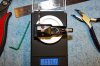
FWIW... The headshell + Denon DL-103D and DL-103R (with Soundsmith boron cart and NCL stylus) weights. This weight range resulted in an 8Hz resonance on my SME 3009, Type II Improved arm. I used Shure and Tacet tracking records to find resonance frequency.

There’s tons of great info in this thread, but can someone please help me with the following question:
Why is the resonance of the DL103R at 9Hz so strong HORIZONTALLY, that it forces the needle to sometimes even jump out of the groove of the test record? And why is the VERTICAL strength of that very 9Hz resonance quite reasonably soft?
Would other tonearms, given they have the same effective mass (including headshell and pickup), react the same way - and if not: why and how can I judge what to expect?
Maybe, you might need some more additional info on the setup: I am experimenting with a SME 3009 S2 improved, knowing very well, that with its effective mass of 9.5 g it belongs to the more “light” class of tonearms. Therefore I added a heavy headshell (Yamamoto HS-1a or Jelco HS-20) plus “The Cap” (aluminum “cap” for the DL103) and used a heavier counterweight (the “middle” one of the three), which sits nicely and not too far extended to the back. Using a test record, I can see a resonance spanning from 7Hz to 11Hz with a peak at 9Hz (a tad lower, when using the slightly heavier Jelco).
I have two DL103R, one being 2 months old, one almost 20 years old. Both yield the same results, so I strongly assume, that this might be the typical behavior of the Denon with that very combination.
Also, would you please be so kind to answer the question: how does the position of the counterweight influence these results - would it matter, if I tried to use the third, most heavy counterweight, which will sit nearer to the pivot?
Thanks so much for helping me in the matter!
Why is the resonance of the DL103R at 9Hz so strong HORIZONTALLY, that it forces the needle to sometimes even jump out of the groove of the test record? And why is the VERTICAL strength of that very 9Hz resonance quite reasonably soft?
Would other tonearms, given they have the same effective mass (including headshell and pickup), react the same way - and if not: why and how can I judge what to expect?
Maybe, you might need some more additional info on the setup: I am experimenting with a SME 3009 S2 improved, knowing very well, that with its effective mass of 9.5 g it belongs to the more “light” class of tonearms. Therefore I added a heavy headshell (Yamamoto HS-1a or Jelco HS-20) plus “The Cap” (aluminum “cap” for the DL103) and used a heavier counterweight (the “middle” one of the three), which sits nicely and not too far extended to the back. Using a test record, I can see a resonance spanning from 7Hz to 11Hz with a peak at 9Hz (a tad lower, when using the slightly heavier Jelco).
I have two DL103R, one being 2 months old, one almost 20 years old. Both yield the same results, so I strongly assume, that this might be the typical behavior of the Denon with that very combination.
Also, would you please be so kind to answer the question: how does the position of the counterweight influence these results - would it matter, if I tried to use the third, most heavy counterweight, which will sit nearer to the pivot?
Thanks so much for helping me in the matter!

tnsilver
Stereo Puppy
It's a simple matter of (rotational) inertia, which is what 'effective mass' is. Inertia (I) is affected by the mass (m), and the distance (radius - 'r') of the mass from the pivot. The relationship is expressed as I=mr². You can see a linear effect of mass - but exponential effect of distance. This means that if you increase the mass two times, inertia is increased by two times (linear relationship), but if you increase the distance by two times, inertia is increased by four times (exponential relationship).Also, would you please be so kind to answer the question: how does the position of the counterweight influence these results - would it matter, if I tried to use the third, most heavy counterweight, which will sit nearer to the pivot?
Thus, sometimes, counter-intuitively, increasing the mass of the counterweight, requires moving it closer to the pivot (in order to balance the tonearm), which not only cancels its contribution to the total effective mass, but may actually reduce it. Of-course, the total effective mass of the tonearm is the sum of inertia on both sides - so this is assuming no change was applied to the headshell / cart side.
Cartridge behavior at the resonance frequency is going to be uncontrolled. Whether it's horizontal and/or vertical motion.
I had tried out that very DL103R in a Linn Ittok and a Linn Ekos and resonances were not as pronounced and bold - is there any explanation for that excessive behavior with the SME?Cartridge behavior at the resonance frequency is going to be uncontrolled. Whether it's horizontal and/or vertical motion.

muovimies
Super Member
I had tried out that very DL103R in a Linn Ittok and a Linn Ekos and resonances were not as pronounced and bold - is there any explanation for that excessive behavior with the SME?
I would suspect it's some combination of arm resonance and bearings. Maybe the SME knife edge can't handle the energy entering the arm from the cart?
tnsilver
Stereo Puppy
SME's, other than the very old series II 3012's and first version 3009 (stainless steel armtube) are NOT a good match for the DL103 and DL103R. This cart begins to shine at 19g eff. mass, and anything bellow that is not advisable. Knife edge bearings have their own quirks, even when assuming the knife edge is intact. SME had used nylon bearings on some variants of the 3009, so there's too many variables in this equation, with eff. mass being the most important.is there any explanation for that excessive behavior with the SME?
You can try to add a couple drops of super-viscous 500KCst silicon oil in the wedge, on both sides of the knife edge bearings for damping, and expect some improvement.
Interesting advice worth trying, thanks! Just to be sure I understand you properly: do you mean 500.000 CST oder 500 CST (you used a "K"), since 500.000 to my understanding has a consistency, that does hardly flow at all ("gel"-like), while 500 might be something in between vegetable oil and motor oil (aka "super-viscous").couple drops of super-viscous 500KCst silicon oil
thank you this answer clearly made my day!Double peanut butter viscous 500,000
I had tried out that very DL103R in a Linn Ittok and a Linn Ekos and resonances were not as pronounced and bold - is there any explanation for that excessive behavior with the SME?
Resonance frequency is by definition an uncontrolled point, where the energy of oscillation overwhelms the system.
https://www.erbessd-instruments.com/articles/resonance-natural-frequency/
If you watch the tonearm, at its fundamental resonance frequency, it's jumping all over the place.
I would not do this. Oil should not be added to any tonearm that uses a dry knife edge. All you are going to do is inhibit some of its movement and attract dust.You can try to add a couple drops of super-viscous 500KCst silicon oil in the wedge, on both sides of the knife edge bearings for damping, and expect some improvement.
cafe latte
Addicted Member
Few arms are a good match for the 103r stock standard. When retipped the compliance can be shifted up a bit so the Denon is happier on arms of 15-18g effective mass, but stock the 103 really needs am arm of around 30g.
Chris
Chris
I use heavier headshell and counterweight on the 3009 Improved --- with Denon 103SA cartridge with Soundsmith boron/nude contact line mod. Resonance frequency is 8Hz.